
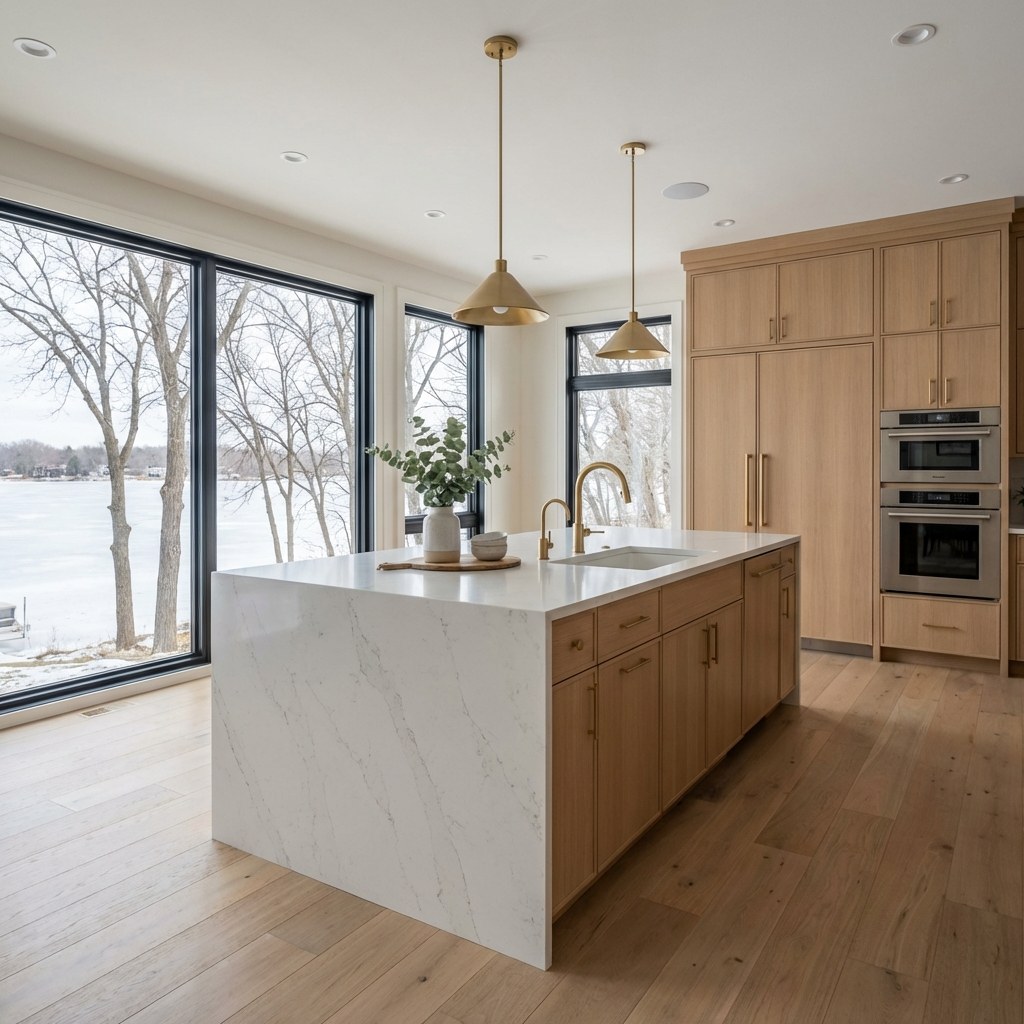
There’s a category of home in the Minneapolis west metro that sits in an interesting position: too valuable to tear down, too outdated to live in comfortably without significant investment. These are typically homes built in the 1970s, 80s, or early 90s on lots that would cost far more to replicate today — well-located in Edina or Wayzata or Plymouth, with mature landscaping and established neighborhoods, but with floor plans, finishes, and mechanical systems that don’t reflect how the current owners want to live.
For these homes, a whole home renovation is often the right answer. Not a teardown. Not a series of incremental projects spread over a decade. A comprehensive project that addresses the kitchen, the primary suite, the bathrooms, the living spaces, and where necessary, the building envelope — all at once, with a coherent design direction and a single construction mobilization.
Partners COS executes whole home renovations throughout the west metro. Our restoration background means we approach these projects with a specific advantage: we’ve been inside these homes after events that revealed what’s actually behind the walls. That knowledge shapes how we plan and execute renovation work.
Why Whole Home Renovation Instead of Sequential Projects
The sequential renovation approach — kitchen this year, primary suite next year, bathrooms the year after — is common and understandable. It distributes cost over time and limits the period of construction disruption in the home. But it has a significant hidden cost: when each project is executed in isolation, the opportunities created by opening walls and ceilings are missed.
When you renovate a kitchen, you open walls. Those walls contain mechanical systems — plumbing, electrical, HVAC ducts — that serve not just the kitchen but adjacent spaces. If those systems need upgrading for the adjacent bathroom renovation you’re planning next year, doing it while the walls are open in the kitchen costs a fraction of what it costs after they’ve been closed and finished. The same logic applies to insulation, vapor management, and structural corrections that are only economically addressable when construction is already open in those areas.
A comprehensive whole home renovation plans the work as a system. The sequence of trades through the project is optimized across the full scope rather than optimized within each individual project. The result is typically better outcomes at lower total cost than sequential renovation — and significantly less cumulative disruption to the household.
What the Restoration Background Reveals in West Metro Homes
West metro homes from the 1970s and 80s have predictable characteristics when you open them up:
Vapor retarder placement that doesn’t match current understanding. Homes built before the mid-1990s often have vapor retarders placed based on guidelines that have since been revised. In cold climate assemblies, the vapor retarder belongs on the warm side of the insulation — but some older homes have it placed in ways that create condensation conditions within the wall assembly. Renovation is the opportunity to correct this.
Minimal or absent rim joist insulation. The rim joist cavity was essentially uninsulated in most homes built before the 1990s. Energy audits on these homes consistently show significant heat loss and occasionally moisture infiltration at this location. A whole home renovation that opens the basement ceiling is the moment to address this with closed-cell spray foam — permanently and effectively.
Mechanical systems at or beyond service life. A 1985 home likely has HVAC equipment that has been replaced at least once, but may have ductwork, plumbing drain lines, or electrical panels that haven’t been touched since original construction. Whole home renovation is the time to assess and address these systems in conjunction with the finish work — not after.
Where We Work in the West Metro
Our whole home renovation work is concentrated in the communities where we have the deepest restoration history — Edina, Wayzata, Plymouth, Minnetonka, and Eden Prairie. These are the communities where our restoration work has given us the working knowledge of the existing housing stock that renovation projects benefit from.
Frequently Asked Questions — Whole Home Renovation Minneapolis West Metro
What is included in a whole home renovation?
Scope varies by project, but a comprehensive whole home renovation typically includes kitchen, primary suite, secondary bathrooms, living areas, and any building envelope or mechanical systems that need to be addressed. We develop the scope collaboratively with each client based on their program, budget, and how long they plan to remain in the home.
Why is a whole home renovation often better than sequential projects?
When walls and ceilings are open, the cost of addressing adjacent systems — plumbing, electrical, insulation, structural — is a fraction of the cost of opening finished surfaces later. A comprehensive project plans the work as a system, optimizes the trade sequence across the full scope, and captures opportunities that sequential projects miss.
How long does a whole home renovation take?
Comprehensive whole home renovations in the west metro typically run six to twelve months depending on scope, complexity, and the condition of existing systems discovered during construction. We provide detailed scheduling after pre-construction investigation that assesses existing conditions before a fixed timeline is committed.
Leave A Comment