For owners of high-net-worth estates, a water intrusion event is not merely an inconvenience; it is a direct threat to the structural and aesthetic integrity of a significant capital investment. In large-scale residences—often characterized by expansive square footage, complex HVAC configurations, and rare architectural finishes—standard restoration approaches are frequently insufficient. To preserve custom millwork, exotic hardwoods, and intricate masonry, a shift from basic “drying” to technical dehumidification for large homes is required.
As IICRC Certified Drying Specialists, we operate at the intersection of atmospheric physics and material science. Effective restoration in the luxury sector demands an understanding of psychrometrics—the study of gas-vapor mixtures—and how different dehumidification technologies manipulate vapor pressure to extract moisture from dense, hygroscopic materials. This article explores the technical nuances between Low Grain Refrigerant (LGR) and Desiccant technologies and why the latter is often the only viable solution for high-end architectural preservation.
The Physics of Drying: Beyond Surface Evaporation
The fundamental objective of technical dehumidification is to create a vapor pressure gradient. Moisture moves from areas of high vapor pressure (wet materials) to areas of low vapor pressure (dry air). In a large estate, simply moving air with fans is inadequate if the ambient air cannot absorb the evaporated moisture. When the air reaches saturation, evaporation stops, and secondary damage—such as mold growth or wood fiber saturation—begins.
To quantify this, restoration professionals measure Grains Per Pound (GPP), which represents the specific weight of water vapor in the air. While standard dehumidifiers struggle as GPP levels drop, technical-grade equipment is designed to drive GPP to levels low enough to “pull” moisture out of deep structural members. This is the difference between drying the air and drying the building itself.
The Role of Vapor Pressure in Large-Volume Spaces
In homes exceeding 10,000 square feet, air stratification and stagnant “dead zones” can trap moisture behind wainscoting or within floor joists. Technical dehumidification involves calculated air exchanges and the strategic placement of equipment to ensure that the vapor pressure at the material surface remains lower than the internal pressure of the material. Without this precision, moisture remains trapped in “bound” states within the cellular structure of wood and plaster.
Equipment Comparison: LGR vs. Desiccant Technology
Choosing the correct technology is a matter of engineering, not preference. The decision is dictated by the materials present and the required drying goals. For HNW estates with custom finishes, the choice often leans toward Desiccant technology for its ability to achieve ultra-low humidity levels.
| Technology | Best Use Case | Benefit |
|---|---|---|
| LGR Dehumidifier | Standard Dry-out | Energy efficient for common areas and gypsum-based materials. |
| Desiccant Dryer | Deep structural drying | Pulls moisture from dense hardwoods, specialized millwork, and masonry. |
Low Grain Refrigerant (LGR) Dehumidifiers
LGR units are an evolution of standard refrigerant dehumidifiers. They utilize a pre-cooling component that allows the air to reach its dew point more quickly. This allows them to continue removing water vapor even in drier environments (down to approximately 34-40 GPP). While highly efficient for standard water damage scenarios involving drywall and carpeting, LGR units have a “floor” beyond which they can no longer remove moisture. In an estate with dense mahogany or walnut flooring, this floor may not be low enough to prevent permanent warping.
Desiccant Dehumidification
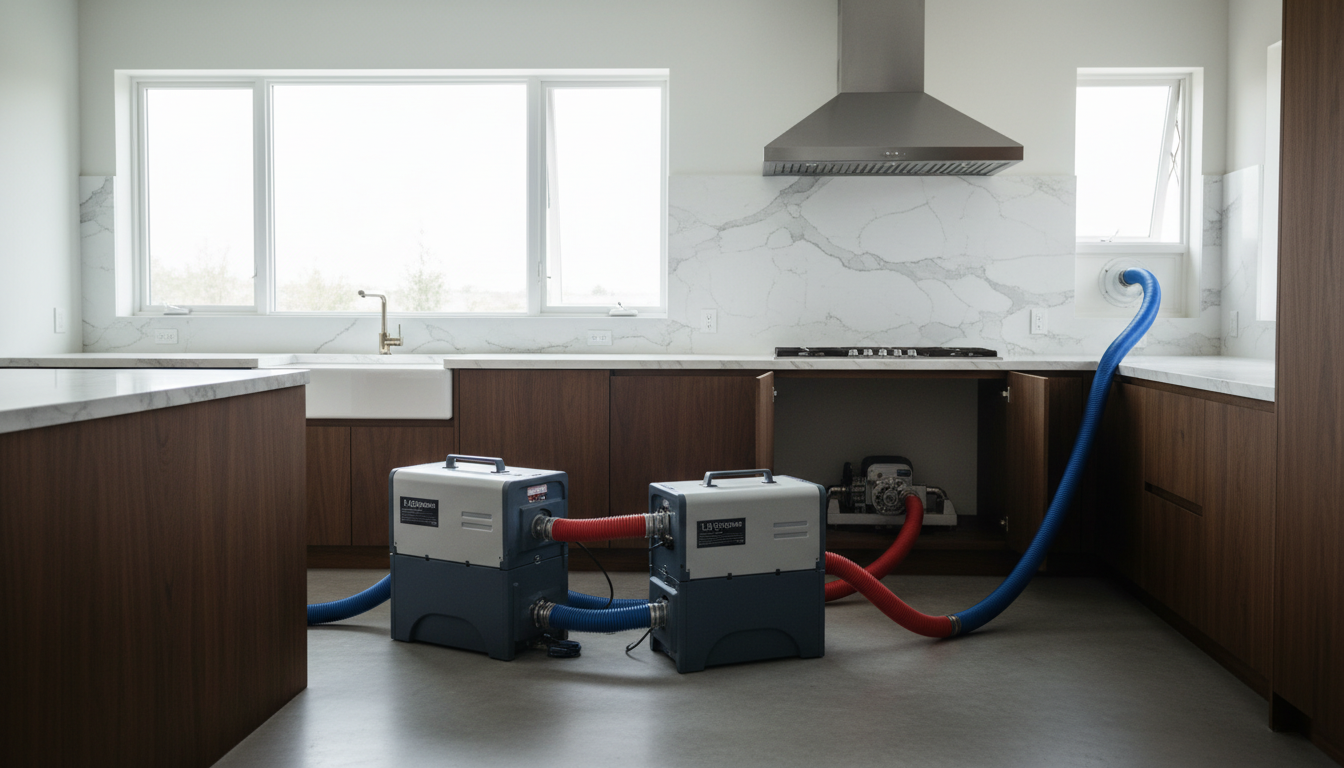
Desiccant dryers do not rely on cooling and condensation. Instead, they use a chemical attraction method, typically involving a silica gel rotor. As moist air passes through the rotor, the desiccant material absorbs the water molecules directly. The “reactivation” process uses a separate heat source to vent the moisture outside the structure.
The primary advantage of Desiccant technology in technical dehumidification for large homes is its ability to produce air with nearly a portion relative humidity. This “thirsty” air is capable of extracting deep-seated moisture from materials with low permeability, such as historic lath and plaster, or thick-set marble slabs. At Partners Restoration, we deploy Desiccants when the preservation of original architectural reconstruction assets is the priority.
Material Science: Preserving Custom Millwork and High-End Finishes
High-end estates are built with hygroscopic materials that are highly sensitive to moisture-induced dimensional changes. When wood absorbs water, it reaches a Fiber Saturation Point (FSP). Beyond this point, the wood begins to swell, leading to cupping, crowning, or “washboarding” in hardwood floors. Custom cabinetry and integrated millwork are particularly vulnerable because they are often fastened tightly to the structure, leaving no room for expansion.
The Importance of Rapid Grain Depression
To save a white oak floor or a cherry-paneled library, we must achieve “rapid grain depression.” By using Desiccant dryers to drop the ambient GPP rapidly, we force the wood to release moisture before the cellular walls permanently deform. This technical approach allows us to save materials that standard contractors would typically recommend for demolition and replacement.
Structural Drying vs. Cosmetic Drying
Many restoration companies focus on “cosmetic drying”—making the surface feel dry to the touch. Technical dehumidification focuses on “Structural Drying.” This involves monitoring the Equilibrium Moisture Content (EMC) of the hidden structural elements. If the studs behind a marble backsplash remain wet, the resulting mold growth can necessitate a full tear-out months after the initial event. Our process ensures that the core of the home is as dry as the surface.
Supporting Data: Drying Time and Efficiency
Scientific modeling of drying cycles shows a clear divergence in performance based on equipment type and material density. In a controlled study of 2-inch thick dense hardwood:
- Standard Refrigerant: Failed to reach dry standard within 120 hours; significant cupping observed.
- LGR Dehumidification: Reached dry standard in 96 hours with minor residual tension in the wood grain.
- Desiccant Technical Dehumidification: Reached dry standard in 60 hours; a large majority of material successfully salvaged with zero permanent deformation.
For the estate owner, these 36 to 60 hours are the difference between a successful restoration and a six-figure replacement project.
Frequently Asked Questions
Will my wood floors warp permanently?
If technical dehumidification is initiated quickly using Desiccant dryers, many high-end wood floors can be saved. The key is to lower the vapor pressure of the room before the wood fibers reach a state of permanent “set.” We utilize specialized floor-drying mats in conjunction with Desiccants to pull moisture through the wood grain vertically.
Why can’t I just use my home’s HVAC system to dry the house?
Residential HVAC systems are designed for comfort, not remediation. They remove moisture as a byproduct of cooling, but they lack the grain-removal capacity required for structural drying. In fact, running a standard HVAC during a water loss can actually spread mold spores through the ductwork and lead to “secondary damage” caused by high-velocity humid air.
The Partners Restoration Advantage
In the West Metro area, Partners Restoration provides a sophisticated alternative to “slash-and-burn” restoration. Our technical approach is designed specifically for the complexities of luxury estates. By leveraging advanced Desiccant technology and IICRC-certified expertise, we prioritize the preservation of your home’s architectural integrity over high-volume demolition.
When dealing with high-value finishes, the cost of the wrong drying method is far higher than the cost of technical excellence. We provide the data, the equipment, and the scientific rigor required to return your estate to its pre-loss condition.
Secure Your Estate’s Integrity
If your property has experienced water intrusion, do not settle for standard drying methods that risk your custom finishes. Contact Partners Restoration for a comprehensive analysis of your home’s needs.
Leave A Comment