Fire Damage Recovery: Managing Smoke Soot in High-Volume Spaces
The aftermath of a residential fire is a profound disruption of sanctuary. For owners of expansive estates in the West Metro, the challenge extends far beyond the immediate charred remains. In high-volume homes characterized by vaulted great rooms, open-concept floor plans, and complex multi-zone HVAC systems, smoke and soot behave with a sophisticated level of aggression. When fire strikes a luxury property, the structural integrity and the curated aesthetic of the home are both at risk. Restoration is not merely a matter of cleaning surfaces; it is a technical discipline involving molecular chemistry, specialized engineering, and a deep respect for architectural detail.
As a Fire Restoration Project Manager, I have walked through countless properties where the fire was extinguished in minutes, but the smoke damage threatened to linger for a lifetime. In these high-volume spaces, the “chimney effect” draws soot and hot gases upward, depositing corrosive residues on crown molding, recessed lighting, and intricate ceiling textures that are often twenty or thirty feet out of reach. Professional fire damage restoration smoke soot removal requires a systemic approach that addresses the visible damage while neutralizing the invisible threats to air quality and structural health.
The Complex Chemistry of Smoke and Soot
To the untrained eye, smoke is a cloud; to a restoration expert, it is a pressurized delivery system for acids and particulates. When synthetic materials, natural woods, and fine textiles burn, they create a chemically complex byproduct. The type of soot produced dictates the restoration protocol. In many West Metro estates, the presence of high-end finishes—such as marble countertops, silk wallcoverings, and custom millwork—requires an immediate and nuanced response to prevent permanent staining or etching.
Research into soot particle distribution in residential fires indicates that smoke particles can be as small as 0.1 microns. For context, these particles are small enough to penetrate porous surfaces like drywall and wood framing, becoming trapped within the building’s envelope. If these particles are not neutralized at a molecular level, they will continue to off-gas, producing that “burnt” smell every time the humidity rises or the heating system engages.
| Contaminant | Cleaning Method | Goal |
|---|---|---|
| Dry Soot | Chemical sponging | Removing surface particles without smearing |
| Oily Soot | Degreasing agents | Breaking down grease residues from plastics or proteins |
| Protein Residue | Enzyme cleaners | Neutralizing stubborn, invisible odors from organic fires |
The Challenge of High-Volume Spaces
High-volume spaces, such as grand foyers and two-story living areas, present unique logistical and technical hurdles. In these environments, smoke behaves differently than it does in a standard room. Heat rises, and with it, the most corrosive soot particles are driven into the highest points of the structure. This often results in “smoke webs”—ionized soot particles that cling to corners and moldings, mimicking the appearance of cobwebs but carrying a much more destructive chemical load.
Cleaning these areas requires more than just long ladders. We utilize specialized scaffolding and articulating lifts to reach every square inch of the ceiling and upper wall surfaces. Furthermore, the volume of air in these spaces acts as a reservoir for odors. Traditional cleaning methods are insufficient here; we must employ high-capacity HEPA air scrubbers to create a continuous exchange of air, filtering out microscopic particulates that have been suspended in the vast cubic footage of the room.
Phase 1: Stabilization and Air Quality
The first 24 to 48 hours following a fire are the most critical. This is the stabilization phase. We begin by securing the property and addressing Structural Stabilization needs. Once the environment is safe, our focus shifts to air quality. Because smoke is acidic, it begins to corrode metals and yellow plastics almost immediately. By deploying hydroxyl generators, we can begin neutralizing odors and breaking down carbon molecules in the air while our teams work, ensuring that the environment becomes safer and more manageable for the intricate cleaning to follow.
Phase 2: Systematic Smoke and Soot Removal
Once the air is stabilized, we move into the meticulous process of soot removal. In luxury estates, we often encounter “protein fires”—typically kitchen fires where fatty tissues have burned. These leave a virtually invisible, incredibly pungent residue that requires enzyme-based cleaners to digest the oils. For more traditional “dry” fires involving wood and paper, we use chemical sponges that lift soot away from surfaces rather than rubbing it in.
This phase is particularly intensive in homes with intricate architectural details. Every fluted column, every piece of hand-carved molding, and every crystal in a chandelier must be addressed. We take a top-down approach, ensuring that as we clean the high-volume ceilings, any dislodged particulates are captured before we address the flooring and lower-level furnishings.
Phase 3: Molecular Odor Neutralization
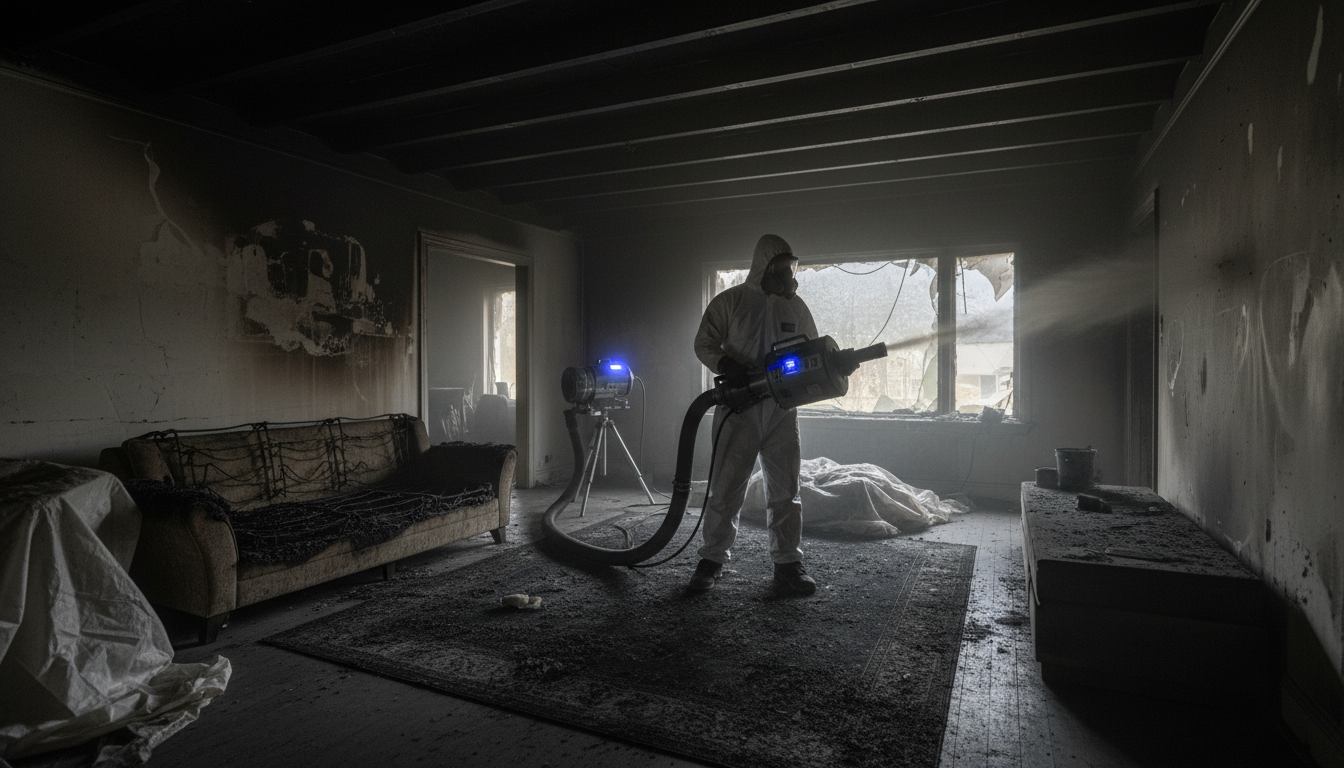
The most common complaint after a fire is the persistent odor. In a large home, the smoke travels through the HVAC system, essentially “infecting” every room, even those far from the seat of the fire. To combat this, we utilize a two-pronged approach. First, we perform a deep cleaning of the entire ductwork system using specialized agitation tools and HEPA vacuums. Second, we employ thermal fogging. This process recreates the fire’s behavior by pressurized delivery of a neutralizing agent in a fine mist, which follows the same path the smoke took, penetrating deep into the pores of the building materials to neutralize odors at the source.
Transitioning to Architectural Reconstruction
In many cases, the damage is severe enough that cleaning alone is not the solution. This is where our builder-led expertise becomes invaluable. Once the soot is removed and the odors are neutralized, we transition into Architectural Reconstruction. Because we understand the original structural and aesthetic intent of your home, we can seamlessly replace damaged materials—from specialty insulation to custom-milled hardwoods—ensuring that the finished product is indistinguishable from the original, if not improved.
Our team manages the entire lifecycle of the recovery. We handle the delicate balance of preserving what is salvageable and replacing what is compromised. For an estate owner, this means a single point of accountability and a commitment to maintaining the home’s valuation and historical integrity.
Frequently Asked Questions
How do you get smoke smell out of a vaulted ceiling?
We use hydroxyl generators and thermal fogging to neutralize odors in high-volume, hard-to-reach areas. Hydroxyl generators use UV light to create atmospheric hydroxyl radicals that break down odor molecules. For the highest points of a vaulted ceiling, thermal foggers produce a dry mist that penetrates the same porous surfaces the smoke reached, neutralizing the scent at a molecular level.
Can my HVAC system be saved after a fire?
In most cases, yes, provided it is professionally decontaminated. If smoke has entered the return air vents, the entire system must be cleaned, including the coils, blower motor, and all trunk lines. We use specialized sealants (encapsulants) on the interior of the ductwork if there is a risk of lingering particulates, ensuring the air you breathe is pure.
Restoring Your Peace of Mind
Fire damage is a trauma to both the family and the property. In the West Metro, where homes are often masterpieces of design and engineering, the restoration process must be equally sophisticated. By focusing on the unique demands of high-volume spaces and employing advanced molecular neutralization techniques, we ensure that your home is returned to a state of pristine comfort.
Recovery is about more than just removing what was lost; it is about restoring the sense of safety and luxury that your home represents. Our team of specialists is ready to guide you through every technical and emotional step of this process with empathy, precision, and an unwavering commitment to quality.
Contact our specialists today for a comprehensive evaluation of your property.
Leave A Comment