
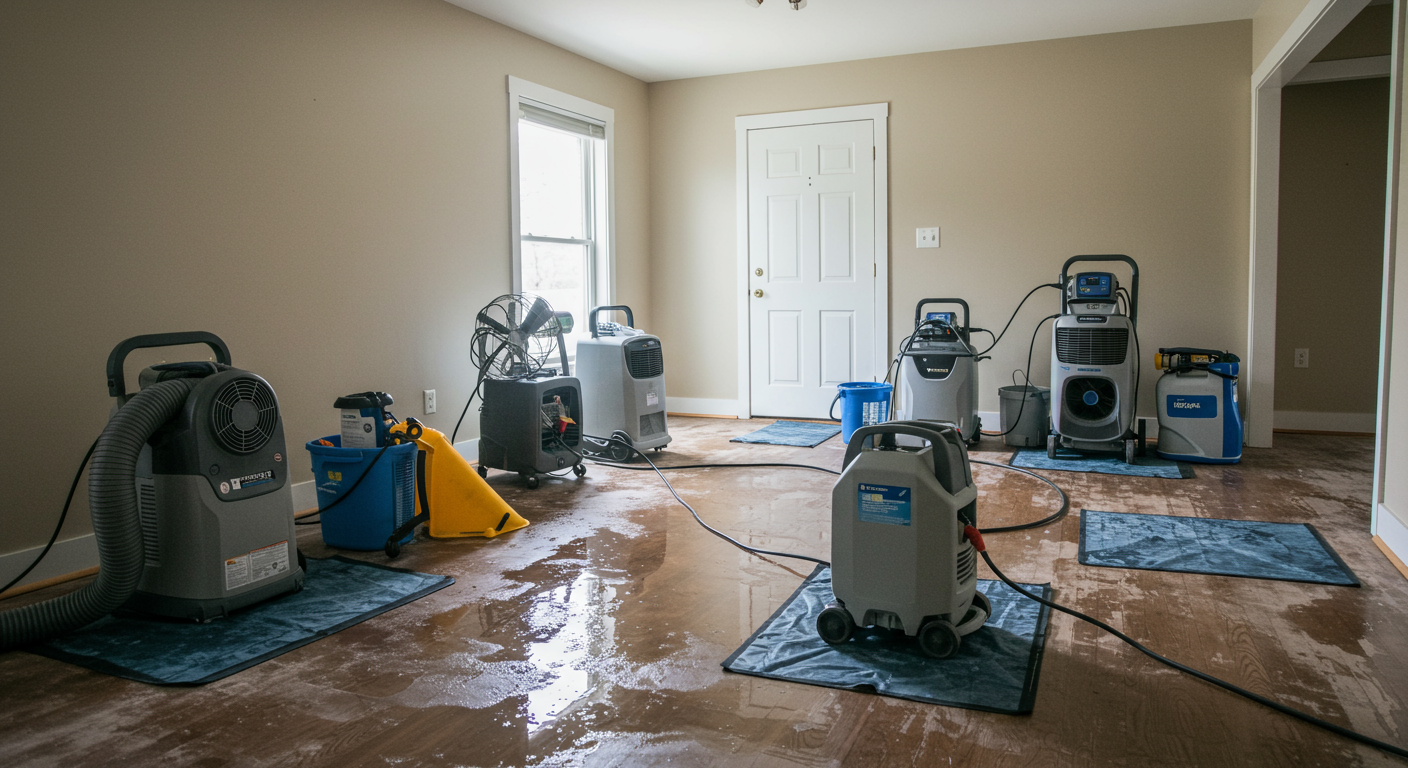
Minnesota is one of the most demanding climates in North America for residential moisture management. The combination of cold winters (climate zone 6 in most of the state’s population centers), significant indoor-outdoor temperature differentials, freeze-thaw cycling in shoulder seasons, and the high indoor humidity that comes from people and cooking and breathing inside a sealed building creates conditions where moisture management decisions made during construction determine whether a home performs well for 50 years or develops problems within a decade.
Partners COS builds in this climate with a specific advantage: we’ve spent years doing restoration work in homes whose moisture management details didn’t perform. That experience is embedded in every specification decision we make on new construction. This article explains the science behind why moisture management matters in Minnesota and how we build differently because of it.
The Physics: Why Cold Climates Are Hard on Buildings
Warm air holds more moisture than cold air. This is the fundamental fact that drives cold climate building science. When warm, humid interior air contacts a cold surface — a window, a wall cavity that’s colder than the dew point of the interior air, a rim joist with inadequate insulation — that moisture condenses. Over time, condensation within building assemblies creates the conditions for mold growth, wood decay, and structural damage.
The vapor retarder in a wall assembly is designed to slow the movement of moisture-laden air from the warm interior into the cold wall cavity. In a cold climate like Minnesota, the vapor retarder belongs on the warm side of the insulation — the interior side of the wall — to prevent interior moisture from reaching the cold part of the assembly where it would condense.
This seems straightforward. But it’s complicated by several factors that have changed since most of Minnesota’s existing housing stock was built:
Modern windows and doors are much more airtight than their predecessors. In an older home with single-pane windows and minimal weatherstripping, interior air leaked out of the building envelope continuously, carrying moisture with it. Modern homes are dramatically tighter — which is good for energy efficiency but means moisture that used to escape through air leakage now has to be managed through the wall assembly.
Interior humidity levels have increased. Modern lifestyles — more cooking, more showering, more plants, more people — produce more interior moisture than the lifestyle patterns that prevailed when many moisture management standards were developed.
Energy code requirements have pushed insulation levels higher. More insulation in the wall cavity means a colder outer face of the insulation — which increases the risk of condensation within the assembly if the vapor management details don’t keep pace with the increased insulation levels.
The Details We Build Differently
Rim joist insulation. The rim joist cavity — the framing at the top of the foundation wall where floor framing meets the foundation — is one of the most significant moisture entry points in a cold climate home. Fiberglass batt stuffed into this cavity provides some insulation value but doesn’t create an air barrier. Warm, humid interior air can still contact the cold foundation wall through this cavity. We specify closed-cell spray foam at rim joists on every home we build. It creates both an air barrier and a vapor retarder in a single application — addressing both the energy performance and the moisture management function simultaneously.
Continuous exterior insulation at the wall assembly. Minnesota Energy Code allows wall assemblies that meet thermal performance requirements using only cavity insulation — fiberglass or mineral wool between studs. The problem with cavity-only assemblies in a cold climate is that the studs are thermal bridges — they conduct heat from the interior to the exterior, creating cold spots at each stud location where condensation risk is elevated. Continuous exterior insulation — rigid foam or mineral wool board on the outside of the sheathing — eliminates the thermal bridging at studs and keeps the sheathing surface warmer, reducing condensation risk within the assembly. We specify continuous exterior insulation on new construction because we’ve seen what the absence of it produces in restoration work on homes built without it.
Extended ice and water shield at eaves. Ice dams form when heat escaping through the roof deck melts snow above it, and the meltwater runs down to the cold eave and refreezes. The water backs up behind the ice dam and can infiltrate under roofing through capillary action. Minnesota Building Code requires ice and water shield to extend 24 inches inside the interior wall line at eaves — a minimum that protects against most ice dam events. We extend coverage further on every project, and we pay specific attention to the attic insulation and ventilation details that prevent ice dam formation in the first place. We’ve remediated too many ice dam claims in west metro homes to treat the code minimum as the actual standard.
Foundation waterproofing scaled to site water table conditions. Standard dampproofing — a single coat of bituminous material on the foundation wall — is code-compliant on most sites. On lakeshore lots and other sites with elevated water tables, it’s inadequate. We specify a drainage board and dimple mat system on below-grade walls in water-table-sensitive locations — the same system we specify when we’re waterproofing an existing foundation that has failed. Doing it on new construction, before the foundation is backfilled, is dramatically more effective and less expensive than addressing it afterward.
What the Restoration Record Shows
The most common moisture-related failure modes we’ve addressed in restoration work throughout the Minneapolis west metro cluster around a small number of construction detail categories. Ice dam damage at eaves. Basement water infiltration on lots with high water tables. Condensation damage within wall assemblies. Window and door water intrusion at flashing details that passed inspection but failed over time.
None of these are random. They’re predictable outcomes of specific construction decisions — made to code minimum, not to performance standard. The restoration record is a dataset about what code-minimum construction produces over 20 to 40 Minnesota winters. We build to a different standard because we’ve read that dataset firsthand.
The Standards and Research Behind Moisture Management Practice
The building science principles that govern moisture management in cold climates have been developed and codified over several decades. Understanding the primary sources helps contextualize why the standards have evolved and what they require.
The 2020 Minnesota Residential Energy Code, adopted by the Minnesota Department of Labor and Industry, establishes minimum thermal performance requirements for wall assemblies, attic insulation, foundation insulation, and window performance. Minnesota’s energy code is among the more stringent state codes in the country, reflecting the climate zone 6 designation that applies to the Twin Cities metro and most of the state’s population centers.
ASHRAE Standard 160 (Design Criteria for Moisture Control in Buildings) establishes criteria for moisture management system design in buildings. The standard defines acceptable moisture conditions within building assemblies and provides a framework for evaluating whether a given wall, roof, or foundation assembly will perform adequately in a specific climate. Building professionals designing high-performance assemblies in cold climates reference ASHRAE 160 as a tool for evaluating moisture risk in proposed assembly designs.
Building Science Corporation, founded by Dr. Joseph Lstiburek, has produced the most widely cited research and guidance on building enclosure performance in North American climate zones. BSC’s guidance on vapor retarders and vapor barriers in cold climates has directly influenced how the Minnesota residential construction industry thinks about vapor management — including the understanding that vapor retarder placement requirements differ by climate zone and that cold climate assemblies require different approaches than mixed or hot-humid climate assemblies.
The IICRC S500 Standard for Professional Water Damage Restoration establishes the documentation and drying protocols for water damage events in buildings. The S500 framework requires categorization of water source, classification of affected materials by porosity and contamination risk, and documentation of drying conditions to support insurance claim processing. The construction details that Partners COS builds to — particularly in foundation waterproofing and window flashing — are specifically designed to prevent the conditions that trigger S500 restoration events.
A Moisture Management Checklist for Minnesota Custom Homes
The following represents the moisture management system Partners COS applies as standard practice on new construction in climate zone 6. Each item addresses a specific failure mode observed in restoration work on existing homes in the same market.
- Rim joist insulation: Closed-cell spray foam, minimum 2 inches, covering the full perimeter of the rim joist cavity. Creates continuous air barrier and vapor retarder at one of the highest-risk thermal bridge and moisture entry locations in a cold climate home.
- Vapor retarder placement: On the warm-in-winter (interior) side of the insulation in wall assemblies. In practice, this means confirming that vapor-permeable house wraps are used on the exterior (vapor open) and that interior finishes — paint, vapor retarder membrane where specified — are on the warm side.
- Continuous exterior insulation: Rigid foam or mineral wool board at the exterior face of wall sheathing. Keeps sheathing temperature above dew point in cold weather, preventing condensation within the stud cavity. Minimum R-5 at climate zone 6 on 2×6 framing; more for enhanced performance.
- Ice and water shield extent: Extended from the eave edge to a point at least 36 inches inside the interior warm-wall line — beyond the 24-inch code minimum. Combined with proper ventilation baffle continuity from soffit to ridge to prevent ice dam formation.
- Window pan flashing: Flexible flashing membrane at window sills, integrated with weather-resistive barrier per manufacturer installation requirements. The pan must drain to the exterior. Sill flashing must be lapped under the weather-resistive barrier at the sides, and over it at the top — in the correct sequence.
- Foundation waterproofing: Drainage board and dimple mat on below-grade walls where seasonal water table is within 4 feet of footing elevation. Footing drains piped to daylight or sump where applicable.
- Crawl space or basement vapor management: Vapor barrier on crawl space soil, continuous and lapped at seams. In conditioned crawl spaces, insulation on walls rather than floor, and crawl space included in building’s thermal boundary.
- Mechanical ventilation: HRV (heat recovery ventilator) in airtight new construction to manage indoor humidity levels that can’t escape through a tight envelope. Sized to ASHRAE 62.2 requirements for dwelling unit ventilation.
Frequently Asked Questions — Moisture-Resistant Home Construction Minnesota
Why is Minnesota classified as climate zone 6 and what does that mean for construction?
The U.S. Department of Energy climate zone map classifies the Twin Cities metro and most of Minnesota as climate zone 6 — a very cold climate zone defined by heating degree days. Climate zone 6 triggers the most stringent residential energy code requirements in the continental United States, including minimum insulation levels, vapor control requirements, and fenestration performance standards. Builders who work primarily in milder climate zones and then build in Minnesota often underestimate the envelope performance requirements that zone 6 imposes.
What is the difference between a vapor barrier and a vapor retarder?
A vapor barrier (Class I vapor retarder) is essentially impermeable to water vapor — polyethylene sheeting is the common example. A vapor retarder (Class II or III) slows vapor movement but allows some permeability. In cold climate assemblies, the correct specification depends on the assembly design: a wall with continuous exterior insulation keeping the sheathing warm may not require a Class I vapor retarder on the interior, while an assembly without exterior insulation typically does. Using an impermeable vapor barrier in the wrong location can trap moisture within an assembly rather than preventing it from entering.
What causes ice dams and how does new construction prevent them?
Ice dams form when heat escaping through the roof deck melts snow above the attic, and meltwater runs to the cold eave — which is not over conditioned space — and refreezes. The ice dam grows until meltwater backs up behind it and infiltrates under roofing at the eave. Prevention requires two things simultaneously: adequate attic insulation and air sealing to prevent heat from escaping through the deck, and continuous ventilation baffles from soffit to ridge to maintain a cold roof deck temperature. Extended ice and water shield at the eave addresses the infiltration risk when prevention partially fails during severe events.
What is the rim joist and why is it the most important location to insulate?
The rim joist is the framing member at the top of the foundation wall, where floor framing sits on the foundation. In an uninsulated rim joist cavity, warm interior air can contact the cold foundation wall directly — creating both energy loss and condensation conditions. Closed-cell spray foam at the rim joist addresses both: it provides R-value per inch (approximately R-6 to R-7 per inch), creates a continuous air barrier, and acts as a vapor retarder. It’s the most cost-effective single envelope improvement in a cold climate home, whether new or existing.
Does Partners COS use HRV systems in new construction?
Yes — heat recovery ventilators (HRVs) are standard in Partners COS new construction. Modern homes built to current energy code are airtight enough that indoor humidity levels must be managed mechanically rather than relying on envelope leakage. An HRV provides controlled ventilation that exhausts stale, humid indoor air while recovering most of its heat energy to temper incoming fresh air — maintaining indoor air quality without the energy penalty of uncontrolled infiltration.
What foundation waterproofing does Partners COS specify on lakeshore lots?
On lakeshore lots and other sites with elevated seasonal water tables, Partners COS specifies a drainage board and dimple mat system on below-grade walls rather than standard dampproofing alone. The drainage board creates a drainage plane between the foundation wall and the backfill, directing water to the footing drain rather than allowing it to accumulate against the foundation. This system is the same one used to retrofit existing foundations that have failed — doing it on new construction, before backfill, is significantly more effective and less expensive.
Leave A Comment