
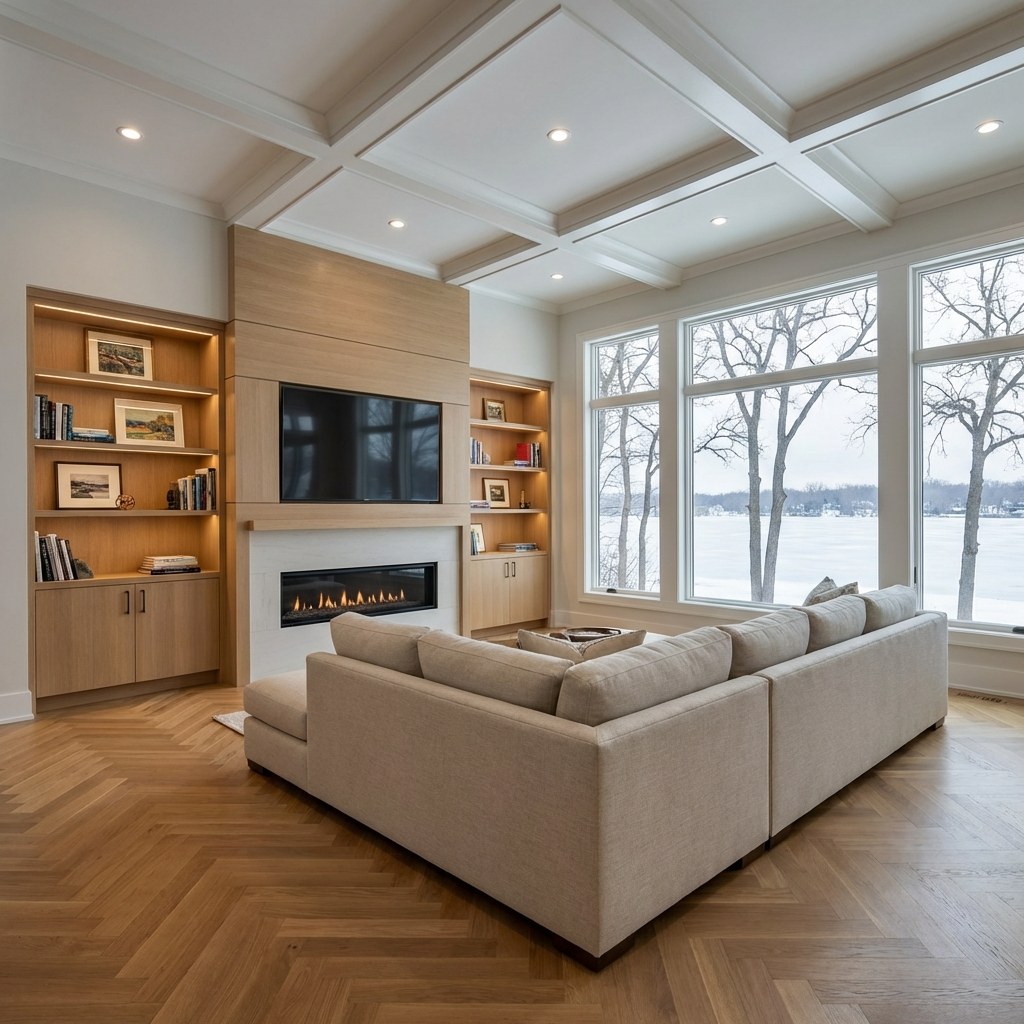
Lake Minnetonka is the standard against which every other custom home market in Minnesota is measured. The homes on its shores and in its surrounding communities — Wayzata, Orono, Deephaven, Minnetonka, Minnetrista — represent the highest end of the state’s residential market. Building here requires capability that isn’t common: regulatory fluency in a complex shoreland environment, construction standards that match the investment these homes represent, and the design sensibility to engage with one of the country’s most beautiful freshwater landscapes.
Partners COS builds on and around Lake Minnetonka. We currently have two custom homes under construction in the corridor. And we’ve spent years doing restoration work throughout these communities — which means the homes we build are informed by a specific, earned knowledge of what custom construction on this lake needs to deliver.
The Lake Minnetonka Regulatory Environment
Building on or near Lake Minnetonka means operating within a layered regulatory framework that has no equivalent in standard suburban construction. Understanding it is a prerequisite for building here competently.
Minnesota DNR shoreland rules establish the foundational framework: setbacks from the ordinary high-water mark (typically 75 feet for recreational development waters, 150 feet for natural environment waters), impervious surface limits, and bluff impact zone restrictions.
Hennepin County shoreland overlay implements the DNR framework at the county level, with specific impervious surface limits and review requirements for lots within the shoreland zone. Most Lake Minnetonka lakeshore lots fall under this overlay.
Minnehaha Creek Watershed District requires permits for projects that disturb significant soil or create new impervious surface within its jurisdiction — which covers essentially the entire lake corridor. MCWD permit applications require detailed stormwater management plans reviewed by the district’s technical staff.
City-level requirements vary by municipality — Wayzata, Orono, Deephaven, Minnetonka, and Minnetrista each have their own building permit processes, setback interpretations, and in some cases supplemental design standards.
Navigating all four layers simultaneously, without delays caused by incomplete applications or design revisions required mid-review, requires experience. We’ve done it. We know which MCWD reviewers focus on which aspects of stormwater plans, which city departments have longer review cycles, and how to sequence permit applications to minimize the total permitting timeline.
What Luxury Construction Standards Mean in Practice
In a market where homes regularly transact above $3 million, “luxury” is a baseline expectation, not a differentiator. What differentiates builders in this market is the quality of decision-making at the construction detail level — the choices that don’t show up in the finishes but determine whether the home performs over 50 years or requires expensive remediation within 10.
Our restoration background has given us direct exposure to what happens when construction details underperform in Lake Minnetonka corridor homes. The failure modes are consistent: envelope failures at lakeshore-facing exposures where wind-driven rain and freeze-thaw cycling are most severe, foundation waterproofing that wasn’t adequate for lakeshore water table conditions, ice dam damage at eaves on homes with inadequate ventilation detailing at the critical eave-to-soffit transition.
Our standard construction specifications address each of these — not as premium options, but as baseline requirements for building on this lake. The clients we build for are making significant investments. The construction standards need to protect those investments over a long horizon.
The Communities We Build In
Our Lake Minnetonka corridor work spans the full range of communities on and around the lake:
Wayzata — The most recognized Lake Minnetonka address. Small-lot lakeshore and larger interior parcels, City of Wayzata permitting, strong design expectations from a community that has seen decades of high-quality construction set the local standard.
Orono — Larger parcels, more private character, significant private well and septic inventory, estate-scale builds and compound programs with multiple structures.
Deephaven — Established neighborhoods, heavily treed lots, infill construction that must engage with the existing residential character of one of the lake’s most established communities.
Minnetonka — The eastern lake corridor, with shoreland lots on the lake’s easternmost bays and an extensive interior residential market informed by decades of high-quality construction.
Each community has its own regulatory nuances, design expectations, and site conditions. We build in all of them with the same fundamental approach: understand the site before design begins, build to standards that exceed code minimum at the details that matter most, and bring the restoration background to every decision about how the envelope goes together.
Comparing the Lake Minnetonka Communities for Custom Home Construction
Each community on the Lake Minnetonka corridor has a distinct regulatory profile, lot character, and design expectation. Understanding the differences before committing to a lot purchase is part of how Partners COS advises clients in the early stages of a project.
| Community | Lot Character | Key Regulatory Factor | Design Expectation |
|---|---|---|---|
| Wayzata | Smaller lakeshore lots; tight impervious surface limits | MCWD permit + shoreland overlay; 75-ft OHW setback | Premium finishes; strong neighborhood design context |
| Orono | Large parcels; estate scale; private well & septic | MCWD + well/septic due diligence; Hennepin County | Privacy; natural materials; compound programs |
| Deephaven | Established; heavily treed; infill character | Shoreland overlay; tree protection; infill context | Quiet quality; contextual design; established character |
| Minnetonka | Varied — lakeshore to interior; mature housing stock | City-wide 25% impervious limit; MCWD near creek | High finish expectations; restoration-informed building |
Regulatory Authorities Governing Lake Minnetonka Construction
Building on or near Lake Minnetonka requires coordination with multiple regulatory authorities simultaneously. Understanding each body’s jurisdiction and permit process is prerequisite knowledge for any builder working in this corridor.
The Minnehaha Creek Watershed District (MCWD) is the primary stormwater and land use regulatory authority for the Lake Minnetonka shoreland zone. Its permit requirements apply to projects disturbing more than one acre of soil or creating significant new impervious surface within its watershed boundary — which encompasses the entire Lake Minnetonka corridor. The MCWD’s permit application process requires a stormwater management plan reviewed by district technical staff; review timelines vary by project complexity.
The Minnesota Department of Natural Resources Shoreland Management Program establishes the foundational setback and impervious surface standards that Hennepin County implements through its shoreland overlay ordinance. The DNR classifies water bodies by use (recreational development, natural environment, general development) — a classification that directly determines the applicable structural setback distance from the ordinary high-water mark.
Hennepin County’s Shoreland Overlay District applies to all unincorporated shoreland areas and extends into municipal jurisdictions through the county’s planning authority. For incorporated cities — Wayzata, Orono, Deephaven, Minnetonka — the county overlay framework is implemented through each city’s own zoning ordinance, with city-specific provisions layered on top of the county baseline.
Frequently Asked Questions — Luxury Home Builder Lake Minnetonka
What makes the Lake Minnetonka corridor the most complex place to build a custom home in Minnesota?
The four-layer regulatory framework — DNR shoreland classification, Hennepin County shoreland overlay, MCWD permit requirements, and individual city building permits — has no equivalent in standard suburban construction. Each layer has its own application requirements, review timelines, and technical standards. A project on a Wayzata lakeshore lot requires simultaneous coordination with the City of Wayzata, the MCWD, and Hennepin County — all with different reviewers, different submission formats, and different response timelines. Builders who haven’t navigated this framework before encounter avoidable delays.
What is the ordinary high-water mark and why does it matter for lakeshore construction?
The ordinary high-water mark (OHW) is the boundary established by the Minnesota DNR as the point where the presence and action of water leaves a distinct mark on the land — typically the line of vegetation or physical evidence on the shoreline. All structural setbacks on lakeshore lots are measured from the OHW, not from the shoreline as it appears on a given day. The OHW must be confirmed by survey before setback calculations are made; assuming it from a property line or visual observation produces calculations that may not hold up in permit review.
What is the impervious surface limit on a Lake Minnetonka lakeshore lot?
Hennepin County shoreland overlay typically limits impervious surface to 25 percent of total lot area on recreational development waters, with stricter limits applying on natural environment water bodies. The calculation includes all structures, driveways, patios, walkways, and other impervious cover. Many existing lakeshore lots are at or near this limit before any new construction begins — which is why calculating existing coverage is the first step of pre-design due diligence on every lakeshore project.
How many custom homes does Partners COS currently have under construction on Lake Minnetonka?
Partners COS currently has two custom homes under construction in the Lake Minnetonka corridor — one in the Wayzata area and one further west along the Minnetonka shore. Both projects apply the construction standards developed through years of restoration work in the same communities.
What is the MCWD permit process for lakeshore construction?
The Minnehaha Creek Watershed District permit requires a stormwater management plan demonstrating how the project manages runoff from the disturbed site and from the new impervious surface created by the project. Plans are reviewed by MCWD technical staff; review timelines vary but typically run four to eight weeks for complete applications. Pre-application meetings with MCWD staff are available and recommended for complex lakeshore projects — they identify potential plan review issues before formal submittal.
Which communities on Lake Minnetonka are best for large-parcel estate construction?
Orono and Minnetrista offer the largest residential parcels in the Lake Minnetonka corridor — estate-scale lots with room for compound programs including guest structures, pool houses, and detached garages. Wayzata and Deephaven tend toward smaller, more defined lots with stronger neighborhood context. The right community depends on the client’s priorities around privacy, lot size, design latitude, and proximity to specific Lake Minnetonka access points.
Leave A Comment