
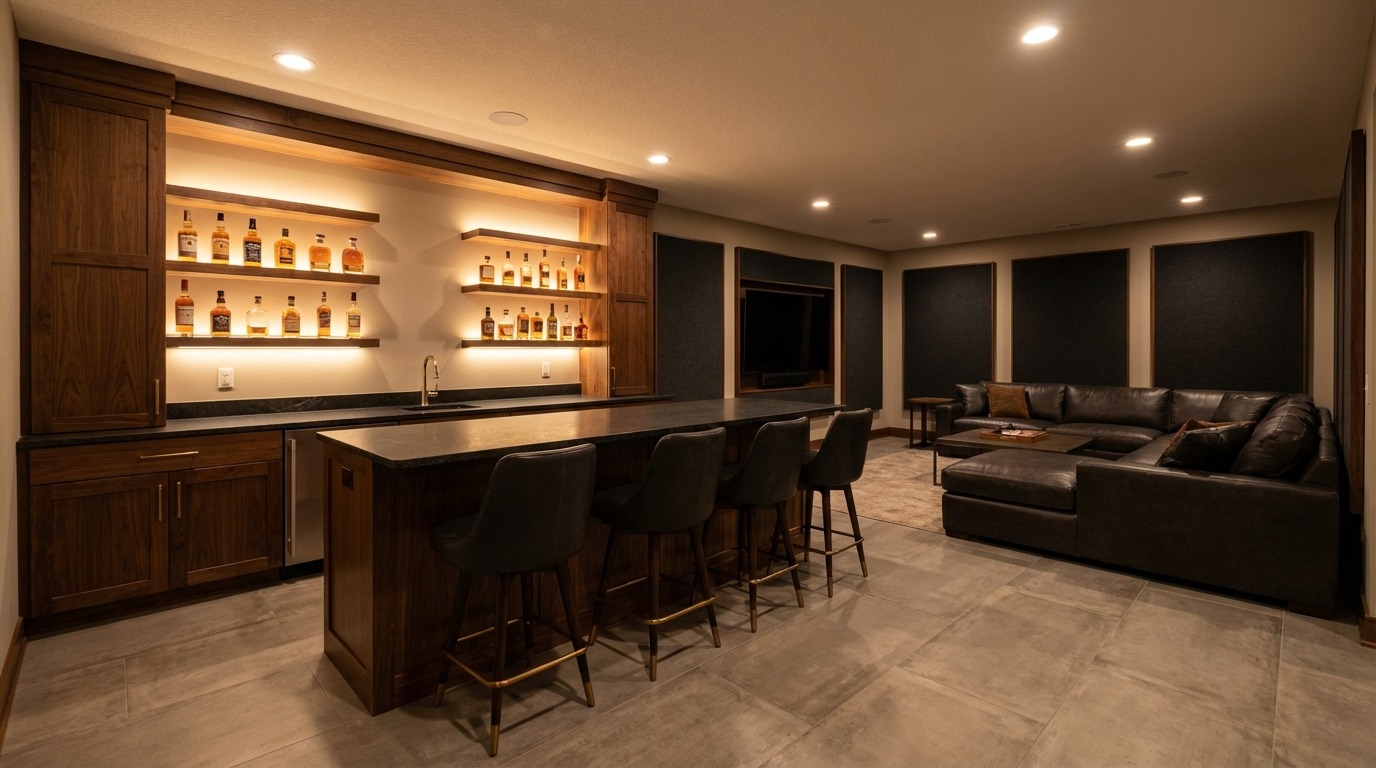
South Florida has a basement problem: it doesn’t have basements. The water table sits too close to the surface, and below-grade finished space is essentially nonexistent in Miami, Fort Lauderdale, and Palm Beach. What South Florida has instead is a pervasive design culture built around the social bar — the indoor-outdoor wet bar that serves as the social anchor of the home, the place where evenings actually happen.
Minnesota has the opposite problem. Basements are universal, generously proportioned, and almost universally underdesigned. The typical finished lower level in a Minnetonka or Plymouth home is carpet, a sectional sofa facing a mounted television, and a laminate bar that nobody actually uses because it feels like an afterthought. The Miami design culture has something to teach Minnesota basements, and it starts with taking the bar seriously.
What a serious bar actually looks like
The Palm Beach or Miami bar that’s worth importing to Minnesota shares several characteristics. It is architecturally integrated rather than furniture-grade — built into the room rather than placed against a wall. It has a proper back bar with display shelving, under-shelf LED lighting that warms the bottles from below, and dedicated storage for glassware worth showing. The counter surface is a material decision — honed dark granite or leathered quartzite rather than laminate or standard quartz. The sink is real, the refrigeration is serious, and the bar stools are leather on brass frames rather than vinyl on chrome.
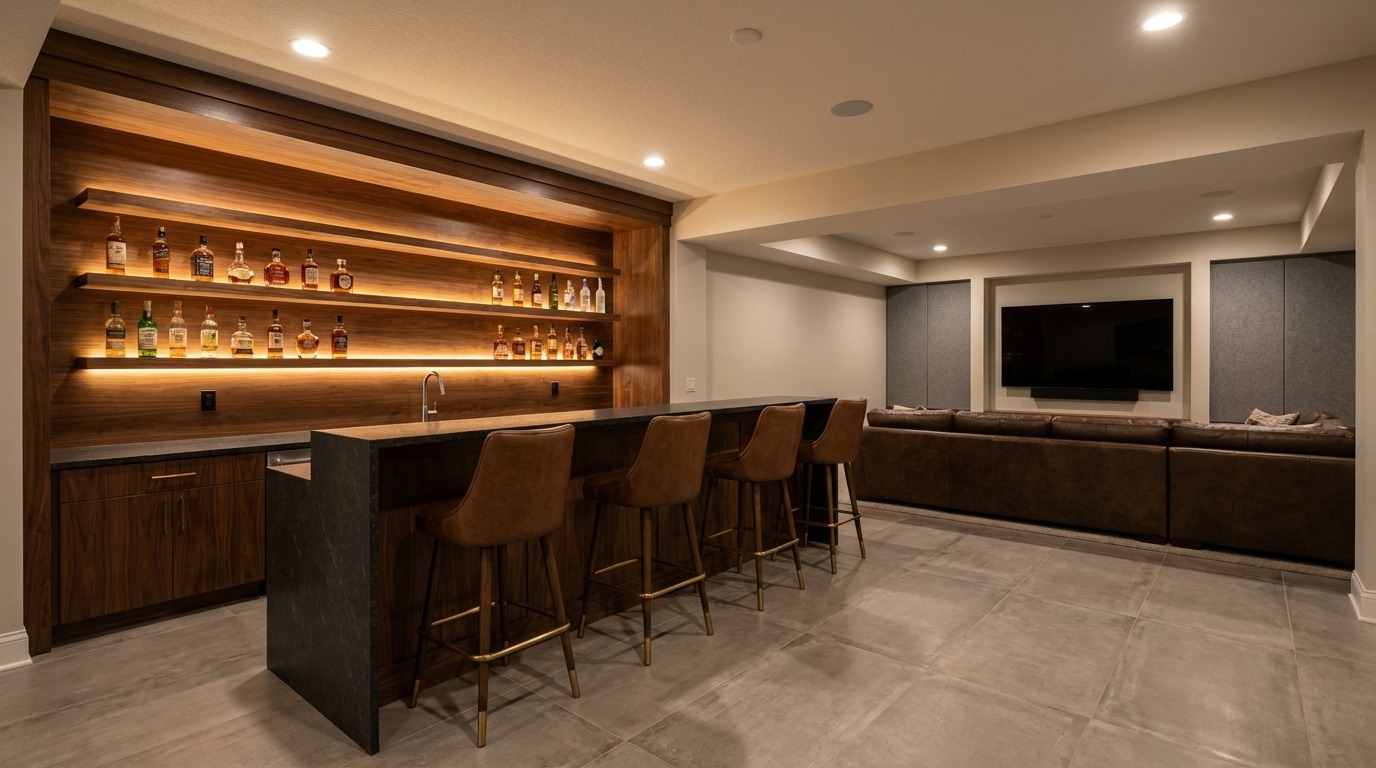
The visual tone in South Florida tends to run light and coastal — white lacquer cabinetry, natural rattan accents, tropical materials. That specific palette doesn’t translate directly to a Minnesota lower level. But the underlying design intention does. Walnut floating shelves with integrated LED lighting against a warm neutral wall reads as the Minnesota equivalent of the Miami back bar — warm, material-forward, designed to look good at 9pm with a glass in your hand.
The bar doesn’t have to be maximal to be intentional
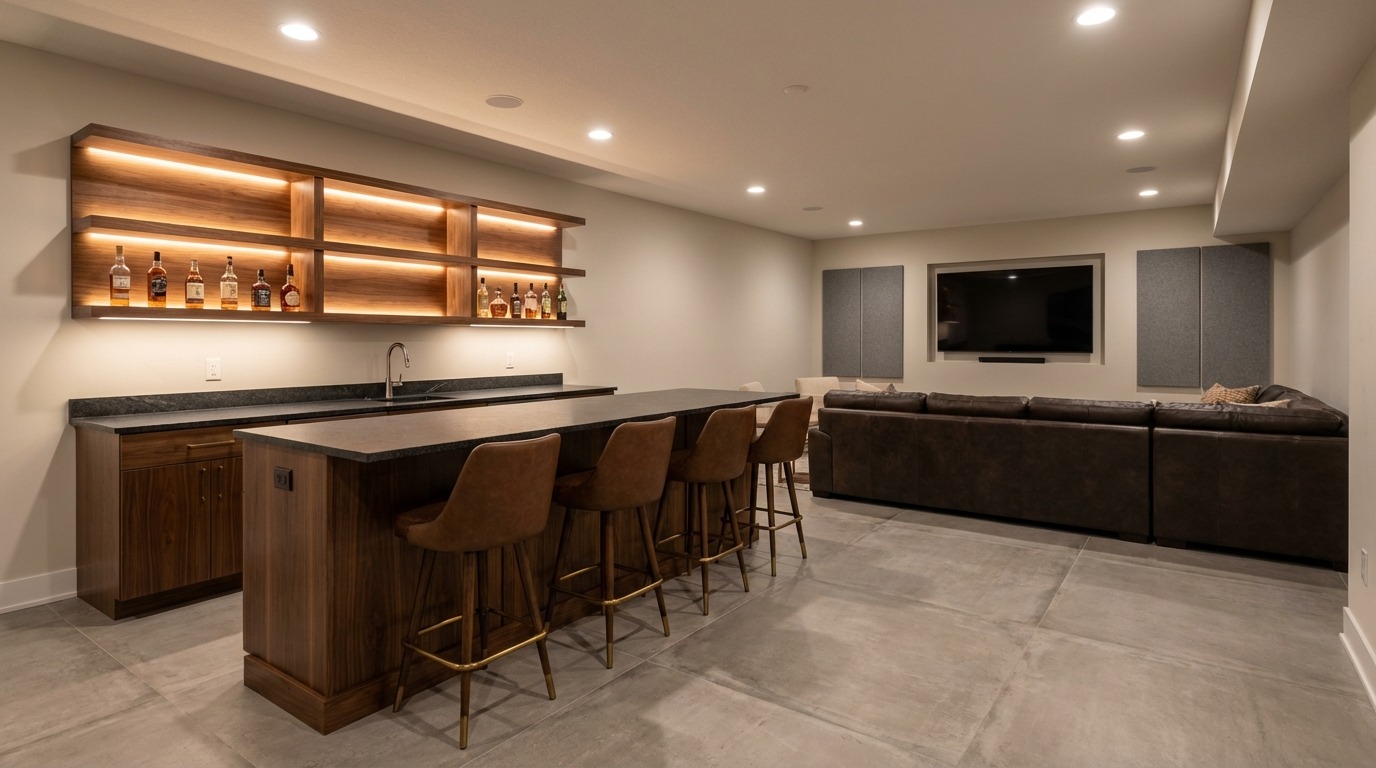
One of the more useful things the Miami bar culture teaches is that scale is less important than specificity. A full floor-to-ceiling millwork surround with integrated cabinetry and a custom back bar is one version of this. A cleaner, more minimal approach — floating walnut shelves with LED strip lighting, a dark granite counter, and four leather stools — delivers the same design register at a different investment level. What both have in common is that they’re designed, not assembled. The difference between a bar that works and one that doesn’t is almost never size.
The zoning strategy that makes it work
The South Florida home solves for indoor-outdoor flow between the bar and the pool or patio. The Minnesota basement solves for a different kind of flow — between the bar zone, the lounge zone, and the media zone. When a lower level is being rebuilt after a flood or water event, this is the moment to think about it as three rooms in one open space rather than one room with a TV and a couch.
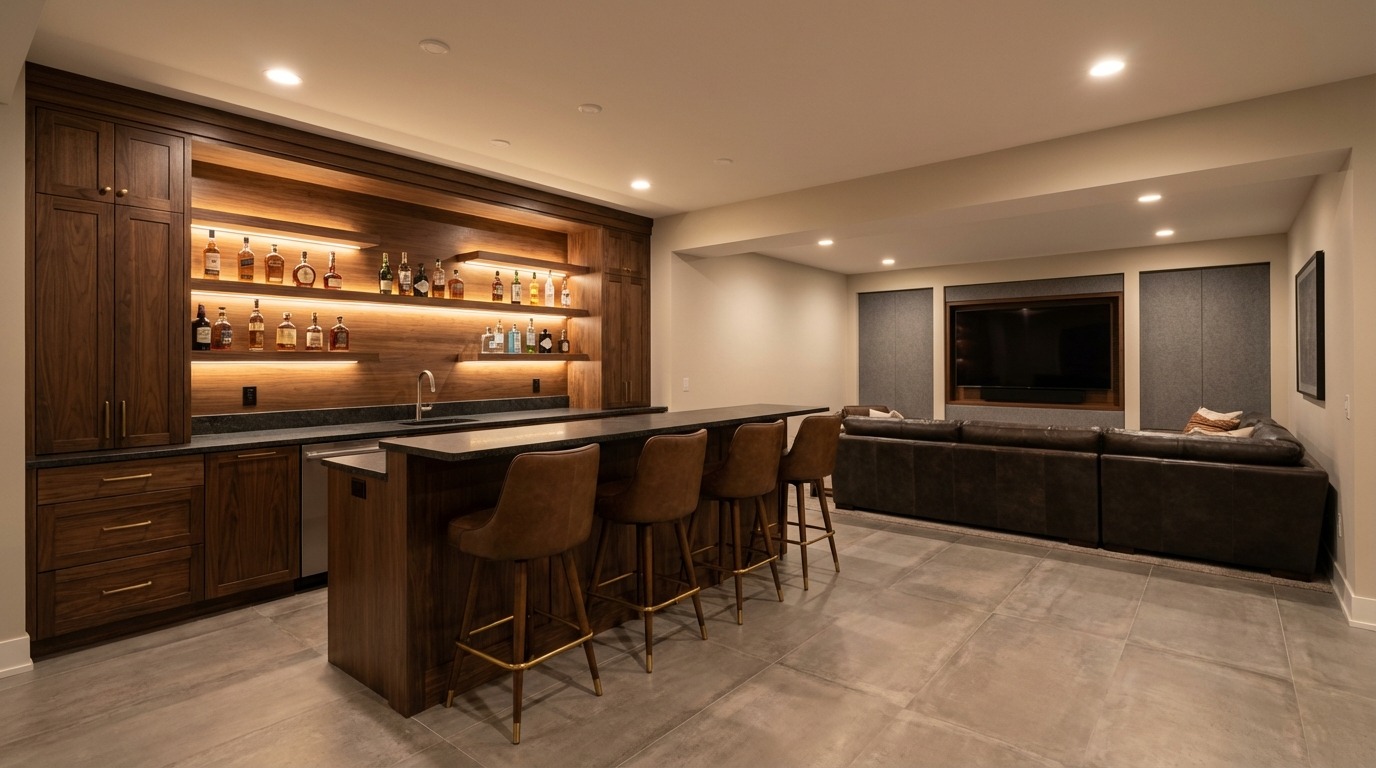
The bar occupies one end, architecturally defined by its millwork and shelving. The lounge anchors the center — seating arranged for conversation rather than purely facing a screen. The media zone anchors the far end, with acoustic panel treatment on the flanking walls and a recessed television that doesn’t dominate the room when it’s off. Large format concrete-look porcelain tile underfoot in a neutral tone runs the full length, tying the zones together without subdividing the room.
The rebuild conversation
A flooded Minnesota basement that’s being remediated and rebuilt is the ideal moment to have this conversation. The layout decisions — where the bar goes, how the zones are defined — happen before the framing goes back up. That’s the design phase, and it costs nothing to participate in it. Partners Restoration coordinates finish selections and layout planning with your insurance adjuster’s reconstruction scope, so the bar that gets built during your rebuild is the bar you actually wanted rather than the one that was easiest to specify.
See a Minnetonka basement flood rebuilt as a luxury lower level: Before & After — Basement Flood in Minnetonka.
Talk to Partners Restoration about your lower level rebuild →
Leave A Comment