Direct answer: DIY water cleanup is appropriate for small, clean-water spills with less than 1 hour of exposure and no wall penetration. For anything involving standing water for several hours, water in wall cavities or under flooring, contaminated water sources, or any event large enough to file an insurance claim — professional restoration is necessary, not optional. The cost of missing hidden moisture is mold remediation on top of reconstruction, which typically costs 3–5x what professional mitigation would have cost.
This isn’t an argument against DIY. It’s a practical guide to where the line is — because misjudging it costs Minnesota homeowners tens of thousands of dollars every year in preventable mold damage.
The Decision Matrix: DIY vs. Call a Pro
| Situation | DIY OK? | Why |
|---|---|---|
| Small appliance drip, caught immediately, hard floor only | ✅ Yes | No penetration, clean water, minimal exposure |
| Spilled water bottle, carpet, small area | ✅ Yes | Towels + fan sufficient, no contamination |
| Dishwasher overflow, 30 min, hardwood floor | ⚠️ Maybe | Hardwood requires moisture monitoring; check for subfloor penetration |
| Supply line burst, 2+ hours of water | ❌ No | Wall penetration likely; hidden moisture requires professional equipment |
| Toilet overflow or sewage backup | ❌ No | Category 2/3 contaminated water; health hazard requires PPE and disinfection |
| Basement flooding from any source | ❌ No | Volume and exposure time require industrial extraction and drying |
| Ice dam water intrusion | ❌ No | Wall cavity saturation; insulation replacement required |
| Any event with insurance claim | ❌ No | Professional documentation required for claim; DIY cleanup voids documentation |
What Professional Equipment Does That Yours Can’t
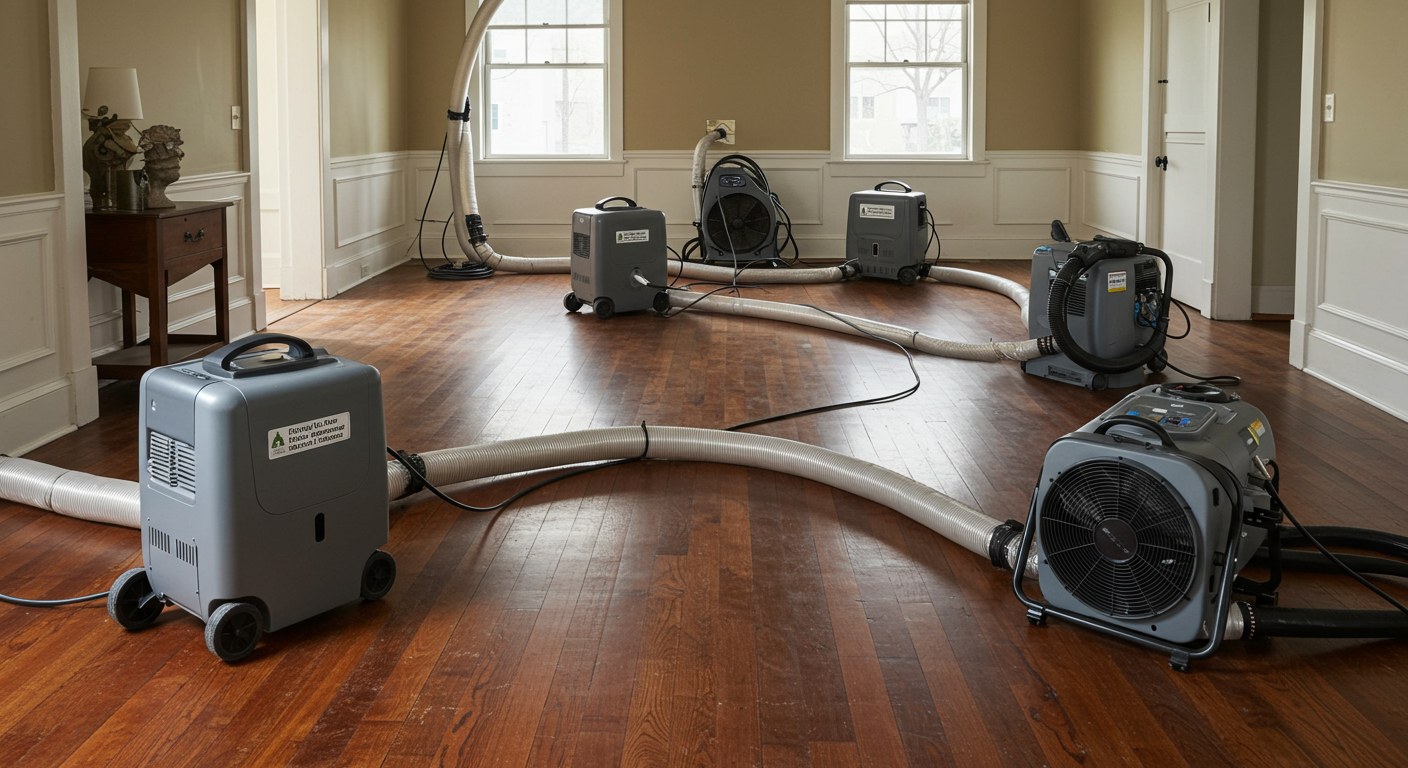
The fundamental problem with DIY water damage cleanup isn’t effort — it’s equipment. Here’s the gap:
| Task | Consumer Equipment | Professional Equipment |
|---|---|---|
| Water extraction | Shop vac: 5–10 gal/min | Truck-mount: 100–200 gal/min |
| Dehumidification | Consumer unit: 30–50 pints/day | LGR unit: 100–180 pints/day per machine |
| Air movement | Box fan: surface drying only | High-velocity air mover: dries wall cavities |
| Moisture detection | None / visual | Pin meter + thermal camera: sees inside walls |
A household dehumidifier running for a week cannot achieve what a single commercial LGR unit achieves in 3–4 days. And without moisture meters, you have no way of knowing whether the wall is actually dry or just feels dry on the surface while the cavity remains saturated.
The Hidden Moisture Problem: What You Can’t See
This is the core risk of DIY water cleanup. Water travels. It follows gravity and wicks through porous materials. A supply line burst in a second-floor bathroom sends water through the subfloor, into the ceiling cavity below, along the bottom plate of the wall, under the flooring, and into the wall insulation — often spreading 10–15 feet from the source by the time you discover it.
Surface drying — fans, towels, household dehumidifiers — removes surface moisture. It does not dry wall cavities or subfloor assemblies. The drywall surface feels dry. The insulation behind it is still wet. Three days later, you smell mold. Two weeks later, you’re looking at a mold remediation project that costs $8,000–$20,000 — because what would have been a $3,000–$5,000 mitigation job was not treated professionally.
What Happens to Your Insurance Claim if You DIY
Insurance companies cover professional water damage restoration as part of the claim. If you attempt DIY cleanup and later discover mold — or if the adjuster determines the damage could have been mitigated but wasn’t — they can reduce or deny the portion of the claim they attribute to the delayed or inadequate response. A professional contractor’s documentation (moisture logs, thermal images, equipment logs, daily readings) is the paper trail that keeps your claim intact.
Partners Restoration responds to water damage events across the Minneapolis west metro within 60 minutes. We bring the documentation from hour one and work directly with your insurance adjuster. Serving Edina, Plymouth, Minnetonka, Chanhassen, Hopkins, St. Louis Park, and surrounding communities.
Leave A Comment