
Orono’s mold challenge sits at the intersection of three factors that don’t exist in the same combination anywhere else in the Twin Cities: Lake Minnetonka’s direct water table influence on lakefront properties, a city split between municipal sewer and private septic that changes the remediation calculus when sewage is involved, and historic estate materials that require a preservation-first approach rather than the default tear-out-and-replace model. Getting any one of these wrong produces a worse outcome for the homeowner.
Lake Minnetonka’s Water Table: The Mold Driver Without a Leak
Orono controls roughly 40% of Lake Minnetonka’s shoreline. The lake’s level is managed by the Minnehaha Creek Watershed District through Gray’s Bay Dam, but it still fluctuates meaningfully — a wet spring in the upper watershed raises it, a dry summer lowers it. For Orono’s lakefront and near-shore properties, groundwater in adjacent soils tracks this lake level directly.
During high-water years, groundwater around shoreline foundations rises to levels that transmit significant moisture vapor through masonry walls. Original foundations on Orono’s older estates — fieldstone, early brick, and pre-modern concrete block — are porous. They weren’t waterproofed with modern membranes. They’re transmitting moisture from surrounding soil into lower-level spaces whenever the water table is high enough to press against them.
The mold that results from this mechanism is chronic rather than event-driven. It doesn’t develop in 48 hours after a flood. It develops over years of elevated humidity in crawl spaces, wine cellars, and lower-level spaces where vapor transmission is ongoing and ventilation is limited. Homeowners in dry years may have no symptoms. In high-water years — or after several consecutive wet springs — they notice a persistent musty odor, discoloration on stone or masonry surfaces, and allergy-like symptoms in lower-level spaces.
Septic System Complications in Orono Mold Work
Outside the Navarre area and Highway 12 corridor, Orono’s estate properties are on private septic. The city bills a quarterly septic fee and maintains compliance records, but the systems are private infrastructure. This creates two distinct scenarios where septic intersects mold remediation.
The first is the straightforward compliance issue: any remediation or reconstruction work within 50 feet of a well or 20 feet of a drainfield requires permit coordination with the city’s Planning and Zoning department. For estate properties on large lots, this is often manageable with advance planning. For properties on smaller lots where the drainfield and foundation are in closer proximity, it can constrain project sequencing.
The second is more serious: if the moisture source contributing to mold growth is a failed or underperforming septic system — slow leaks from distribution boxes, drainfield saturation, or system backup that introduces Category 3 sewage moisture into a crawl space or lower level — the mold remediation must be coordinated with licensed septic system repair. Mold remediation alone, without addressing a contributing septic failure, will not resolve the moisture source.
Historic Materials: What’s Worth Saving and How to Save It
Orono’s historic estates include materials assembled over a century — original limestone and granite foundations, hand-finished plaster walls, custom millwork installed by craftsmen who are long gone, period tile and stone that can no longer be sourced. When mold reaches these materials, the question isn’t just “is it contaminated” but “can it be saved, and what’s the right approach if it can.”
Original Masonry
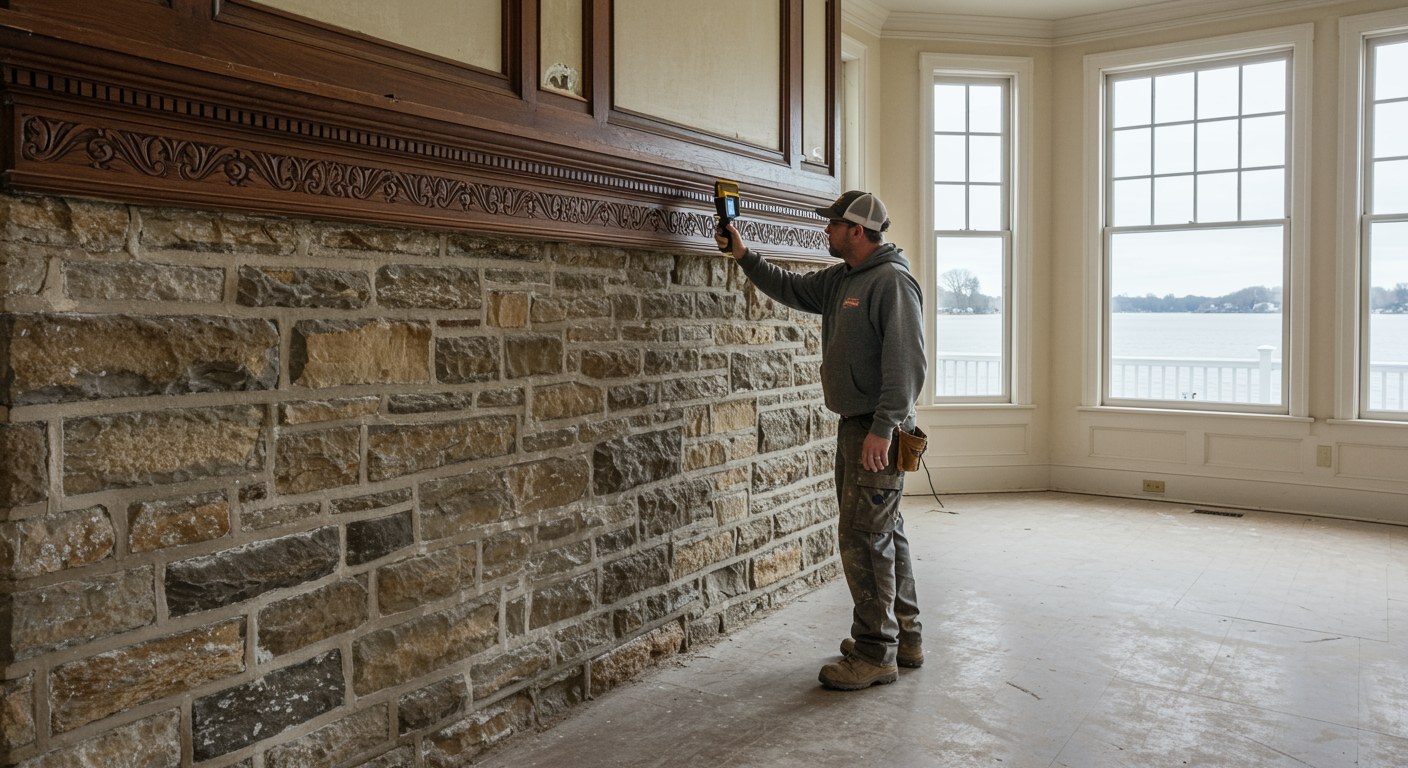
Stone and brick foundations with surface mold growth can often be treated without removal — HEPA vacuuming, antimicrobial application, and improved ventilation can address surface contamination. The standard for “clearance” on masonry is different than on drywall: the goal is eliminating active growth and bringing spore counts to background levels, not removing the substrate. Stone and brick don’t need to come out because they have mold on the surface.
Period Millwork and Built-Ins
Custom millwork from the 1920s through 1960s is irreplaceable at any budget. When mold reaches period millwork, the assessment question is depth of penetration: surface mold can be treated and the piece preserved; mold that has penetrated deep into the wood grain may require removal and replacement with custom reproduction. Disassembly for treatment — rather than removal for disposal — is the right first step, and it requires someone who knows how the piece was assembled in order to take it apart without damage.
Frequently Asked Questions — Mold Remediation in Orono, MN
What causes mold in Orono’s lakefront homes without an obvious leak?
Lake Minnetonka’s water table is the primary driver. When lake levels are high — after a wet spring or sustained rainfall — groundwater around shoreline and near-shore properties rises accordingly. This elevated groundwater increases vapor transmission through masonry and concrete foundation walls into lower-level spaces. Original foundations on Orono’s older estates, built without modern waterproofing membranes, transmit this moisture continuously during high-water periods. The result is chronic moisture in crawl spaces and lower-level spaces that supports mold growth without any specific plumbing event.
How does Orono’s septic system infrastructure affect mold remediation?
Most of Orono’s estate properties — outside the Navarre/Highway 12 corridor — are on private septic systems. If a mold remediation project involves any work near a septic drainfield (within 50 feet of a well, 20 feet of the drainfield), permits and inspections may be required. More directly: if the moisture source contributing to mold is a slow septic system leak or drainfield failure, the mold remediation must be paired with septic system remediation — a more complex and regulated process than standard water damage remediation.
Can original plaster and period millwork in Orono estates survive mold remediation?
Often, yes — with the right approach. Original plaster on Orono’s historic properties requires material-specific assessment: moisture meters calibrated for plaster, not drywall; evaluation of the depth of penetration rather than assuming full removal; and preservation-first decision-making for surfaces that are intact and contamination is surface-level. Period millwork and built-ins can typically be disassembled, treated, and reinstalled when contamination is addressed at the surface before deep penetration occurs. The key is early intervention and a contractor who understands the material.
What MCWD permits are needed for mold remediation on Orono lakefront properties?
Most interior mold remediation — removing drywall, treating surfaces, reinstalling finishes — doesn’t trigger MCWD permits. However, any project that involves exterior work near regulated wetlands, changes to drainage patterns, foundation excavation near the lake, or disturbance of shoreline areas requires MCWD review. Partners Restoration identifies permit requirements in the initial assessment, not mid-project.
How should a high-value Orono estate document mold remediation for insurance and real estate purposes?
Documentation should include pre-remediation air sampling establishing a baseline mold count and species identification, photographic documentation of all affected materials with notation of specific construction type (original plaster, period millwork, etc.), a written scope of work referencing IICRC S520 standards, photos during remediation showing containment and removal process, and post-remediation clearance testing by an independent industrial hygienist confirming the space is within acceptable parameters. Partners Restoration provides complete documentation packages for Orono properties.
Mold concern in your Orono property? Contact Partners Restoration. Based in Medina, directly adjacent to Orono’s eastern border. Call 952.500.2426.
Also see: Mold remediation services in Orono | All restoration and remodeling services in Orono, MN | Water damage restoration in Orono
Leave A Comment