
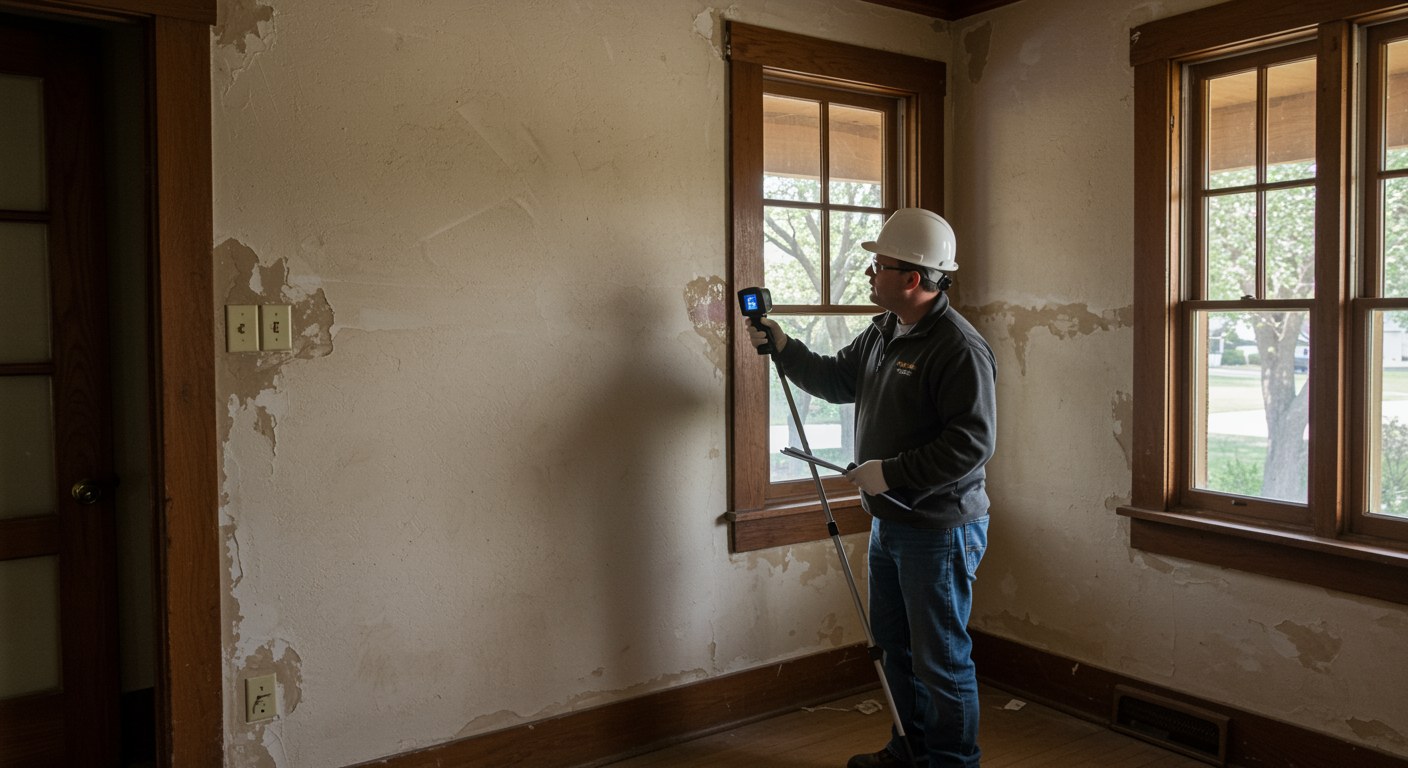
Edina’s mold picture has a geographic split that mirrors its water damage risk. Morningside faces a documented, city-acknowledged groundwater problem that makes chronic basement moisture the baseline condition for many homes — not an occasional event. The Country Club District faces a different problem: original plaster walls and pre-war construction that behaves differently under moisture than modern drywall, requiring a different remediation approach. Understanding which situation you’re in is the starting point.
Morningside: What Rising Groundwater Does to Basements Over Time
Edina’s publicly documented Flood Risk Reduction Strategy contains a data point that most homeowners in Morningside don’t know: a groundwater monitoring well near Bredesen Park has shown approximately a 15-foot rise in groundwater since 2010. That’s not a flood event. That’s a slow, persistent, structural change in the moisture environment surrounding homes that were built in a drier baseline condition.
What a 15-foot groundwater rise means practically for a Morningside basement: the soil immediately surrounding the foundation is wetter than it was when the house was built. Moisture vapor transmission through concrete and masonry foundation walls increases. Relative humidity in unfinished basements rises. In finished basements built against the foundation without a drainage plane — the standard construction practice in Morningside’s 1940s–1960s housing stock — that elevated vapor transmission feeds directly into wall cavities.
Mold doesn’t need a leak to establish in these conditions. It needs moisture and time. Morningside basements that have never had a visible water event can harbor mold in wall cavities behind finished surfaces simply because the soil has gotten wetter over 15 years. This is exactly the scenario that standard home inspections don’t catch — the inspector looks for water stains and active leaks, not for elevated vapor transmission rates in a shifting groundwater environment.
Country Club District: Why Plaster Requires a Different Approach
The Country Club District’s pre-war homes — most built in the 1920s and 1930s — have plaster walls. Not a drywall substitute. Not a historic quirk. Original three-coat plaster over wood or metal lath, installed by craftsmen using materials and methods that produce a wall with genuinely different physical properties than gypsum drywall.
Plaster absorbs moisture differently than drywall. It’s denser and slower to wet, which means it’s more resistant to brief moisture events — but when it does absorb moisture over extended periods, the moisture penetrates more deeply into the substrate. Mold in plaster can exist in the body of the plaster, on the back face against the lath, and in the lath itself. Standard drywall moisture meters don’t read plaster accurately. Standard drywall drying protocols don’t apply to plaster.
The remediation decision for mold in Country Club District plaster walls requires someone who understands the material. Surface contamination that hasn’t penetrated deep into the plaster body can sometimes be treated and preserved — saving original walls that define the character of the home. Contamination that has reached the lath or penetrated deeply requires removal, but the approach to that removal — and what’s done with the void in terms of moisture management before replastering — is different than drywall replacement.
Nine Mile Creek Watershed and Edina’s Broader Mold Context
Beyond Morningside and the Country Club District, Edina sits within the Nine Mile Creek Watershed District, which covers 50 square miles across Edina, Hopkins, Bloomington, Minnetonka, and Richfield. Properties near Nine Mile Creek’s path through Edina — through the Concord, Creek Knoll, and corridor neighborhoods — have baseline groundwater that responds to creek conditions across the entire watershed. High-water conditions upstream in Minnetonka or Hopkins can elevate groundwater in Edina’s creek corridor without any local rainfall, creating moisture conditions that persist in lower-level spaces long after the event that caused them.
The cumulative picture in Edina is a city with above-average chronic moisture pressure from multiple sources: rising groundwater in Morningside documented by the city itself, creek corridor groundwater dynamics through the Nine Mile watershed, and a housing stock that includes the oldest residential construction in Hennepin County’s western suburbs. Mold risk in Edina isn’t just about water damage events — it’s about the baseline moisture conditions that homes in certain neighborhoods are operating in every day.
Frequently Asked Questions — Mold Remediation in Edina, MN
Why is mold risk elevated in Edina’s Morningside neighborhood?
Edina’s own Flood Risk Reduction Strategy documents a groundwater table near Bredesen Park that has risen approximately 15 feet since 2010. Morningside homes in low-lying areas near the Lynn/Kipling basin and Grimes Avenue low point are sitting in a demonstrably wetter substrate than they were when most of them were built. This elevated groundwater increases vapor transmission through foundation walls, creating chronic moisture conditions in basements that support mold growth even without a specific water damage event.
Can original plaster walls in Edina’s Country Club District be remediated without full replacement?
In some cases, yes. Plaster has different moisture absorption and mold penetration characteristics than gypsum drywall. Surface mold on plaster — where contamination is at the surface rather than deep in the substrate — can sometimes be treated and preserved. The assessment determines the depth of penetration: if the lath is colonized or the plaster body is deeply contaminated, removal is appropriate. If surface treatment can achieve clearance, preservation is better for both the material and the budget. Partners Restoration assesses each wall section individually rather than defaulting to removal.
How does Edina’s split water system affect mold risk in Morningside?
Morningside receives treated surface water from Minneapolis through Edina-maintained piping — different from the groundwater wells serving the rest of Edina. Older piping in the Morningside distribution system is susceptible to pinhole leaks and slow failures that create the kind of long-duration, low-level moisture that’s ideal for mold growth. A slow leak in a Morningside wall cavity can produce mold colonization over months before it becomes detectable.
What mold species are found in Edina’s older homes?
Cladosporium, Penicillium, and Aspergillus are the most common species in below-grade and poorly ventilated spaces in Edina’s older housing. In Morningside homes with documented elevated groundwater — where foundation walls transmit moisture year-round — Cladosporium is particularly prevalent on window frames, exterior-facing walls, and in finished basement assemblies where moisture accumulates. Stachybotrys chartarum requires prolonged cellulose saturation and appears in cases of long-standing undiscovered leaks.
What does IICRC S520 mold remediation require in Edina homes?
IICRC S520 requires containment of the affected area, negative air pressure with HEPA filtration during removal, appropriate PPE, removal of contaminated porous materials, disinfection of adjacent surfaces, and independent clearance testing before reconstruction. Partners Restoration follows S520 on every job. For Country Club District homes with original plaster and millwork, we modify the standard protocol to assess preservation vs. removal on a material-by-material basis rather than defaulting to tear-out.
Mold concern in your Edina home? Contact Partners Restoration for a moisture assessment and mold inspection. Call 952.500.2426.
Also see: Mold remediation services in Edina | All restoration and remodeling services in Edina, MN | Water damage restoration in Edina
Leave A Comment