
Eden Prairie’s mold problem traces to the same underlying cause as its stormwater problem: the city developed quickly, and some of the construction practices used during that rapid growth are now producing consequences in homes that are 25 to 40 years old. Purgatory Creek’s humidity corridor adds a specific geographic dimension. Understanding both is essential to understanding why Eden Prairie homeowners are encountering mold in homes that have never had a visible leak.
Purgatory Creek’s Humidity Corridor
Purgatory Creek runs 16 miles through Eden Prairie before descending into the Minnesota River Valley. The riparian zone along the creek maintains higher ambient humidity than the upland areas of the city — a function of the creek itself, the wetlands along its banks, and the sandy soils in much of the corridor that allow groundwater to interact with the surface more readily. Homes built near Purgatory Creek, the Purgatory Recreation Area, and Staring Lake don’t just face flood and erosion risk. They face a persistently elevated moisture environment that affects everything from basement humidity to attic condensation.
The Riley-Purgatory-Bluff Creek Watershed District has monitored creek health since the 1980s and documented that increasing residential runoff has intensified the creek’s flow dynamics — more water, moving faster, more often. This has amplified the creek corridor’s moisture influence on adjacent properties. Homes near the creek that were built in relatively dry baseline conditions in the 1980s may now be in a meaningfully moister microclimate than when they were constructed.
The 1990s Construction Problem: How Good Intentions Trapped Moisture
Eden Prairie’s largest residential cohort is 1990s construction — the developments that filled out the city’s current footprint. This era saw significant improvements in energy efficiency standards compared to the 1970s and 1980s, but those improvements sometimes created new problems. Specifically:
Tighter Construction, Less Natural Drying
More energy-efficient homes have less air infiltration. Less air infiltration means less natural drying of moisture that accumulates in wall and ceiling assemblies. In the 1990s construction era, homes were made tighter without always being made smarter about moisture management — vapor barriers were installed, but sometimes on the wrong side of the insulation for Minnesota’s heating-dominated climate. Moisture that enters a wall cavity (from vapor transmission, condensation, or a slow leak) in a tight 1990s Eden Prairie home has fewer pathways to dry out than it would in a leakier older home.
Finished Basements with Interior Insulation
The same pattern as Plymouth’s 1980s construction, just a decade later in Eden Prairie: interior-insulated basement walls built against concrete without a drainage plane. The concrete transmits moisture vapor from the surrounding soil; the warm interior face of the insulation creates a condensation point; over years, mold establishes in the insulation and framing. Eden Prairie’s 1990s finished basements are now 25 to 35 years into this process, which is the age when the problem typically becomes obvious for the first time.
Ice Dam Damage and Attic Mold in Eden Prairie
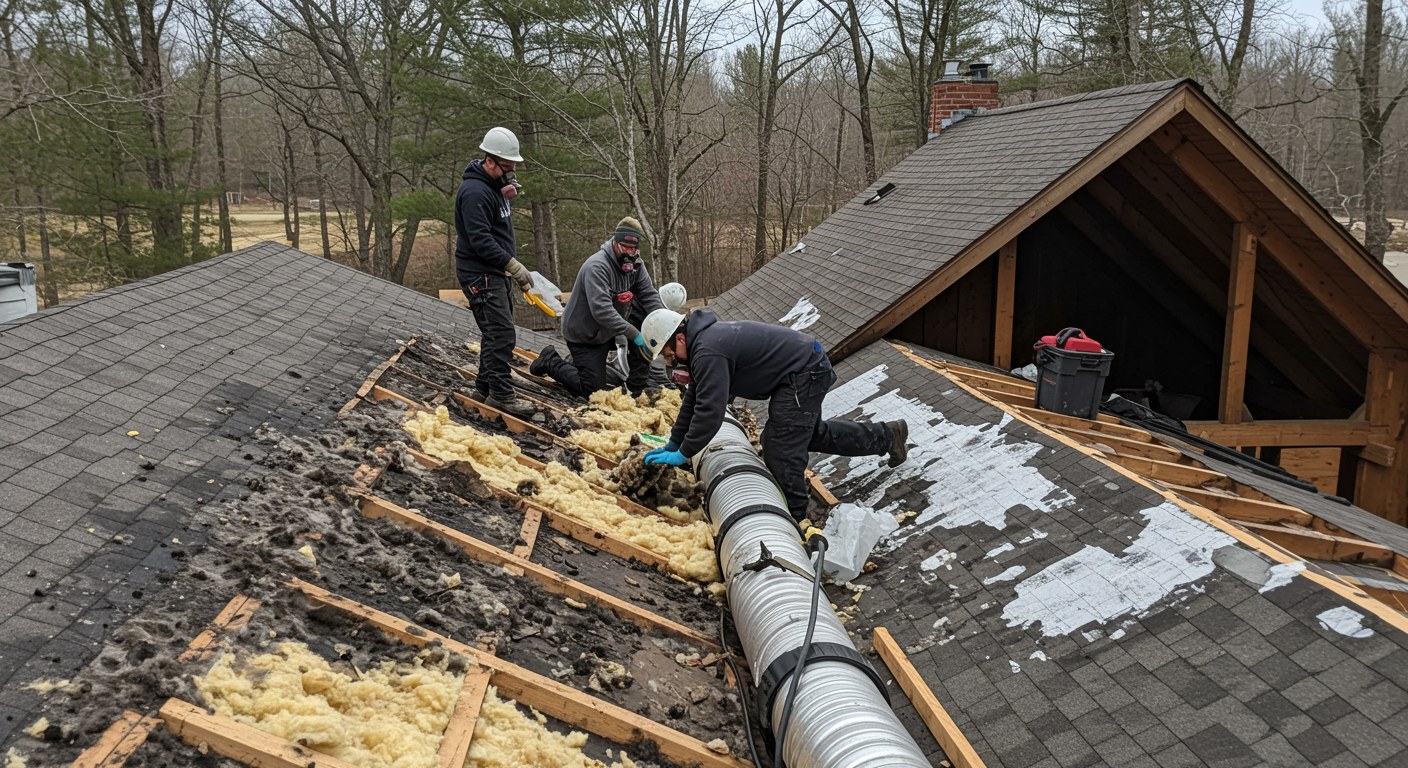
Eden Prairie’s attic insulation quality is highly variable. Homes from the 1980s and 1990s often have inadequate air sealing at the attic floor — meaning warm household air escapes into the attic, warms the roof deck from below, melts snow unevenly, and creates ice dams at the eaves. This is a well-understood mechanism. What’s less often discussed is the cumulative effect: repeated ice dam events over 20 to 30 winters, each producing some water intrusion behind the shingles, each saturating the insulation and wetting the sheathing — building toward mold in the roof assembly that’s discovered when a roofer pulls the first shingle.
Attic mold remediation in Eden Prairie homes typically involves removing affected insulation, treating the sheathing and rafters, and then addressing the underlying air sealing problem before installing new insulation. Remediating attic mold without fixing the ice dam cause will produce the same result after the next series of winter storms.
Frequently Asked Questions — Mold Remediation in Eden Prairie, MN
What makes Eden Prairie homes near Purgatory Creek prone to mold?
Properties in the Purgatory Creek corridor are in one of the more persistently moist microclimates in the western suburbs. The creek’s riparian zone maintains elevated ambient humidity, and the sandy soils that line much of the creek corridor don’t retain moisture in the same way clay soils do — but they also don’t provide the same vapor barrier effect. Homes built on or near the bluffs above Purgatory Creek have specific moisture exposure that standard suburban homes don’t have.
Why do Eden Prairie’s 1990s homes have unexpected mold issues?
Eden Prairie’s large cohort of 1990s construction used building practices that are now understood to trap moisture. Interior-insulated basement walls without drainage planes, vapor barriers installed on the warm side rather than the cold side of insulation, and inadequate attic air sealing all create conditions where moisture accumulates in wall and ceiling assemblies. These homes are now 25 to 35 years old — the age when chronic moisture issues become visible for the first time in homes that were dry for decades.
How does ice dam damage lead to mold in Eden Prairie attics?
Eden Prairie’s housing stock has highly variable attic insulation quality. In homes where attic insulation is inadequate or where air sealing at the attic floor is poor, heat escaping from the living space warms the roof deck — causing uneven snow melt, ice dam formation, and eventual water intrusion behind the shingles. This water saturates attic insulation and wets the roof sheathing. Sheathing that stays wet through repeated ice dam events develops mold — often discovered during a roof replacement years after the original events.
Does homeowners insurance cover mold in Eden Prairie attics from ice dams?
Mold in an attic resulting from a covered ice dam water damage event is typically covered under the original claim if addressed promptly. However, mold discovered years after repeated ice dam events — and attributed to long-term moisture accumulation rather than a single event — may be disputed. Prompt assessment after each ice dam event, and documentation that drying was completed appropriately, is the best protection for preserving coverage.
What is the mold remediation process for Eden Prairie homes?
Partners Restoration follows IICRC S520 for all mold remediation: full containment of the affected area, negative air pressure with HEPA filtration, removal of contaminated porous materials, disinfection of adjacent structural surfaces, and clearance testing before reconstruction. We also identify and address the underlying moisture source to prevent recurrence. We don’t close walls until clearance testing confirms the space is clean.
Mold concern in your Eden Prairie home? Contact Partners Restoration for a moisture assessment and mold inspection. Call 952.500.2426.
Also see: Mold remediation services in Eden Prairie | All restoration and remodeling services in Eden Prairie, MN | Water damage restoration in Eden Prairie
Leave A Comment