
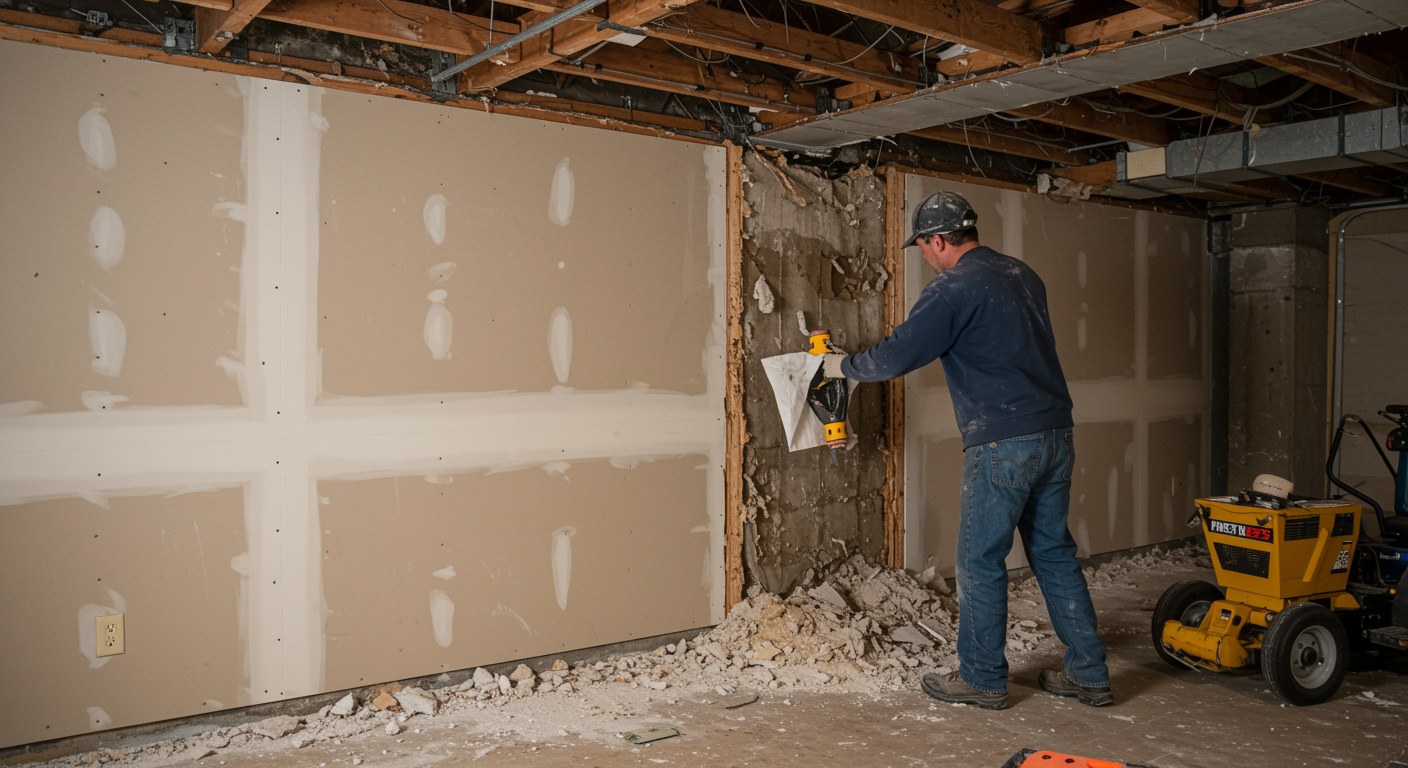
Plymouth’s mold problem has a demographic explanation: the city built tens of thousands of fully finished basements in the 1980s, and those basements are now showing the consequences of construction practices that prioritized livable space over moisture management. You’ll find mold in Plymouth basements that have never had a visible water event — because the moisture didn’t come from a leak. It came through the concrete, slowly, for decades.
The 1980s Basement Problem: Construction That Didn’t Account for Long-Term Moisture
In the 1980s residential construction era, finishing a basement meant framing 2×4 walls directly against or near concrete foundation walls, stapling fiberglass batt insulation between the studs, and hanging drywall. This approach creates warm, comfortable living space. It also creates a moisture trap.
Concrete is not a vapor barrier. All concrete foundation walls transmit moisture vapor from the surrounding soil — slowly, continuously, year-round. When that moisture vapor contacts the temperature differential between the cool concrete and the warmer interior of the wall cavity, it condenses. The condensed moisture wets the insulation, wets the framing, and wets the paper face of the drywall. Over years, this produces mold growth throughout the wall cavity — typically most heavily on the back face of the drywall, where it’s invisible until the drywall comes off.
Plymouth homeowners who are opening up a 1980s basement for a renovation often discover wall cavities with significant mold coverage that they never suspected. There’s no single event to point to, no water stain on the ceiling, no insurance claim to file. It’s 30 to 40 years of vapor transmission doing its work.
Medicine Lake and Bassett Creek: Elevated Moisture for Adjacent Neighborhoods
Plymouth’s drainage relationship with Medicine Lake and Bassett Creek creates elevated soil moisture in the neighborhoods near these water features. Properties in West Plymouth near Medicine Lake, and properties along the Bassett Creek corridor in eastern Plymouth, have higher baseline groundwater than properties on upland sites elsewhere in the city. This elevated groundwater increases the moisture vapor transmission rate through concrete foundation walls — amplifying the chronic moisture problem described above.
For homeowners near these water features, whole-home dehumidification isn’t optional — it’s the minimum baseline defense against below-grade mold. An undehumidified finished basement in a Plymouth home adjacent to a pond or creek will have relative humidity in the range where mold can establish itself during summer months, even without any water damage event.
Finding the Mold Before It Finds You: Assessment in Plymouth Homes
The most common scenario we encounter in Plymouth: a homeowner notices a musty smell in the finished basement, assumes it’s general dampness, runs a portable dehumidifier, and the smell persists. Eventually they pull a section of baseboard or remove an outlet cover and find the wall cavity is black. By the time mold is detectable by smell, it’s been growing in the cavity for years.
Professional mold assessment in Plymouth’s 1980s basements uses moisture meters calibrated for the specific wall assembly and thermal imaging to identify cold spots (moisture accumulation areas) without destructive testing. This lets us map the extent of likely mold growth before opening walls — allowing for a scoped remediation rather than a strip-and-gut approach where it isn’t necessary.
When remediation is required, the process follows IICRC S520: containment, negative air pressure with HEPA filtration, removal of contaminated materials, disinfection of adjacent structural surfaces, and clearance testing before reconstruction. We don’t close walls until clearance testing confirms the space is clean.
Rebuilding Correctly: Preventing the Same Problem from Returning
Mold remediation in a Plymouth basement without addressing the underlying moisture pathway will produce the same result again. After remediation, the correct reconstruction approach includes:
- Drainage plane against the foundation wall — dimple mat or similar product between the concrete and any insulation or framing, allowing moisture to drain down rather than accumulating in the wall cavity
- Closed-cell spray foam insulation on the concrete surface — this creates a vapor barrier at the concrete face, eliminating the temperature differential in the wall cavity that causes condensation
- Whole-home dehumidification integrated with the HVAC — maintaining 40–50% relative humidity in the basement year-round
- Moisture-resistant materials — paperless drywall, pressure-treated framing lumber, and mold-resistant insulation in any reconstructed wall assemblies
Frequently Asked Questions — Mold Remediation in Plymouth, MN
Why are 1980s Plymouth basements prone to mold?
Plymouth’s 1980s construction era built fully finished basements as standard — drywall, carpet, and wood framing directly against or near concrete foundation walls. These basements were often insulated on the interior side without a drainage plane between the concrete and the framing. Over decades, moisture from concrete and soil vapor transmission accumulates in the wall cavity, creating conditions where mold grows on the paper face of drywall and the wood framing without any specific leak event occurring.
How does Plymouth’s proximity to Medicine Lake and Bassett Creek affect mold risk?
Properties in Plymouth within the drainage area of Medicine Lake and Bassett Creek have elevated baseline groundwater and soil moisture. This elevated moisture transmits through concrete foundations and increases relative humidity in below-grade spaces. Homes near these water features that don’t have whole-home dehumidification or crawl space encapsulation are at meaningfully higher mold risk than properties on higher, well-drained ground elsewhere in Plymouth.
What does IICRC S520 mold remediation require in Plymouth homes?
IICRC S520 requires proper containment barriers, negative air pressure during removal (to prevent spreading spores to unaffected areas), PPE for technicians, removal of all mold-contaminated porous materials, disinfection of adjacent surfaces, and a clearance inspection after remediation to verify the space is clean. Partners Restoration follows S520 on every job. Without proper containment, mold remediation in a Plymouth basement wall spreads spores to the HVAC system and throughout the home.
Can I remediate mold in my Plymouth basement myself?
Small surface mold on non-porous materials can be cleaned by homeowners. Mold in building materials — drywall, insulation, wood framing — cannot be effectively cleaned and must be professionally removed. In Plymouth’s 1980s basements, mold is almost always in the wall cavity, not just on the surface. DIY cleanup of wall cavity mold without proper containment spreads contamination and leaves the underlying source unaddressed.
How much does mold remediation cost in Plymouth, MN?
Mold remediation costs vary significantly based on scope. A contained single-wall mold issue runs from a few thousand dollars for small areas to $10,000 to $20,000 for a significant basement wall section. Whole-basement mold remediation involving multiple walls, subfloor, and HVAC can exceed $30,000. We provide detailed assessments and line-item estimates before any work begins.
Concerned about mold in your Plymouth home? Contact Partners Restoration for a moisture assessment and mold inspection. Call 952.500.2426.
Also see: Mold remediation services in Plymouth | All restoration and remodeling services in Plymouth, MN | Water damage restoration in Plymouth
Leave A Comment