
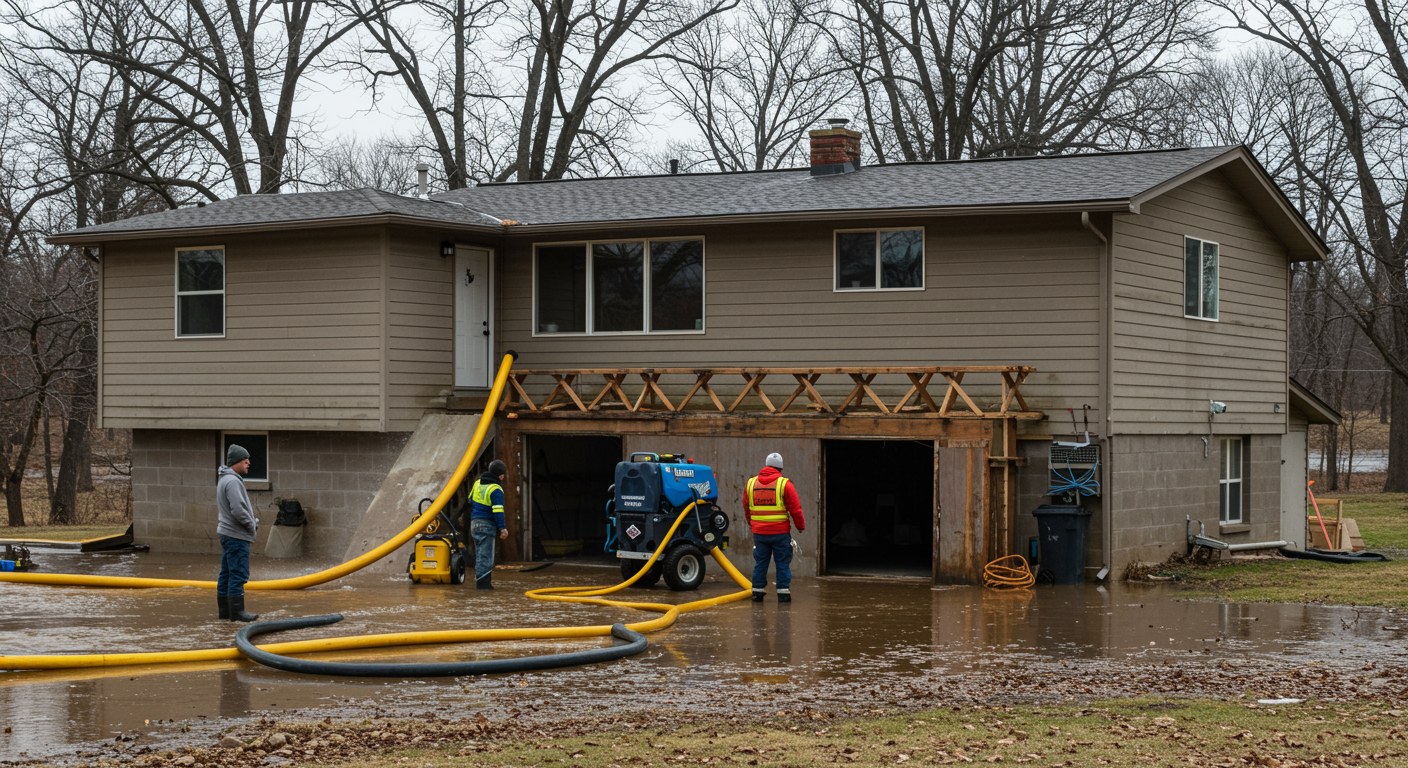
Bloomington’s relationship with water is one of the more complex in the Twin Cities metro. The city sits at the confluence of three distinct water risk systems: the Minnesota River floodplain along its southern edge, Nine Mile Creek running through its northern and central neighborhoods, and a stormwater infrastructure that was stress-tested catastrophically in 1987 and has been rebuilt and expanded since — but not infinitely. Understanding which of these affects your specific property is the starting point for understanding your actual risk.
The 1987 Event: What It Revealed About Bloomington’s Water Vulnerability
July 1987 produced one of the most severe flash flooding events in Twin Cities history. Interstate 494 in Bloomington flooded with water reported at depths that required motorists to abandon vehicles on the highway. A railroad bridge in Bloomington was washed out. Thousands of homes sustained damage and total property damage exceeded $30 million. The event lasted hours but left effects that shaped Bloomington’s stormwater planning for decades afterward.
What the 1987 event revealed was that Bloomington’s stormwater system — designed and built largely in the 1960s and 1970s to serve rapid postwar suburban growth — was not sized for extreme precipitation events. The city has invested substantially in stormwater infrastructure since then, and the 1987 event is no longer representative of the system’s capacity. But it’s a useful reference point: Bloomington’s topography, its relationship to Nine Mile Creek, and the density of impervious surface in its neighborhoods create conditions where extreme rainfall still produces significant flooding pressure even with improved infrastructure.
The Minnesota River Floodplain: Bloomington’s Southern Boundary
Bloomington’s southern edge runs along the Minnesota River Valley — one of the most significant floodplains in the Twin Cities metro. The Minnesota Valley National Wildlife Refuge occupies much of this corridor, but the transition zone between the refuge and residential Bloomington includes neighborhoods that are in or near the FEMA-mapped floodplain. Properties along Black Dog Road, near the bluffs above the valley, and in the southern residential areas closest to the river have flood exposure driven by the Minnesota River’s basin-wide conditions — not just local rainfall.
Minnesota River flooding is different from local stormwater flooding in an important way: it’s driven by conditions across the entire Minnesota River watershed, which extends hundreds of miles upstream into western Minnesota. A wet spring in the upper basin can cause the Minnesota River to rise in Bloomington days after the local weather has been dry. Homeowners near the floodplain who rely on their own property’s recent history — “we’ve never had a problem” — may not have owned the property long enough to have experienced a high-water year in the basin.
Nine Mile Creek Through Bloomington
The Nine Mile Creek Watershed District covers approximately 50 square miles across Bloomington, Edina, Hopkins, Minnetonka, and Richfield. In Bloomington, the creek runs through the northern and central portions of the city. Creek conditions in Bloomington are influenced by what happens upstream in Edina and Minnetonka — heavy rain in those communities can raise Nine Mile Creek levels in Bloomington hours later.
Residential properties within several blocks of the Nine Mile Creek corridor in Bloomington have flood exposure from two directions: direct overflow during high creek events, and groundwater seepage when the creek is running high and the surrounding water table rises with it. The second mechanism — groundwater seepage rather than surface flooding — is often missed in standard flood risk assessments because it doesn’t show up the same way on FEMA maps.
Bloomington’s Housing Stock: A City Built in the Postwar Boom
Bloomington grew faster than almost any US city in the 1950s and 1960s — from a small farming community to a major suburb in under two decades. The housing stock reflects this: a large portion of Bloomington’s single-family homes were built between 1955 and 1975. That cohort now has plumbing, sump systems, and foundations that are 50 to 70 years old.
Galvanized steel supply pipes from the 1950s and 1960s — common in this era’s construction — have a design life that has been exceeded. Internal corrosion in these pipes reduces water pressure, discolors water, and creates failure points at fittings and joints. When they go, they go suddenly. Cast iron drain lines from the same era are prone to joint deterioration and root intrusion. Original sump pump configurations in many Bloomington homes are single-pump systems with no backup — a configuration that works until it doesn’t.
Bloomington also has a significant commercial and multi-family sector — Mall of America, the airport corridor, and extensive commercial development along 494. Water damage in commercial and multi-family properties follows different patterns than residential, and Partners Restoration handles large-loss commercial restoration as well as residential work.
Frequently Asked Questions — Water Damage Restoration in Bloomington, MN
Does the Minnesota River affect flood risk for Bloomington homes?
Bloomington’s southern boundary is the Minnesota River floodplain. Properties in the southern portion of the city — particularly near Black Dog Road, the Minnesota Valley National Wildlife Refuge corridor, and neighborhoods developed close to the bluffs — are in or near the FEMA-mapped floodplain. Flooding from the Minnesota River is distinct from local stormwater flooding: it’s driven by watershed-wide conditions across the Minnesota River basin, not just by Bloomington’s own rainfall.
What happened to Bloomington in the 1987 flash flood?
In July 1987, an extreme flash flood event produced flooding across the Twin Cities metro. In Bloomington, Interstate 494 flooded with water reported up to 8 feet deep in some locations, a railroad bridge was washed out, and thousands of homes sustained damage — with total property damage exceeding $30 million in the affected area. The event demonstrated Bloomington’s vulnerability to extreme precipitation events and the limits of the stormwater infrastructure that was in place.
How does Nine Mile Creek affect water damage risk in Bloomington?
Nine Mile Creek runs through the northern and central portions of Bloomington as part of the Nine Mile Creek Watershed District, which covers approximately 50 square miles across Bloomington, Edina, Hopkins, Minnetonka, and Richfield. Creek levels in Bloomington can be affected by conditions throughout the watershed — heavy rain in Minnetonka or Edina can raise Nine Mile Creek levels in Bloomington hours after the rain has stopped upstream.
What are the most common water damage causes in Bloomington’s 1960s and 1970s homes?
Bloomington has a large cohort of homes built in the 1960s and 1970s that are now reaching critical infrastructure age. Original galvanized steel supply pipes are at or past design life. Cast iron drain lines in this era are prone to joint failure and root intrusion. Original sump pump configurations — many with undersized pits and no battery backup — are a significant risk. And original attic insulation in this era is typically inadequate by modern standards, creating ice dam vulnerability every winter.
Should Bloomington homeowners near the Minnesota River buy flood insurance?
Properties within the FEMA-mapped 100-year floodplain in Bloomington are required by most mortgage lenders to carry flood insurance. But the 2020 First Street Foundation flood risk mapping identified many more properties at meaningful flood risk than FEMA’s maps show — particularly in areas with low-lying topography that doesn’t obviously connect to named water bodies. If your Bloomington property is near any body of water or in a topographic depression, reviewing your actual flood risk rather than assuming FEMA’s map is complete is worthwhile.
Water damage in Bloomington? Contact Partners Restoration for emergency response or an assessment. We answer 24/7 at 952.500.2426.
Also see: Water damage restoration services in Bloomington | All restoration and remodeling services in Bloomington, MN | Insurance claims help
Leave A Comment