
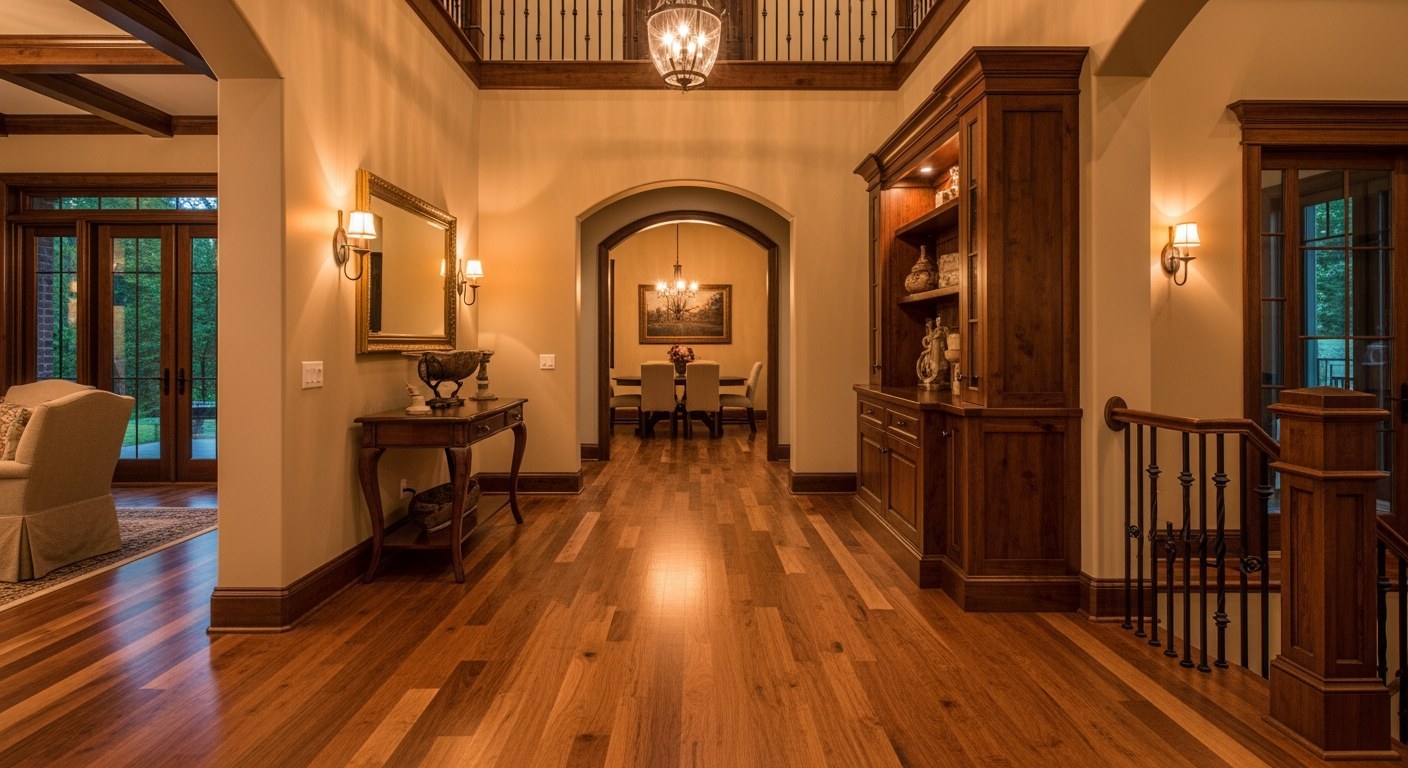
Replacing floors in the Twin Cities western suburbs is a different project than flooring work in warmer climates. Minnesota homes cycle through extreme humidity swings — from dry winter air that shrinks wood to humid summer conditions that cause expansion. A flooring contractor who understands those dynamics installs products that move with the house rather than buckle against it.
Partners Restoration serves Medina, Plymouth, Wayzata, Minnetonka, Orono, Maple Grove, Long Lake, and Rogers. Our flooring crews have installed hardwood, engineered wood, luxury vinyl plank, tile, and carpet in hundreds of homes throughout Hennepin County and the western suburbs. This guide covers what to expect from the process, which materials hold up best in Minnesota homes, and how to choose the right contractor for your project.
Why Minnesota Climate Demands a Specialist Flooring Contractor
Wood is a hygroscopic material — it absorbs and releases moisture in response to ambient humidity. In Minnesota, interior relative humidity commonly swings dramatically from bone-dry winter conditions (when heating systems run continuously) to high summer humidity. That range causes solid hardwood to contract and expand by measurable amounts across the width of each plank.
A contractor who does not account for this will install hardwood without adequate expansion gaps, skip the acclimation period, or use interior-grade adhesives unsuitable for our temperature extremes. The result: gapping in winter, cupping or buckling in summer, and squeaky subfloors year-round.
The right flooring contractor for a Medina or Wayzata home will specify and test subfloor moisture levels before installation begins, allow solid hardwood to acclimate on-site for the manufacturer-specified period, leave correct expansion gaps at walls and fixed objects, recommend species and products rated for Minnesota humidity range, and use moisture barriers or vapor retarders on slab-on-grade and basement installations.
Flooring Types Available in the Minneapolis Area
Solid Hardwood Flooring
Solid hardwood — milled from a single piece of wood — is the most traditional choice for main-level living areas in Minnesota homes. Common species include red oak, white oak, hard maple, and American walnut. Each behaves differently in our climate: oak is forgiving with humidity swings; maple is harder but more prone to checking if moisture changes are abrupt; walnut is dimensionally stable but shows scratches more readily than oak.
Solid hardwood can be sanded and refinished multiple times over a home life, making it a long-term value in Orono or Minnetonka homes where resale quality matters. It is not appropriate for below-grade installations or areas with persistent moisture exposure.
Engineered Hardwood Flooring
Engineered hardwood uses a real wood veneer bonded over multiple cross-ply wood layers. The cross-ply construction resists dimensional movement, making engineered products significantly more stable than solid hardwood in Minnesota humidity swings. Engineered hardwood can be installed on, above, or below grade — including basements — and over radiant heat systems common in western suburban homes.
Quality engineered products carry a veneer thick enough for at least one refinishing. Lower-quality engineered floors have thin veneers that wear through before the floor has reached end of life, so species selection and veneer thickness matter when comparing products.
Luxury Vinyl Plank (LVP)
Luxury vinyl plank has become the dominant choice for kitchen, bathroom, mudroom, and basement installations in western suburban homes. It is fully waterproof, dimensionally stable, and tolerant of the subfloor imperfections common in older Minneapolis-area homes. High-end LVP products replicate the look of hardwood convincingly enough that many homeowners choose them for main living areas as well.
Modern LVP is a multi-layer product with a rigid core, a photographic layer, a wear layer rated in mil thickness, and an attached underlayment. Wear layer thickness matters: lighter residential products are appropriate for low-traffic areas, while thicker commercial-grade wear layers handle high-traffic areas and households with pets.
Ceramic and Porcelain Tile
Tile remains the standard for bathrooms, entryways, laundry rooms, and mudrooms throughout the western suburbs. Porcelain is denser and less porous than ceramic, making it better suited for wet areas and high-traffic zones. For heated floors — a common upgrade in Minnesota bathrooms — the contractor must use a membrane-backed installation system designed for in-floor heating rather than standard thinset mortar.
Large-format tile requires a particularly flat subfloor. Any flex or deviation produces hollow spots and potential cracking. Proper substrate preparation is the most important factor in tile longevity.
Carpet
Carpet remains popular in bedrooms, home offices, and lower-level recreation rooms throughout the western suburbs. Modern carpet products offer improved stain resistance and durability compared to older generations. Fiber type — nylon, polyester, or wool — and pile construction determine appearance, durability, and maintenance requirements.
The Flooring Installation Process in Minnesota Homes
Step 1: Site Assessment and Moisture Testing
Before any product is specified, the contractor assesses the subfloor condition and tests moisture levels. In Minnesota homes, concrete slabs commonly retain moisture from spring snowmelt and summer humidity. Wood subfloors in older Medina and Plymouth homes may have deflection, squeaks, or previous damage that must be addressed before new flooring goes down. Moisture readings above accepted thresholds require mitigation — whether a vapor barrier, additional dry time, or a moisture-tolerant product selection.
Step 2: Product Selection and Ordering
Product selection should account for the room function, subfloor type, installation method (nail-down, glue-down, or floating), and the home existing aesthetic. Materials are ordered with appropriate overage — typically additional square footage beyond the measured area — to account for cuts, pattern matching, and future repair pieces. Skimping on overage creates problems when a damaged plank needs replacement years later and the product has been discontinued.
Step 3: Subfloor Preparation
This is the step that separates quality installations from callbacks. Subfloor preparation includes removing existing flooring and adhesive residue, checking and correcting flatness across the field, securing any loose areas, and applying appropriate primers or moisture mitigation products. For hardwood nail-down installations, the subfloor must be structurally sound enough to hold fasteners.
Step 4: Acclimation
Solid hardwood and some engineered products must acclimate to the home temperature and humidity before installation. This means storing the product in the installation space for a period specified by the manufacturer — typically several days to over a week depending on the product and conditions. Skipping acclimation is one of the most common causes of post-installation movement and failure in Minnesota homes.
Step 5: Installation
Installation method depends on product and subfloor. Solid hardwood over wood subfloor is typically nailed or stapled. Engineered hardwood may be glued, floated, or nailed depending on the product specification. LVP is typically floated or glued. The installer manages direction (usually parallel to the longest wall or to incoming natural light), expansion gaps, transitions between rooms, and trim at doorways and thresholds.
Step 6: Finishing (for site-finished hardwood)
Site-finished hardwood is sanded smooth after installation, then stained if desired and finished with polyurethane or oil-based hardener. This produces a seamless result because the finish bridges the seams between boards. Pre-finished hardwood (factory-finished) skips this step but has slightly visible beveled edges between planks. Both approaches are used in western suburban homes; the choice depends on preference, timeline, and budget.
Flooring and Property Damage Restoration
Partners Restoration flooring expertise extends beyond new installations. Water damage, fire and smoke damage, and structural repairs frequently require partial or complete floor replacement as part of the restoration process. Our team coordinates flooring scope within the broader restoration project — ensuring the replacement product matches the existing floor where possible, or helping homeowners select an upgrade when it makes sense.
Insurance-covered flooring replacement requires documentation, material matching, and scope coordination with the adjuster. Our restoration background means we understand that process from the inside, which simplifies the project for homeowners in Maple Grove, Long Lake, and surrounding communities dealing with an insurance claim.
Choosing a Flooring Contractor in the Minneapolis Western Suburbs
Minnesota requires contractors performing flooring installation to hold a valid contractor license. Ask any flooring contractor you consider for their license number and verify it through the Minnesota Department of Labor and Industry. Unlicensed flooring work can create problems with homeowner insurance, permits, and resale.
Beyond licensing, look for contractors who perform their own installation rather than subcontracting all labor, who offer a written warranty on labor separate from the product manufacturer warranty, and who can provide references from projects in your area. A contractor familiar with the specific home styles, subfloor conditions, and building codes of Hennepin County will produce better results than a lower-cost operator who does not know the market.
Frequently Asked Questions About Flooring Contractors in Minneapolis
How long does flooring installation take in a typical Minneapolis home?
A single room takes one to two days for most flooring types, including subfloor preparation. A whole-home flooring project covering multiple rooms typically takes three to seven days depending on scope, product type, and whether site-finishing is involved. Hardwood site-finishing adds time because each coat must cure before the next is applied.
What is the best flooring for a Minnesota basement?
Luxury vinyl plank is generally the best choice for Minnesota basements because it is fully waterproof, handles temperature fluctuations well, and performs over concrete without requiring the extensive moisture mitigation that wood products demand. Engineered hardwood over a moisture barrier is a second option. Carpet should be avoided in basements with any history of water intrusion.
How much does new flooring cost in the Minneapolis area?
Flooring costs vary widely by product and installation complexity. Luxury vinyl plank with standard installation is generally the most affordable option. Engineered hardwood runs higher, and solid hardwood with site-finishing is typically the most expensive per square foot. Tile cost depends heavily on the tile selected and the complexity of the layout. A detailed quote from a licensed contractor after a site visit is the most accurate way to budget your specific project.
Can flooring be installed over existing flooring?
In some cases floating LVP or engineered hardwood can be installed over existing flooring if the height difference at transitions is manageable and the existing floor is flat and stable. However, installing over existing material adds height, can create transition problems at doorways, and may hide subfloor issues that should be addressed. Most quality installations start with a clean subfloor.
Does flooring replacement require a permit in Medina or Plymouth?
Standard flooring replacement does not typically require a permit in Medina, Plymouth, or other Hennepin County communities. However, structural subfloor repairs or work associated with a water damage claim may involve permit requirements depending on scope. Your contractor should be familiar with local requirements and advise accordingly.
Leave A Comment