
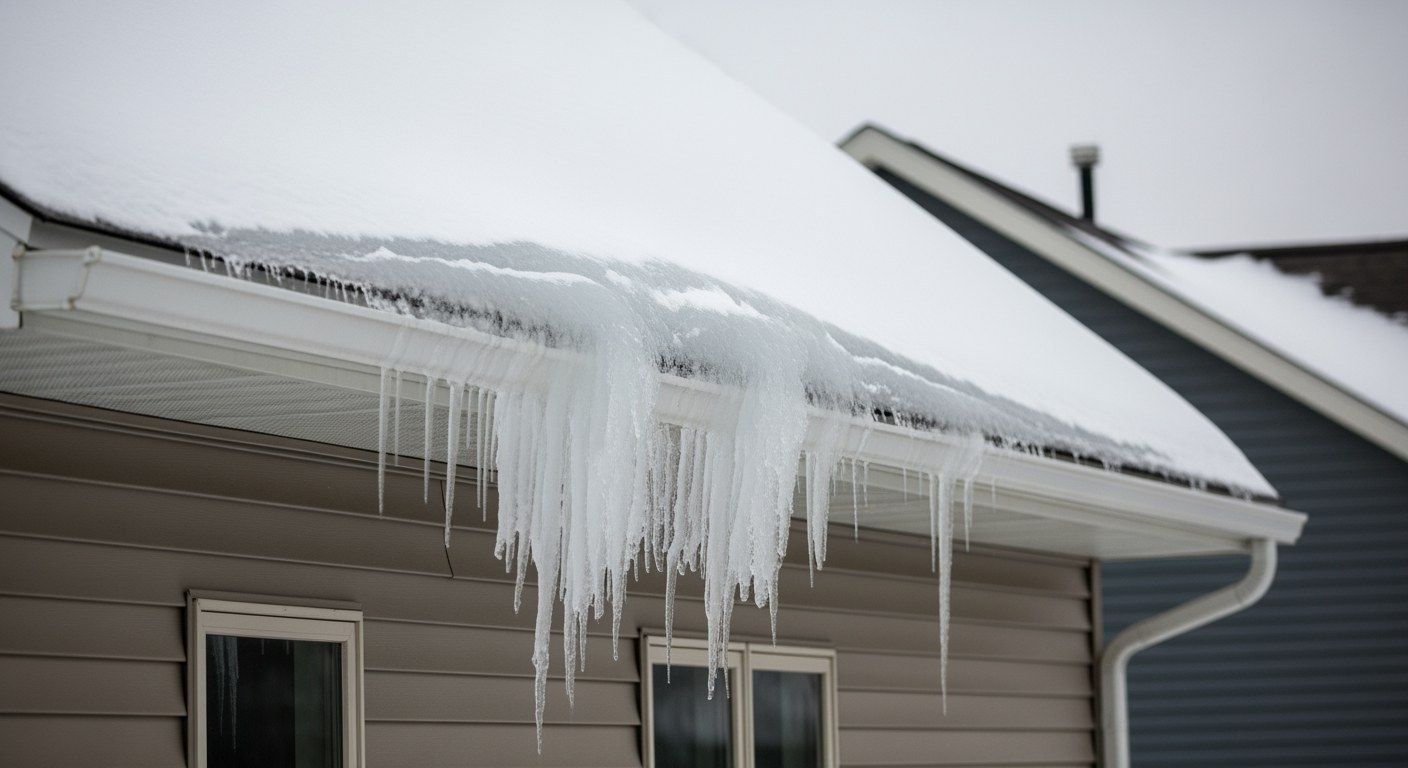
Ice dam damage occurs when ice accumulation at the eave of a roof forces meltwater to back up under shingles and infiltrate the roof assembly, wall cavities, and ceiling spaces below. Ice dams are a function of heat loss through the roof deck — warm air escaping from the living space melts snow on the upper roof, which runs down to the cold eave and refreezes. The resulting ice ridge blocks drainage and converts every subsequent melt event into interior water infiltration.
Partners Restoration provides ice dam damage assessment and interior restoration across the Minneapolis western suburbs — Medina, Wayzata, Minnetonka, Orono, Deephaven, Excelsior, and surrounding lake communities. Ice dam water damage is covered by most Minnesota homeowner policies as a sudden and accidental loss. Call 952.500.2426 for 24/7 emergency response. Our ice dam work connects to our full water damage restoration Minneapolis services.
Why Ice Dams Form on Minnesota Homes
The physics of ice dam formation require three conditions: snow on the roof, a roof deck temperature above 32°F in the upper section, and a roof deck temperature below 32°F at the eave. All three conditions are routinely present in Minnesota winters, particularly in homes with: inadequate attic insulation (below R-49, which is the current Minnesota code minimum for attic insulation), insufficient attic ventilation that allows warm air to stratify against the roof deck, air leaks from the conditioned space into the attic at penetrations, and complex roof geometries with valleys and dormers that create cold spots where ice accumulates.
Lake area homes in Wayzata, Orono, and Deephaven — with their frequently complex rooflines, dormers, and large overhangs — are disproportionately affected by ice dam damage. These architectural features create the cold spots and irregular drainage paths where ice preferentially accumulates.
What Ice Dam Water Damage Looks Like Inside
Ice dam water infiltration is deceptive because interior symptoms typically appear weeks after the infiltration event — after temperatures warm enough for water to migrate through saturated insulation and appear at the drywall face. By the time you see a brown ceiling stain or bubbling paint, the roof assembly above has typically been wet for an extended period.
Common interior presentations of ice dam water damage:
- Brown or yellow staining on ceilings at the eave line — often in the upper corners of rooms adjacent to exterior walls
- Paint bubbling or peeling on interior walls at the top of the wall, just below the ceiling
- Saturated or collapsed insulation visible when the ceiling or wall is opened
- Visible mold growth on wall or ceiling surfaces — typically appearing in spring, months after the ice dam winter event
- Warped or buckling hardwood flooring in upper-floor rooms adjacent to eave lines
- Interior wall staining that tracks downward from the ceiling — indicating water that migrated through wall insulation and is now running inside the wall cavity
Ice Dam Damage Restoration
Assessment and moisture mapping
Our inspector uses thermal imaging in addition to pin-type and pinless moisture meters to map ice dam water infiltration. Thermal imaging reveals temperature differentials that indicate wet insulation and saturated wall assemblies — including areas not yet visible at the surface. This is particularly important with ice dam damage because the true scope routinely extends significantly beyond the visible stain.
Controlled opening and drying
Saturated drywall and insulation at the eave line and in affected wall assemblies are removed under controlled conditions. Structural framing — typically the top plate, rafter tails, and any blocking at the eave — is inspected for moisture content and mold growth. Drying equipment is positioned to dry the exposed framing to IICRC S500 dry standard before reconstruction begins. Drying documentation is provided for the insurance claim.
Mold assessment
Ice dam water damage that was not discovered promptly — which is typical, since interior symptoms appear weeks after the event — frequently involves mold growth in the saturated wall and ceiling assemblies. When mold is present, remediation follows IICRC S520 standards before reconstruction proceeds. Partners coordinates mold remediation and reconstruction under a single scope, eliminating the coordination gap between separate contractors.
Reconstruction
New insulation — to current Minnesota code minimum R-49 in the attic and appropriate R-values in wall assemblies — is installed. New drywall is hung, finished, and painted to match. Air sealing at penetrations is addressed as part of the reconstruction to reduce the likelihood of future ice dam formation. For the best long-term outcome, we recommend a thermal envelope assessment by a Building Performance Institute (BPI) certified energy auditor to identify and correct the attic air leakage and insulation deficiencies that created the ice dam conditions.
Ice Dam Damage Insurance Claims
Ice dam water infiltration is covered as a sudden and accidental event under most standard Minnesota homeowner policies. The ice dam removal itself — steam removal or manual removal of ice from the roof — is sometimes covered as a preventive measure to limit further damage; ask your carrier before authorizing removal work. Document interior damage thoroughly before any repairs begin, and contact your carrier promptly — most policies require prompt reporting of covered losses.
Frequently Asked Questions
How do I prevent ice dams?
The permanent solution to ice dams is addressing the roof heat loss that causes them — increasing attic insulation to R-49 minimum, sealing air leaks at attic penetrations (electrical boxes, plumbing vents, HVAC chases), and ensuring balanced attic ventilation. These measures keep the entire roof deck cold, preventing the differential melting that creates ice dams. Roof rakes that remove snow from the eave after storms are a short-term mitigation measure but do not address the underlying heat loss.
Should I use heat cables to prevent ice dams?
Heat cables (self-regulating electric resistance cables installed at the eave) prevent ice dams at the treated zone but do not address the heat loss causing them — and they consume significant electricity during every cold period. They are appropriate as a temporary or supplemental measure for specific problem areas while thermal envelope improvements are planned, but are not a substitute for proper insulation and air sealing.
My ice dam damage appeared in spring — is it still covered?
Yes, in most cases. Ice dam damage that appears in spring as mold growth or ceiling staining from a winter ice dam event is still covered as the ice dam loss — the manifestation of damage is delayed, not the event itself. Document the damage and report to your carrier. The claim is for the original winter ice dam event, not a new loss. Some carriers require a weather verification letter confirming ice dam conditions existed at your location on specific dates.
Leave A Comment