
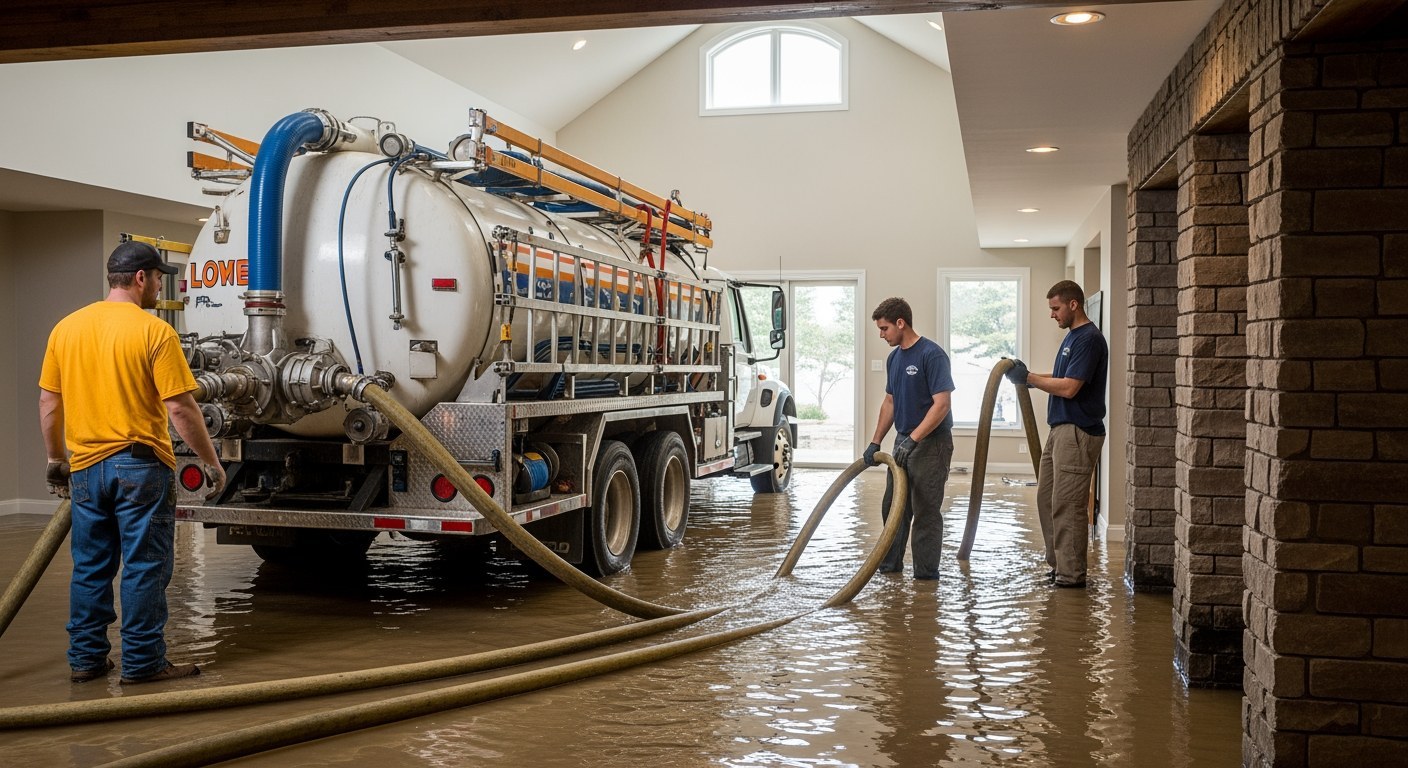
Basement flooding cleanup involves the professional extraction of standing water, structural drying of the below-grade environment, decontamination when sewage or groundwater is involved, and restoration of finished and unfinished basement spaces. In Minnesota, basement flooding is one of the most common and most costly residential water losses — driven by sump pump failure, municipal sewer backup, surface water intrusion, and window well overflow during heavy rainfall events.
Partners Restoration handles basement flooding cleanup across the Minneapolis western suburbs as part of our comprehensive water damage restoration Minneapolis services. We deploy 24/7 for emergency extraction, provide full structural drying documentation, and manage the reconstruction of finished lower levels — from framing and drywall through flooring, millwork, and mechanical systems.
Causes of Basement Flooding in Minnesota
Sump pump failure is the leading cause of basement flooding claims in the Twin Cities metro. Sump pumps fail for several reasons: power outages during the storms that generate the most runoff, mechanical failure of the pump itself, stuck float switches, and overwhelmed pump capacity during extreme rainfall events. Battery backup sump systems significantly reduce risk but are not universally installed in the western suburbs. If your home has a finished lower level and no battery backup sump system, the addition cost ($300–$800 installed) is negligible compared to the average basement flooding claim.
Municipal sewer backup occurs when combined or sanitary sewer systems become overwhelmed during heavy rainfall and sewage flows backward through the home’s floor drain or basement toilet. This is a Category 3 (sewage-contaminated) loss requiring full hazmat protocols, disposal of all porous materials that contacted sewage, and full antimicrobial decontamination of hard surfaces. Sewer backup coverage is an endorsement — not a standard provision — on most Minnesota homeowner policies. Check your declarations page.
Surface water intrusion enters through window wells, foundation cracks, and improperly graded lots where surface water drains toward rather than away from the foundation. The Minneapolis metro’s glacial lake bed soils have high water-holding capacity — during heavy rain events, saturated soils create lateral pressure against foundation walls that exceeds what window well drains and perimeter drainage can handle.
Water Categories and Why They Matter
IICRC S500 defines three water categories that determine the scope and cost of restoration. Category 1 (clean water — pipe breaks, appliance supply lines) can be dried and restored with limited material removal. Category 2 (gray water — washing machine discharge, toilet overflow without solids, dishwasher discharge) requires more aggressive removal of porous materials and antimicrobial treatment. Category 3 (black water — sewage backup, groundwater, rising floodwater) requires full disposal of all porous materials that contacted the water — drywall, insulation, carpet, wood flooring — and full decontamination of hard surfaces. Attempting to dry and retain Category 3-contacted porous materials creates unacceptable health hazards.
Basement flooding from a sump pump failure during a rainfall event is typically Category 2 — groundwater and surface water are not potable but do not contain raw sewage. Basement flooding from a floor drain backup during a storm sewer event is Category 3 regardless of appearance.
The Basement Flooding Restoration Process
Emergency extraction
Truck-mounted extraction units remove standing water rapidly. For a finished 1,000 sq ft basement with 4 inches of standing water (approximately 2,500 gallons), extraction typically takes 2–4 hours. Submersible pumps are deployed first for high-volume extraction, followed by wet vacuuming to remove residual water from flooring and low points.
Selective demolition
Saturated drywall is cut at flood-cut height — typically 12–24 inches above the water line to ensure all wet material is removed. Carpet and pad are removed and disposed of. Insulation in exterior walls is removed and replaced. This controlled demolition exposes the structural framing for drying and allows visual inspection of the foundation wall and any moisture intrusion points.
Structural drying
LGR dehumidifiers and air movers create the controlled drying environment required to dry concrete slab, framing, and any remaining materials to IICRC dry standard. Below-grade environments are more challenging to dry than above-grade — concrete slab and masonry foundation walls absorb and release moisture slowly, and the below-grade temperature differential creates ongoing condensation potential. Drying a finished basement typically takes 5–7 days, longer than above-grade losses of comparable scope.
Reconstruction
Finished basement reconstruction — framing, drywall, insulation, flooring, millwork, doors, and mechanical rough-ins — is handled in-house by Partners. For high-value lower levels with home theaters, wet bars, wine rooms, and custom built-ins, we restore to pre-loss specification. We use moisture-resistant building materials in below-grade reconstruction — paperless drywall, moisture-resistant insulation, and flooring rated for below-grade installation — to reduce the risk and severity of future flooding events.
Frequently Asked Questions
Does homeowner insurance cover basement flooding from sump pump failure?
Coverage depends on your policy. Some standard homeowner policies cover sump pump failure as a sudden and accidental event. Others exclude it or require a separate sewer and water backup endorsement. Review your declarations page before an event — this is a common coverage gap in Minnesota homeowner policies. The endorsement typically costs $50–$200 per year and is strongly recommended for any home with a finished basement.
How quickly does mold grow in a flooded basement?
Mold colonization can begin within 24–48 hours in a flooded basement. Below-grade environments have naturally higher humidity and lower airflow than above-grade spaces, which accelerates mold growth conditions. Professional extraction and drying must begin as quickly as possible — ideally within 24 hours of the flooding event — to minimize mold risk and material loss.
Can LVP (luxury vinyl plank) flooring in a basement be saved after flooding?
LVP flooring is more water-resistant than hardwood or carpet but is not waterproof at the installation level — particularly floating installations where water migrates under the planks and saturates the underlayment and subfloor. The planks themselves may be salvageable if dried and reinstalled, but the underlayment must be replaced and the concrete subfloor must dry to standard before reinstallation. Glue-down LVP has better flood recovery prospects than floating installations.
Leave A Comment