
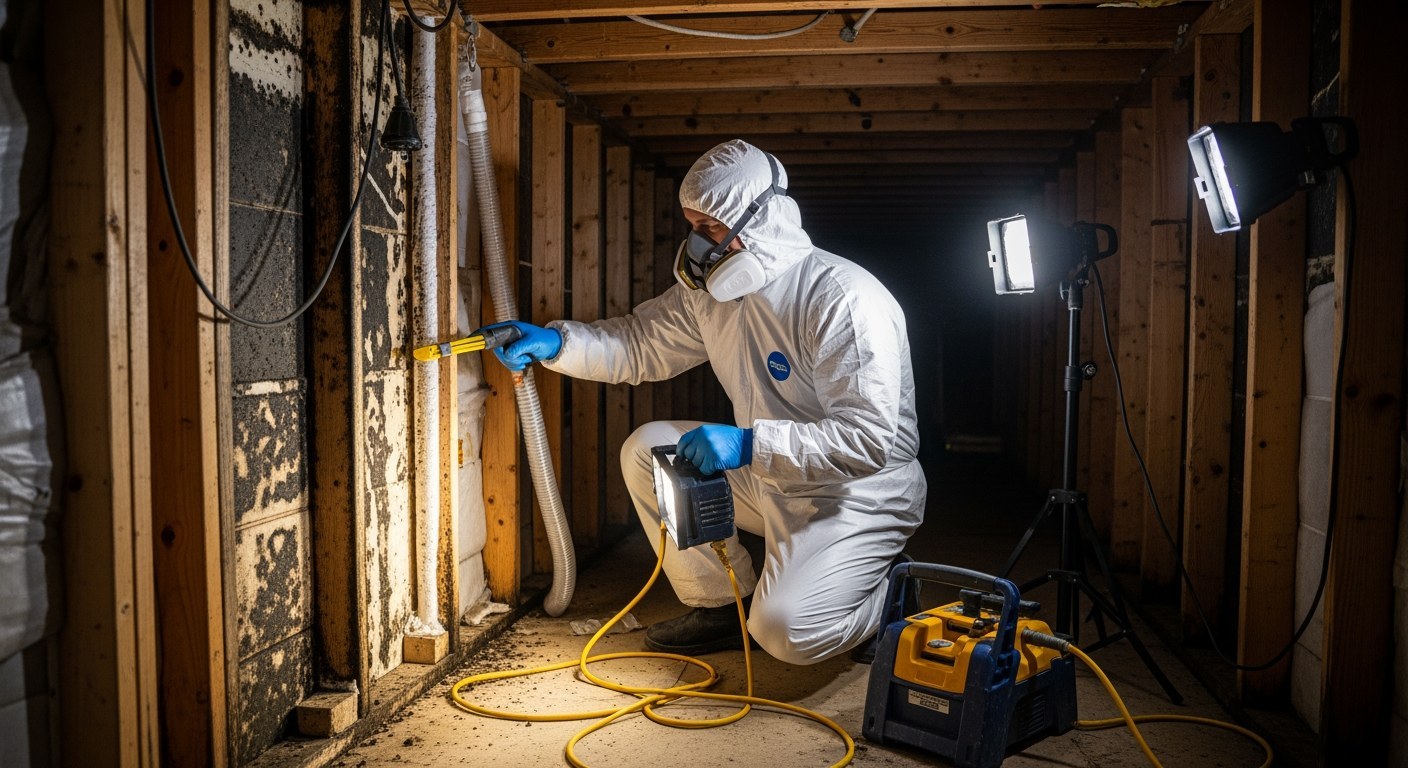
Crawl space mold remediation is the professional treatment of mold growth in the below-grade structural space beneath a home — typically affecting wood framing, subfloor decking, rim joists, and support posts. Crawl space mold in Minnesota is overwhelmingly caused by vented crawl space design that allows warm, humid summer air to contact cold structural surfaces and condense. Remediation without converting to a conditioned or encapsulated crawl space almost always results in recurrence.
Partners Restoration remediates crawl space mold across the Minneapolis western suburbs. Our scope includes full IICRC S520-compliant mold removal, structural wood treatment, encapsulation recommendations, and post-remediation coordination with independent clearance testing. This service is part of our comprehensive mold remediation Minneapolis program.
Why Minnesota Crawl Spaces Develop Mold
Vented crawl spaces were designed to prevent moisture buildup by allowing air circulation — a logic that works in dry climates but fails in the Upper Midwest. Minnesota summers bring extended periods of dew points above 60°F. When this warm, humid outdoor air enters a vented crawl space through foundation vents, it contacts the cooler soil, concrete walls, and wood framing — all of which are below the dew point of the incoming air. Condensation forms on every cold surface. This condensation, in combination with the organic food source of wood framing and subfloor decking, creates ideal conditions for mold growth.
The Building Science Corporation and the U.S. Department of Energy have documented that vented crawl spaces in cold-humid and mixed-humid climates consistently perform worse than sealed, conditioned crawl spaces for both moisture control and energy efficiency. In Minnesota, this is not a marginal issue — it is the structural cause of the majority of crawl space mold problems we remediate.
What Crawl Space Mold Remediation Involves
Containment and access
Technicians in full Tyvek suits, gloves, and P100 respirators establish containment at the crawl space access point. Negative air pressure with HEPA-filtered exhaust prevents cross-contamination of the living space above during remediation. Depending on the extent of growth, containment may also be established within the crawl space to isolate the worst-affected areas from the rest of the structure.
HEPA vacuuming and physical removal
Visible mold colonies on wood framing are HEPA-vacuumed to capture loose spores before disturbing the growth. Wire brushing or sanding removes surface colonization from wood framing when growth has not penetrated deeply into the wood. Heavily colonized material that cannot be cleaned — typically subfloor decking with penetrating growth or structural damage — is removed and disposed of in sealed bags.
Biocide treatment and encapsulation
After physical removal, all treated framing surfaces are coated with EPA-registered biocide (typically borate-based for wood treatment) and then sealed with antimicrobial encapsulant. The encapsulant covers any remaining mold hyphae that may be present below the surface and provides a treated barrier that inhibits future growth. We use white encapsulant on visible framing surfaces so any future mold growth — if the moisture source is not corrected — will be visible during inspections.
Vapor barrier installation or upgrade
A 20-mil reinforced poly vapor barrier installed over the crawl space floor — sealed to walls and piers, with seams overlapped and taped — is the minimum moisture control upgrade that should accompany any crawl space mold remediation. Without it, soil moisture continues to evaporate into the crawl space and sustain elevated humidity. The vapor barrier alone will not prevent recurrence in a vented crawl space in Minnesota’s climate — but it is a necessary component of any lasting solution.
The Permanent Solution: Crawl Space Encapsulation
Crawl space encapsulation converts a vented crawl space to a sealed, conditioned space by sealing all foundation vents, installing a continuous vapor barrier across floor and walls, and conditioning the space either by supplying conditioned air from the HVAC system or by installing a dedicated crawl space dehumidifier. This approach eliminates the humidity source that causes mold growth in the first place.
Encapsulation is not required for mold remediation — but it is the recommendation Partners makes after every crawl space remediation in Minnesota because vented crawl spaces will consistently redevelop mold conditions. The encapsulation cost is sometimes covered in part under a homeowner insurance claim when mold resulted from a covered water intrusion event. We document the causal relationship to support this coverage argument when applicable.
Post-Remediation Clearance
After remediation, an independent industrial hygienist or certified mold inspector performs clearance testing — typically air sampling inside the crawl space and at the crawl space access point — to confirm that spore counts have returned to levels consistent with the outdoor baseline. Partners does not perform its own clearance testing; independent verification protects the homeowner and validates the work for insurance documentation and future property disclosure.
Frequently Asked Questions
How do I know if I have mold in my crawl space?
Musty odor in the first floor of the home — particularly in rooms with floor registers — is the most common indicator. Mold spores from the crawl space migrate into the living space through floor penetrations and HVAC returns. Direct inspection with a flashlight through the access hatch reveals visible growth on framing as gray, white, or black fuzzy or powdery colonies. Any visible growth should be professionally assessed.
Is crawl space mold covered by homeowner insurance?
Crawl space mold resulting from a covered water intrusion event — a burst pipe, plumbing failure, or flooding from a storm drain backup — is typically covered. Mold resulting from chronic moisture conditions in a vented crawl space — the most common scenario — is generally considered a maintenance issue and not covered. Some carriers will cover remediation and encapsulation when the mold is documented as resulting from a sudden event. Partners works with your adjuster to document the causal chain when a covered loss is involved.
How long does crawl space mold remediation take?
Most crawl space mold remediations take 1–2 days for a single-family home crawl space. Larger crawl spaces with extensive growth, heavily colonized structural members requiring replacement, or vapor barrier installation as part of the scope may take 2–3 days. Post-remediation clearance testing results are available within 24–48 hours of sampling by the independent tester.
Leave A Comment