Hardwood floor water damage occurs when water penetrates solid or engineered hardwood, causing the wood cells to absorb moisture and expand. The result — cupping, crowning, buckling, or warping — ranges from cosmetic to structural depending on the species, construction type, finish, subfloor conditions, and how quickly professional drying was initiated. Not all water-damaged hardwood requires replacement.
Partners Restoration evaluates and restores hardwood floors damaged by water across the Minneapolis western suburbs — Wayzata, Minnetonka, Orono, Medina, Plymouth, Eden Prairie, and Edina. Our assessment determines whether drying in place and refinishing can restore the floor, or whether replacement is required. We handle both, and we document our findings for your insurance claim. This assessment is part of our comprehensive water damage restoration Minneapolis service.
What Happens to Hardwood When It Gets Wet?
Wood is a hygroscopic material — it absorbs and releases moisture in response to its environment. When hardwood flooring is exposed to standing water or sustained elevated humidity, the wood cells absorb moisture and expand across the grain. Because the boards are constrained by adjacent boards and fasteners, they cannot expand freely — they deform instead.
Cupping occurs when the bottom of the board absorbs more moisture than the top, causing the edges to rise and the center to dip. This is the most common pattern after a water intrusion event and is often reversible with professional drying if caught early. Crowning is the opposite — the center of the board rises above the edges — and typically occurs when a cupped floor is sanded before it has fully dried. Buckling is the most severe deformation, where boards separate from the subfloor entirely, and almost always requires replacement.
Solid Hardwood vs. Engineered Hardwood: Different Tolerances
Solid hardwood — 3/4-inch solid planks — has higher moisture tolerance and greater ability to recover from cupping when dried carefully. It can typically be sanded 2–4 times over its life, meaning refinishing after water damage is often viable if the deformation is not severe.
Engineered hardwood — a thin hardwood veneer over plywood or HDF core — has significantly lower moisture tolerance. The cross-ply construction is more dimensionally stable in normal humidity variation, but once the adhesive layers delaminate from water exposure, the floor cannot be restored. Engineered hardwood damaged by standing water almost always requires replacement.
When Can a Hardwood Floor Be Saved?
Professional drying in place followed by refinishing is viable when all of the following are true: the exposure was to clean water (Category 1 — not sewage or floodwater), professional extraction and drying was initiated within 24–48 hours, the boards show cupping but not buckling or delamination, the subfloor beneath is structurally sound and drying to standard, and the wood species and thickness allow for sanding.
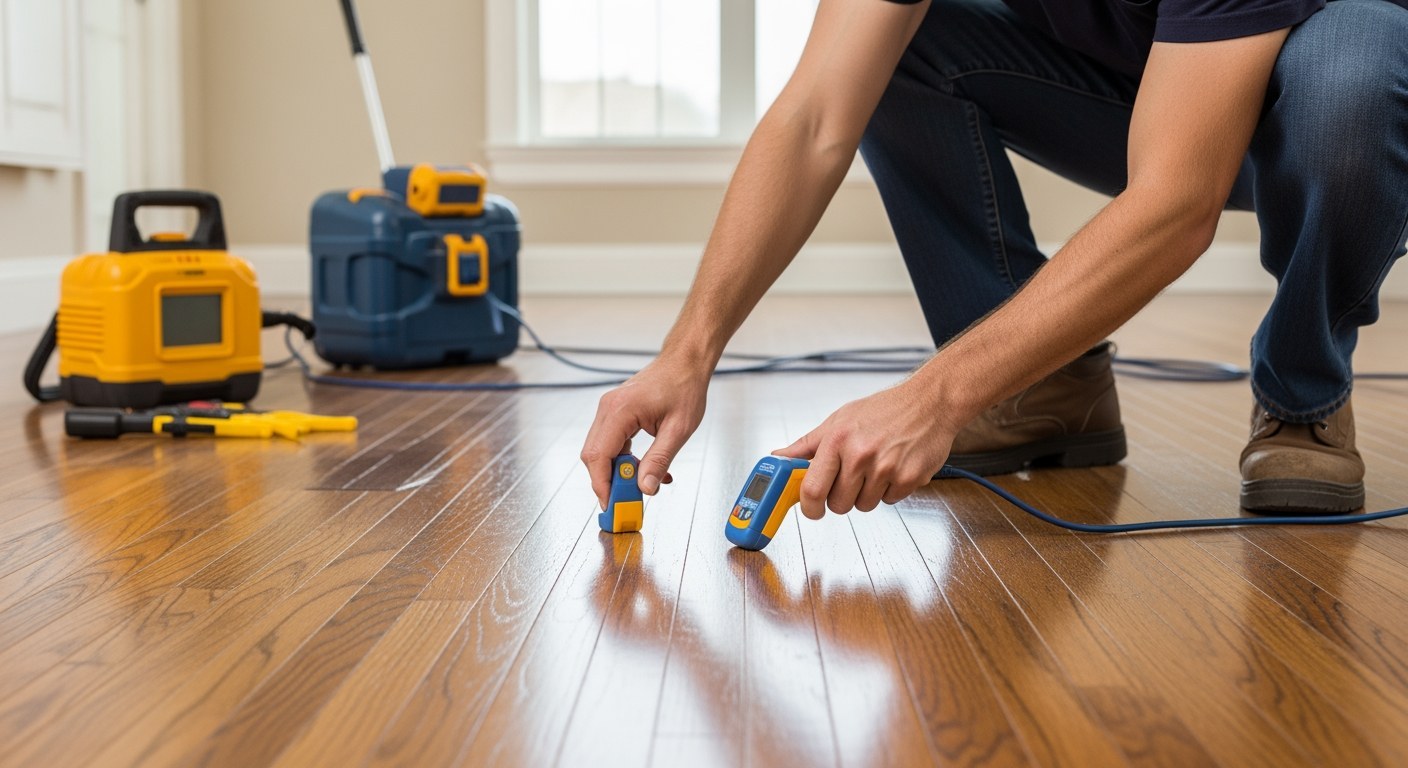
Our flooring specialist evaluates moisture content using a pin-type moisture meter calibrated to the specific wood species. Target moisture content for hardwood flooring in Minnesota is typically 6–9%, reflecting the state’s average indoor humidity range. We document initial readings and track progress to dry standard before making a replacement recommendation.
The Drying Process for Hardwood Floors
Hardwood drying requires controlled conditions — aggressive drying with excessive heat or airflow causes additional stress and can worsen cupping. Our approach uses low-grain refrigerant (LGR) dehumidifiers to lower ambient humidity combined with moderate airflow from air movers positioned to dry the subfloor from below when access allows (through a crawl space or unfinished basement ceiling).
Floor mat drying systems — specialized drying mats placed directly on the floor surface with negative pressure drawing air through the wood — accelerate drying significantly and can reduce drying time from 7–14 days to 3–5 days in suitable conditions. We deploy mat systems when the configuration and species are appropriate.
After drying to standard, the floor is re-evaluated. If cupping has resolved to an acceptable level, sanding and refinishing restores the appearance. If cupping remains beyond what sanding can correct, replacement is indicated.
Hardwood Floor Replacement After Water Damage
When replacement is required, matching is the central challenge — particularly in high-value homes where the existing floor may be an uncommon species, width, or grade. Wide-plank white oak, hand-scraped walnut, antique-reclaimed heart pine, and custom stained floors all require sourcing and mill work that standard flooring contractors cannot match.
Partners works with specialty flooring suppliers and custom mill operations serving the Minneapolis market to source replacement material that matches the existing floor’s species, grade, cut, width, and finish. When an exact match is not achievable — common in floors more than 15–20 years old — we discuss options with the homeowner and their insurer before any material is ordered.
Frequently Asked Questions
How long does it take to know if a hardwood floor can be saved?
An experienced inspector can give a preliminary assessment immediately based on species, deformation severity, and exposure history. A definitive determination requires moisture readings at dry standard — typically after 5–10 days of professional drying — to confirm whether the floor has returned to acceptable moisture content and whether cupping has resolved sufficiently for sanding.
Does insurance cover hardwood floor replacement after water damage?
Yes — hardwood floor replacement from a covered water damage event is a standard element of a homeowner insurance claim. The carrier pays for like-kind-and-quality replacement. If an exact material match requires custom sourcing, that cost is part of the covered scope. Document the existing floor with photographs before any work begins.
Can engineered hardwood be dried in place after a water loss?
Rarely. Engineered hardwood is more dimensionally stable under normal humidity variation, but once water penetrates the adhesive layers between the veneer and core, delamination is typically irreversible. Exposure to standing water or prolonged elevated humidity almost always results in replacement of engineered hardwood.
My floor dried on its own — do I still need professional assessment?
Yes. Floors that appear to have dried often retain moisture in the subfloor beneath and in the adhesive bond (in glue-down installations) that will cause deformation, mold growth, or adhesive failure months later. A professional moisture assessment confirms whether the assembly dried to standard and whether any secondary damage has developed in the subfloor or below-grade structure.
Leave A Comment