For the discerning estate owner in Orono, a natural slate roof is more than a structural necessity; it is a testament to architectural provenance and enduring value. However, the very geological characteristics that render slate a “forever” material—its metamorphic density and layered composition—also make it susceptible to the unique cryogenic stresses of a Minnesota winter. As we approach the season of deep freezes, the priority for Orono’s historic and luxury properties shifts from mere aesthetics to the technical preservation of the roof’s molecular integrity. Effective slate roof maintenance in Orono, MN, requires a sophisticated understanding of how micro-fractures develop and the advanced technologies used to mitigate them.
The Fragility of Geological Perfection: Understanding Slate
Natural slate is a metamorphic rock, formed over millions of years under intense heat and pressure. This process creates the “slaty cleavage” that allows it to be split into thin, durable tiles. While this makes slate incredibly resistant to fire and rot, it also makes it inherently brittle. On an HNW estate, the slate isn’t just a covering; it’s a system of thousands of individual stone units, each with its own internal grain and potential points of failure.
Micro-fractures often originate from the initial quarrying process or can be induced by decades of environmental exposure. These hairline fissures are frequently invisible to the naked eye from the ground, yet they represent a significant liability. When a slate tile suffers a micro-fracture, its structural “ring”—the resonant sound a healthy slate makes when tapped—is dampened. In the context of an Orono winter, these fractures are the entry points for the most destructive force in roofing: the freeze-thaw cycle.
Minnesota’s Freeze-Thaw Engine: The Mechanics of Failure
In Orono and the surrounding Medina enclaves, the winter climate is defined by drastic temperature fluctuations. We frequently witness “thermal shock,” where daytime sun warms the dark slate surfaces, melting snow, only for the temperature to plummet below freezing at night. This is the “Freeze-Thaw Engine.”
When water enters a micro-fracture or infiltrates the delaminating layers of an aging slate tile, it undergoes a phase transition. As water freezes into ice, it expands by approximately a portion in volume. This expansion exerts immense hydrostatic pressure against the stone’s cleavage planes. Over a single winter, a slate tile may undergo dozens of these cycles, effectively “jacking” the stone layers apart. This process leads to sudden tile failure, where sections of the slate may slide off the roof, exposing the underlying high-performance underlayment—or worse, the roof deck—to the elements.
Furthermore, the sheer mass of a slate roof adds a layer of structural complexity. A standard Orono slate roof can weigh between 800 and 1,500 lbs per square (100 square feet). During a heavy Minnesota snowfall, the “dead load” of the slate combined with the “live load” of the snow can reach critical levels. If the slate is already compromised by micro-fractures, the added weight can accelerate the shearing of tiles from their copper fasteners.
Thermal Mapping and Drone Technology: Non-Invasive Diagnostics
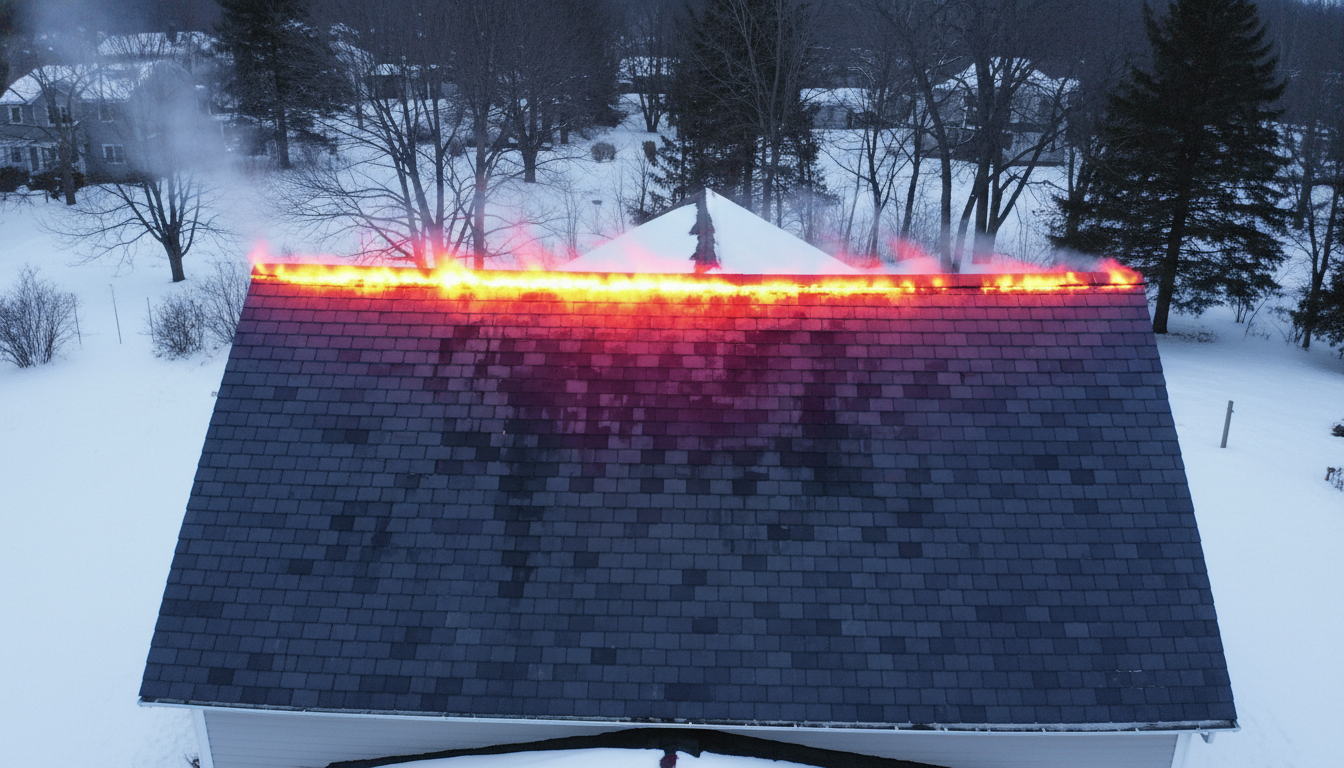
Traditional roof inspections involve a technician walking the roof—a practice we strictly limit on slate estates due to the risk of “foot-traffic trauma.” Even the most careful specialist can cause new micro-fractures simply by weight distribution. To provide a truly elite level of slate roof maintenance in Orono, MN, we utilize non-invasive drone technology equipped with high-resolution thermal imaging sensors.
Thermal mapping allows us to identify “moisture traps” that are invisible to the human eye. Because water retains heat differently than stone, a thermal scan conducted after sunset can pinpoint areas where moisture has infiltrated the slate layers or the sub-roofing assembly. These “hot spots” indicate where the freeze-thaw cycle is most likely to cause tile shattering in the coming months. By utilizing drone-based photogrammetry, we can create a digital twin of the estate’s roof, allowing our specialists to analyze the condition of every individual tile and copper flashing component without ever setting foot on the stone. This precision ensures that we only intervene where necessary, preserving the original patina and integrity of the roof.
Proactive Tile Stabilization and Historic Repair Methods
Once the thermal mapping has identified vulnerable zones, we implement a cryogenic material stress management protocol. This involves the stabilization of compromised tiles using methods that respect the historic nature of the architecture while utilizing modern metallurgical advancements.
The second line of defense is the flashing system. On high-end Orono estates, we exclusively utilize heavy-gauge copper for all valleys, dormers, and chimney crickets. Copper is chosen not only for its longevity but for its malleability in extreme cold. During our winterization audits, we inspect these copper elements for “pitting” or “creep”—the slow movement of metal over time. If a slate tile has slipped due to a failed nail, we utilize specialized slate hooks or copper “bibs” to secure the replacement tile, ensuring the repair is both permanent and aesthetically seamless.
Slate Grade vs. Expected Lifespan in MN Climates
The longevity of your roof is dictated by the grade of the stone used during original construction. The following table outlines how different slate grades perform under the stress of Minnesota’s climate.
| Slate Grade | Mineral Composition | Expected Lifespan (MN) | Freeze-Thaw Resistance |
|---|---|---|---|
| S-1 Grade | Low Carbon/High Silica | 75 – 100+ Years | Excellent |
| S-2 Grade | Moderate Impurities | 40 – 70 Years | Good |
| S-3 Grade | High Carbon/Pyrite | 20 – 40 Years | Fair/Poor |
The Role of Proper Ventilation in Winter Slate Health
A factor often overlooked in estate maintenance is the relationship between attic thermodynamics and slate longevity. If an estate’s attic is improperly ventilated, heat escaping from the living quarters creates a warm roof deck. This causes the bottom layer of snow to melt, leading to ice damming at the eaves. For a slate roof, ice dams are catastrophic. They force water upward, underneath the slate tiles, where it can freeze directly against the nail holes. Once the ice expands in the nail hole, it can literally “pop” the head off a copper nail, causing the entire slate to slide. Our winterization protocol includes a full analysis of the estate’s soffit and ridge ventilation to ensure the roof remains at a “cold” temperature, preventing the melt-refreeze cycle at the source.
Elite Stewardship for Orono Estates
Owning a home in Orono or Medina comes with the responsibility of stewardship. A natural slate roof is an asset that, if managed with technical precision, will outlast generations. By addressing micro-fractures through drone-assisted thermal mapping and stabilizing the structure before the first deep freeze, estate owners can avoid the high costs of emergency repairs and preserve the historic value of their property.
Frequently Asked Questions
- Can you walk on a slate roof?
Only with specialized equipment. We utilize “hook ladders” and soft-soled techniques when necessary, but we prefer non-invasive drone inspections to prevent “foot-traffic trauma” which can create new micro-fractures in the stone. - Why do slate tiles fall off in winter?
This is typically caused by ice expansion in the nail holes or delamination within the stone layers. As water freezes and expands, it exerts enough force to break the copper fasteners or shear the stone away from the nail. - How often should I have my slate roof audited?
For HNW estates in Minnesota, an annual pre-winter audit is recommended to ensure that any tiles compromised during the summer storms are stabilized before the freeze-thaw cycle begins.
The integrity of your estate’s roof is paramount. Do not wait for a visible leak to address the silent progression of micro-fractures. Ensure your slate is prepared for the cryogenic demands of the coming season.
Secure Your Estate’s Legacy
Protect your investment with a technical evaluation from Minnesota’s historic roofing specialists. Contact us today to arrange a comprehensive drone-assisted diagnostic.
Leave A Comment