
As a Medical Facility Manager in Medina, the metrics of success are usually measured in patient outcomes, throughput efficiency, and the strict adherence to sterile protocols. However, when a water intrusion event occurs—whether from a pressurized pipe burst, a cooling system failure, or a flash flood—the metrics shift toward vapor pressure, grain depression, and structural equilibrium. In these high-stakes scenarios, standard restoration techniques are not merely insufficient; they are professionally negligent. For a Medical Facility Restoration in Medina to be successful, it must prioritize the protection of multi-million dollar diagnostic assets and the prevention of long-term microbial reservoirs.
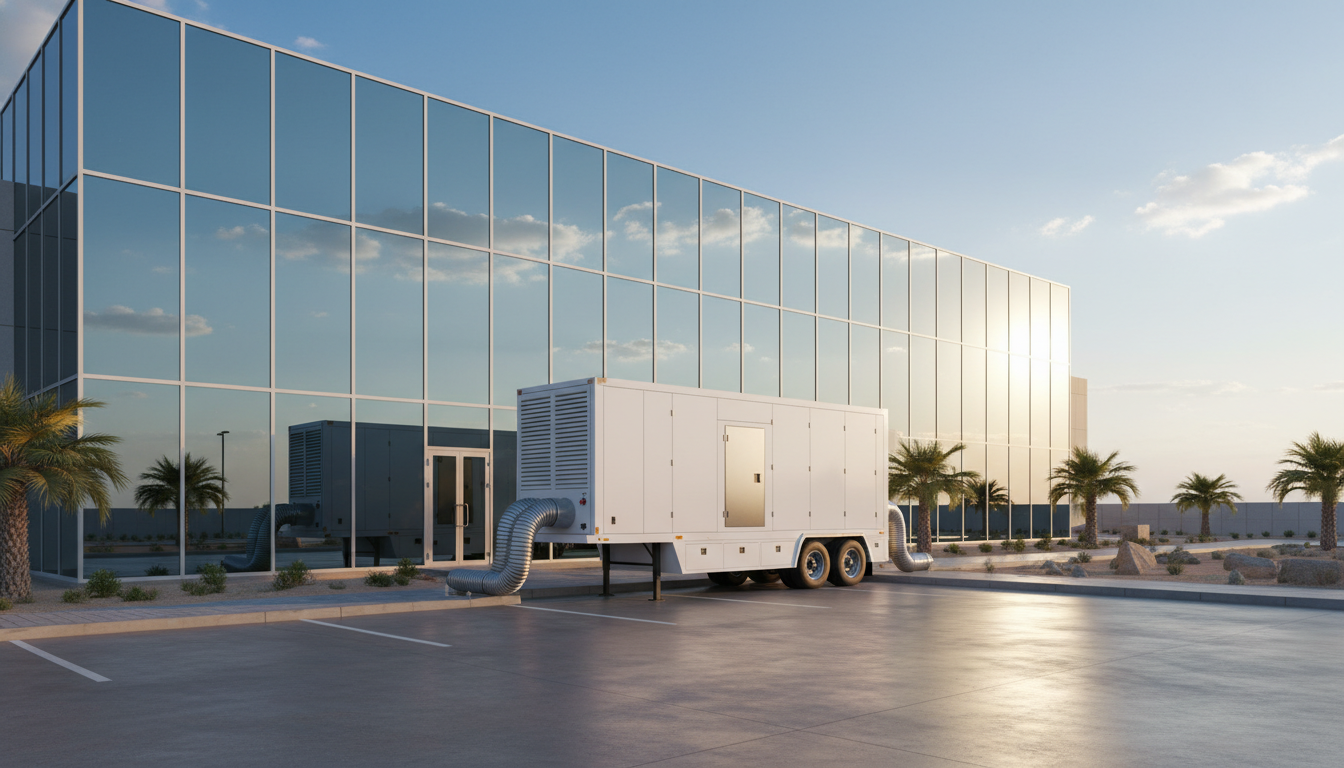
From the perspective of an IICRC Applied Structural Drying Specialist, the physics of a clinical environment dictate a specific response. We are not just drying “wet carpet”; we are managing the hygrothermal performance of a complex building envelope filled with sensitive electronics. The deployment of high-capacity desiccant trailer units is the only engineered solution that meets the rigorous demands of modern healthcare infrastructure.
Clinical Drying Challenges: Why Standard Dehumidification Fails
Medical facilities present a unique set of variables that complicate standard drying procedures. Most commercial buildings can tolerate a “warm and dry” approach. In contrast, clinical environments must often maintain specific temperature set points—frequently below 68°F (20°C)—to accommodate sensitive laboratory reagents and heavy diagnostic machinery. This creates a fundamental conflict for standard Low Grain Refrigerant (LGR) dehumidifiers.
LGR units rely on the principle of condensation. They cool the air to its dew point, causing water vapor to condense into liquid. However, as the ambient temperature drops, the efficiency of an LGR unit plummets. Below 60°F, LGRs struggle to remove enough moisture to create a significant vapor pressure differential. In a Medina medical facility where the HVAC system is struggling to compensate for the added latent load of a flood, the air remains saturated, and the structural materials remain wet.
Furthermore, medical facilities utilize interstitial spaces—cavities between floors and behind sterile walls—that are notoriously difficult to access. Standard dehumidification rarely reaches the “deep” moisture trapped in these voids. This trapped moisture eventually leads to the degradation of drywall, the corrosion of metal studs, and the growth of mold that can compromise the facility’s sterile certification. The only way to move this moisture is through ultra-low vapor pressure, a feat only achievable through desiccant technology.
The Technical Threshold of Grain Depression
In the world of professional restoration, we measure humidity in Grains Per Pound (GPP). This is a measurement of the weight of water vapor in the air. To effectively pull moisture out of dense materials like concrete or fire-rated assemblies, the air in the room must be significantly “drier” (lower GPP) than the moisture trapped in the material. This is known as the vapor pressure differential.
While an LGR unit might struggle to reach 40 GPP in a cool clinical setting, a desiccant trailer can consistently deliver air at 10 to 15 GPP. This massive “grain depression” creates a vacuum-like effect on moisture, pulling it out of the deepest recesses of the building’s structure. For Medical Facility Restoration in Medina, this is the difference between a three-day recovery and a three-week catastrophe.
The Desiccant Advantage: Engineering Precision in Airflow
A desiccant trailer is essentially a giant chemical sponge. It uses a rotating wheel impregnated with silica gel to adsorb moisture directly from the air, regardless of the temperature. Because it does not rely on cooling and condensation, its performance remains consistent even in the chilled environments of an operating room or an imaging suite.
When we deploy these trailers, we are performing a “targeted air exchange.” We duct the processed, ultra-dry air directly into the most critical areas of the facility while simultaneously exhausting the moist air outside. This creates a positive pressure environment that prevents outside contaminants and humidity from entering the sterile field. This engineering-first approach ensures that the facility’s internal climate remains stabilized, even while the structural drying is in peak operation.
LGR vs. Desiccant Performance Comparison
The following table illustrates the performance gap between standard LGR units and desiccant trailers when operating in the typical cool conditions of a medical facility.
| Environmental Factor | LGR Performance (at 65°F) | Desiccant Performance (at 65°F) | Clinical Impact |
|---|---|---|---|
| Lowest Achievable GPP | 40 – 55 GPP | 10 – 25 GPP | Desiccants achieve a substantial portion faster deep drying. |
| Vapor Pressure Differential | Moderate | High/Aggressive | Desiccants pull moisture from dense substrates. |
| Operating Range | Fails below 60°F | Effective to -10°F | Desiccants maintain clinical temp requirements. |
| Internal Hardware Risk | Risk of condensation | Eliminates condensation | Desiccants protect diagnostic circuitry. |
Protecting MRI and Imaging Hubs: Preventing Micro-Corrosion
In a Medina medical facility, the most valuable assets are often the MRI, CT, and PET scanners. These machines are not just expensive; they are the lifeblood of the diagnostic workflow. When a facility is flooded, these machines face two primary threats: direct water contact and the more insidious threat of high-humidity micro-corrosion.
Sensitive electronic components, particularly the high-frequency circuit boards found in imaging equipment, are susceptible to corrosion when the relative humidity (RH) exceeds a significant majority. At this level, a microscopic layer of moisture can form on metal surfaces, leading to oxidation and electrical “tracking” or shorting. If a facility relies on standard dehumidifiers, the RH may stay above this danger zone for days.
By deploying desiccant trailers, we can drop the local RH in an imaging suite to below a meaningful share within hours. This “deep dry” environment halts the corrosion process and prevents the catastrophic failure of diagnostic hardware. As a facility manager, you must ask: Can MRI machines be saved after a flood? The answer is yes—but only if the humidity is controlled instantly and aggressively. Desiccant drying is the only method that provides this level of protection for electronic assets.
Workflow for Minimal Downtime: The a substantial portion Reduction Rule
Data suggests that desiccant drying reduces clinical downtime by a substantial portion compared to LGR units. This is not just a statistical anomaly; it is the result of a more efficient physical process. In the healthcare sector, every hour of downtime represents lost revenue and delayed patient care. Our workflow is designed to minimize this impact through a three-phase deployment:
- Phase 1: Stabilization. Within hours of arrival, desiccant trailers are engaged to stabilize the environment, preventing secondary damage like mold growth and equipment corrosion.
- Phase 2: Targeted Structural Drying. Using infrared thermography, we identify the exact locations of trapped moisture and use specialized ducting to deliver ultra-dry air directly to those cavities.
- Phase 3: Verification and Compliance. We don’t stop when the surfaces feel dry. We use moisture probes to confirm that the internal GPP of the building materials has reached its dry standard, ensuring compliance with both IICRC and medical building codes.
This streamlined workflow, overseen by specialists with builder-level knowledge of medical facility construction, ensures that restoration doesn’t just fix the damage—it restores the facility to its original engineering specifications. For more on how we handle these complex scenarios, see our guide on High-Stakes Commercial and Medical Facility Recovery.
Key Takeaways for Facility Managers
- Refrigerants fail below 60 degrees: If your facility is kept cool, standard restoration equipment will not work efficiently.
- Desiccants are essential for sensitive electronics: Only desiccants reach the low GPP levels required to prevent micro-corrosion on scanners and servers.
- Builder oversight ensures medical code compliance: Successful restoration requires understanding the architectural and mechanical complexities of a clinical space.
Frequently Asked Questions
Can MRI machines be saved after a flood?
Yes, provided that the environment is stabilized immediately. The primary risk to an MRI is not just the water on the floor, but the humidity in the air that can corrode the internal electronics. Desiccant trailer deployment is the gold standard for saving these assets.
Why are desiccants better for clinics?
They achieve a “deep” dry necessary for electronics and dense structural materials. Unlike refrigerant units, they are effective at the lower temperatures typically maintained in medical environments, and they can produce a much higher vapor pressure differential.
How much does desiccant deployment reduce downtime?
On average, desiccant drying reduces clinical downtime by approximately a substantial portion. This is due to the aggressive nature of the grain depression, which pulls moisture out of materials much faster than standard methods.
Conclusion: The Necessity of Professional Precision
Managing a medical facility in Medina requires a commitment to excellence and a deep understanding of the technical requirements of the space. When disaster strikes, that commitment must extend to the restoration process. Choosing desiccant trailer deployment is an engineering-driven decision that protects your patients, your equipment, and your bottom line. Do not leave your facility’s recovery to chance or to under-equipped contractors. Demand the precision that only desiccant technology and IICRC-certified expertise can provide.
Are you prepared for a high-stakes recovery?
Leave A Comment