
As stewards of the most prestigious real estate in the Upper Midwest, homeowners along the Wayzata curves and the secluded bays of Lake Minnetonka understand that a shoreline is more than a boundary; it is a legacy. However, the gentle lap of the waves against a manicured lawn masks a relentless geological struggle. For decades, the reflexive solution to erosion was “hard armoring”—the installation of massive limestone riprap. Yet, as the regulatory landscape evolves and our understanding of lacustrine ecology deepens, the Minnehaha Creek Watershed District (MCWD) has shifted the paradigm.
In the current era of Lake Minnetonka shoreline stabilization, the focus has pivoted from resisting nature to collaborating with it. As a specialized Shoreline Restoration Consultant (BC794459), I have seen firsthand how the transition from traditional riprap to bio-engineered “living shorelines” not only satisfies the stringent MCWD permit requirements but also enhances the intrinsic value and aesthetic majesty of the Wayzata lakefront.
The MCWD Mandate: Navigating the Regulatory Waters
The Minnehaha Creek Watershed District governs with a clear mission: to protect the water quality and ecological integrity of the Lake Minnetonka basin. For the Wayzata homeowner, this means that any modification to the water’s edge is subject to intense scrutiny. The MCWD mandate is no longer just about stopping the soil from falling into the lake; it is about managing the holistic interaction between the land and the water.
Securing an MCWD permit is a sophisticated undertaking. The district discourages the use of vertical walls or excessive rock armoring because these structures, while seemingly permanent, often cause more harm than good to the lake’s ecosystem. The mandate prioritizes “soft” solutions—methods that utilize native vegetation and organic materials to create a transitional zone. For those of us managing high-value estates, understanding this regulatory preference is the first step in avoiding costly delays or enforcement actions. A permit is mandatory for nearly all lakefront work, and the district’s preference for bio-engineering is now the gold standard for approval.
Why Riprap is Fading: The Physics of Wave Energy
To the untrained eye, a wall of limestone riprap appears to be the ultimate defense against erosion. However, the physics of Lake Minnetonka tell a different story. When a wave from a passing wake hits a hard, reflective surface like limestone, the energy does not simply disappear. It is reflected downward and laterally. This “energy reflection” leads to a phenomenon known as scouring, where the lakebed at the base of the rocks is hollowed out, eventually causing the very rocks intended to protect the shore to slump into the water.
Furthermore, hard armoring increases downstream erosion for your neighbors. By failing to absorb the kinetic energy of the water, riprap forces that energy to find the next softest point on the shoreline. This creates a “ping-pong” effect of erosion that degrades the collective health of the bay. From a sophisticated property management perspective, riprap is a blunt instrument in an environment that requires a scalpel. It is a static solution in a dynamic system, and the MCWD has recognized its limitations by favoring more resilient, bio-engineered alternatives.
The Mechanics of Living Shorelines: Biological Rebar
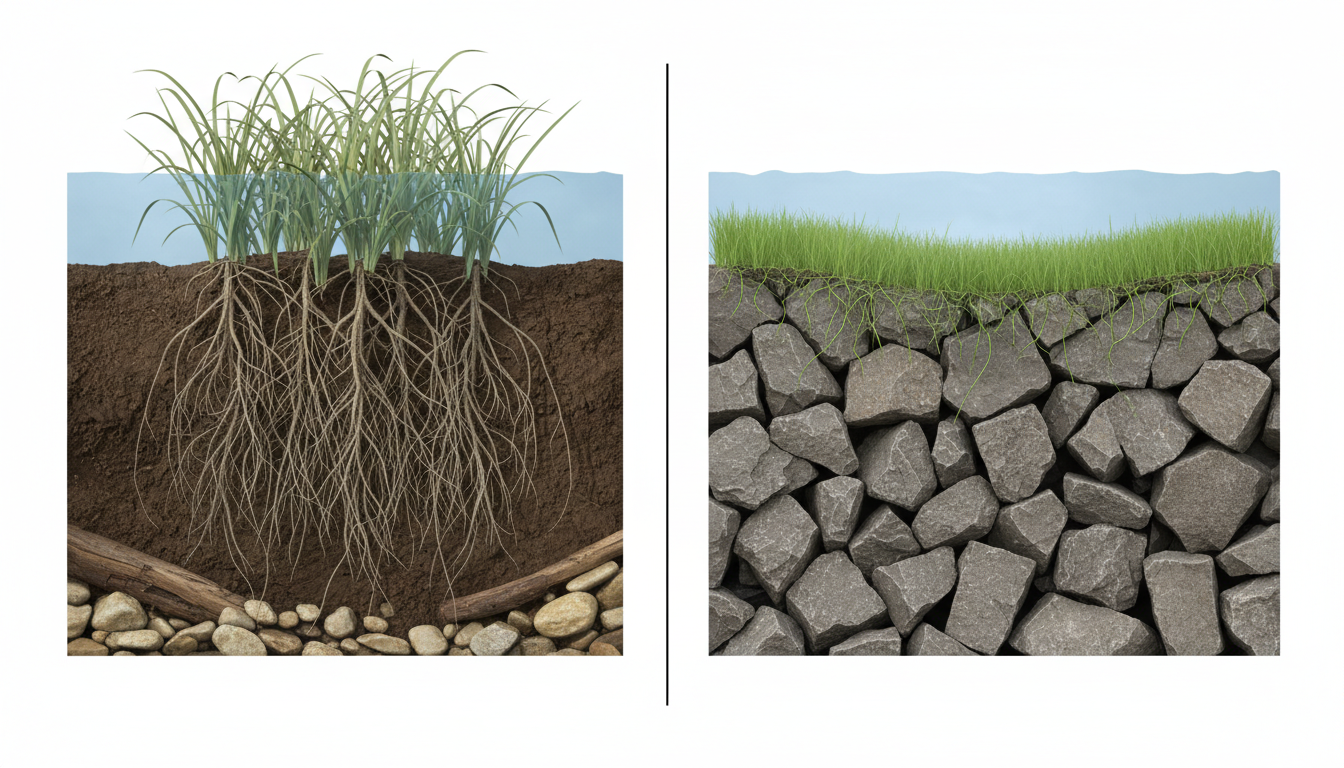
Bio-engineering, or the “living shoreline” approach, uses a sophisticated matrix of organic materials and native biology to stabilize the earth. At the heart of this method is the use of coir logs—densely packed cylinders of coconut fiber—and pre-vegetated mats. These elements act as a temporary structural barrier while the real work happens beneath the surface.
The secret weapon of a stabilized Wayzata shoreline is the root system of native species like Blue Flag Iris, Softstem Bulrush, and various sedges. Unlike the shallow, two-inch roots of Kentucky Bluegrass, these native plants possess root systems that can penetrate five to fifteen feet into the soil. We often refer to these as “biological rebar.” They lace the soil together in a complex, flexible web that can withstand the freeze-thaw cycles of Minnesota winters and the relentless pounding of summer boat wakes.
Moreover, these living buffers serve a critical environmental function. Data suggests that native buffers can reduce phosphorus loading—the primary driver of algae blooms—by up to a significant majority compared to traditional lawn turf. By choosing bio-engineering, the homeowner is not just protecting their lot; they are actively filtering the runoff that enters Lake Minnetonka, ensuring the water remains as clear as the day they purchased the property.
Comparison of Shoreline Armoring Efficacy
When evaluating the long-term investment of shoreline stabilization, it is helpful to look at the empirical data regarding erosion rates and maintenance requirements.
| Stabilization Method | Avg. Annual Erosion Rate | Energy Absorption | Ecological Impact | MCWD Approval Rating |
|---|---|---|---|---|
| Bio-Engineering (Native Matrix) | < 0.1 inches | High (a large majority+) | Positive (Filtration) | Preferred |
| Limestone Riprap (Hard Armor) | 0.5 – 1.2 inches* | Low (Reflection) | Neutral to Negative | Discouraged/Restricted |
| Unstabilized Turf | 2.0 – 5.0 inches | None | Negative (Runoff) | N/A |
*Erosion often occurs due to toe-scour and slumping behind the stones.
Architectural Integration: Aesthetic Stewardship
A common concern among Wayzata homeowners is that a “natural” shoreline will look unkempt or diminish the formal grandeur of their estate. This is a misconception. Modern bio-engineering is a discipline of landscape architecture. A professionally designed living shoreline creates a tiered, textured transition that frames the view of the lake rather than cutting it off with a harsh line of gray rock.
The integration of native wildflowers and architectural grasses provides seasonal interest—vibrant purples in the spring, deep greens in the summer, and golden hues in the autumn. This “soft” edge creates a seamless transition from the curated gardens of the home to the natural beauty of Lake Minnetonka. It signals a sophisticated level of stewardship, showing that the homeowner values both the luxury of their property and the health of the environment that provides its value.
Frequently Asked Questions
- Do I need a permit to fix my dock?
Yes, if the work involves any modification to the shoreline or the lakebed. MCWD and the DNR frequently require permits for dock expansions or permanent dock structures to ensure they do not interfere with navigation or damage sensitive shoreline habitats.
- What exactly is bio-engineering?
Bio-engineering is the practice of using living plant materials, often in combination with biodegradable structural components like coir logs and straw blankets, to provide mechanical stabilization to the soil. It relies on the growth of deep-rooted native plants to hold the shoreline together permanently.
- Is bio-engineering more expensive than riprap?
While the initial design and planting phase can be comparable to high-quality riprap, the long-term costs are often lower. Bio-engineered shorelines are self-healing; as plants grow, the structure strengthens. Riprap, conversely, often requires “topping off” or resetting as stones shift and settle over time.
Conclusion: The Path Forward
The era of battling Lake Minnetonka with heavy stone is giving way to an era of intelligent, biological design. For the discerning homeowner in Wayzata, the choice of bio-engineering is not merely a matter of regulatory compliance with the MCWD; it is an investment in the longevity and beauty of their lakefront legacy. By utilizing the principles of biological rebar and energy absorption, we can create shorelines that are as resilient as they are beautiful.
Navigating the intersection of engineering, ecology, and MCWD policy requires a specialized touch. As you consider the future of your shoreline, ensure you are working with experts who understand the delicate balance of Lake Minnetonka’s unique environment.
Ready to Protect Your Shoreline?
Don’t navigate the complexities of watershed regulations alone. Ensure your estate remains a bastion of stability and beauty with a professional assessment.
Leave A Comment