
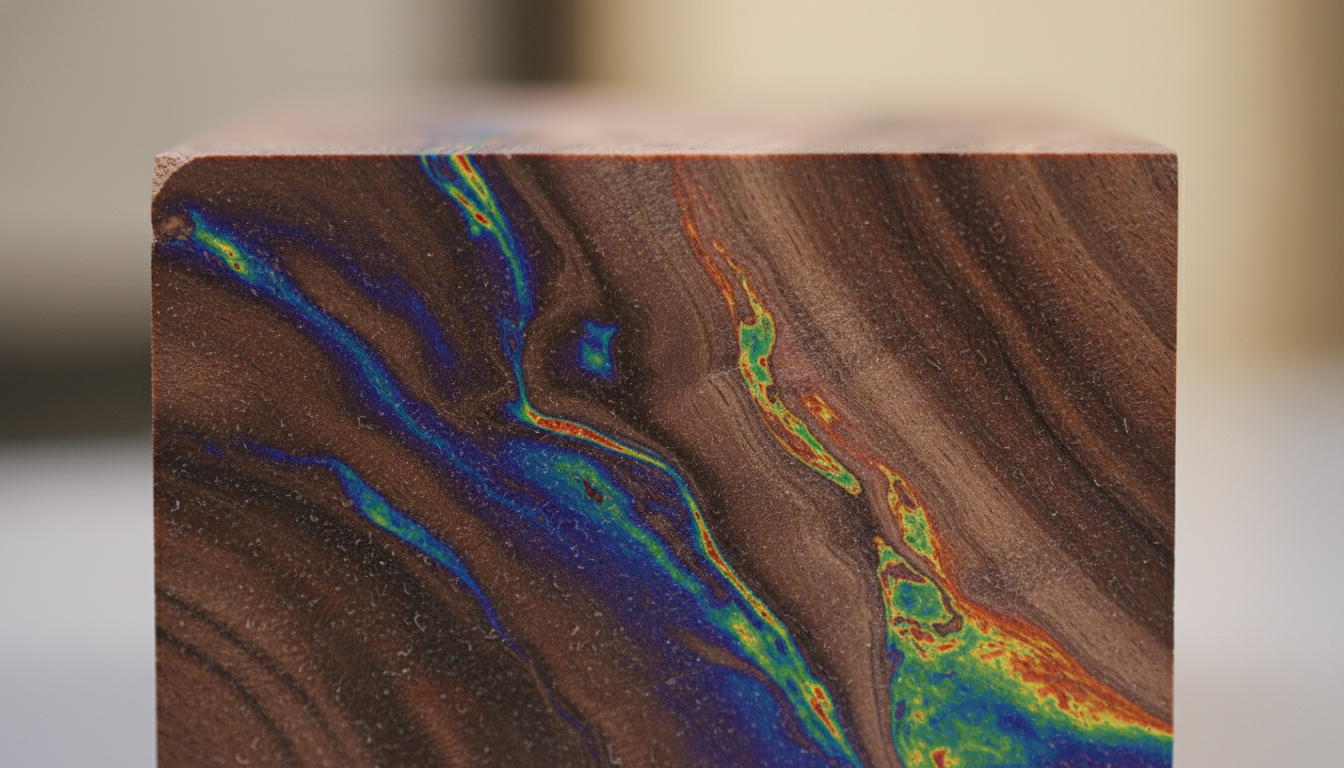
For the discerning estate owner in Orono, a residence is more than a structure; it is a curated collection of rare materials, artisan craftsmanship, and historical continuity. When a mechanical failure or a localized flood introduces water into a home finished with old-growth Walnut, African Mahogany, or Ipe, the immediate reaction of a standard restoration company is “demolition and replacement.” However, for the elite property, replacement is often a failure of imagination and a loss of irreplaceable patina. The solution lies not in hammers, but in physics—specifically through a process known as technical grain depression hardwood stabilization.
The Physics of Saturated Timber: Beyond Surface Moisture
To understand how to save a submerged exotic hardwood floor or a custom-milled library, one must first understand the molecular behavior of wood. Wood is a hygroscopic material, meaning it constantly exchanges moisture with its environment to reach an Equilibrium Moisture Content (EMC). When high-density timbers are subjected to liquid water, the moisture exists in two states: free water (within the cell cavities) and bound water (within the cell walls).
Standard restoration efforts focus on surface drying. However, in exotic hardwoods, the density of the grain acts as a barrier. If the drying process is too aggressive or improperly managed, the exterior of the wood shrinks while the core remains swollen. This creates massive internal tension, leading to “checking” (cracking), “cupping” (warping), or “crowning.” Technical grain depression hardwood management is the art of manipulating the vapor pressure gradient to extract bound water without compromising the cellular integrity of the timber.
As a Licensed MN Residential Building Contractor (BC794459), my perspective is rooted in the structural assembly of the home. We do not view wood as a disposable finish, but as a structural component that requires stabilization to maintain the home’s architectural value.
The Failure of LGR Dehumidification on Dense Grain
Most restoration contractors arrive on-site with LGR (Low Grain Refrigerant) dehumidifiers. While effective for standard drywall or pine framing in a suburban basement, LGR technology has a physical floor. LGR units struggle to pull the relative humidity (RH) below 25-a meaningful share. For high-density exotic hardwoods, this is insufficient.
Dense woods like Ipe or Brazilian Cherry have very low permeability. To move moisture from the center of a 3/4-inch plank to the surface, the surrounding air must be significantly drier than the wood itself. If the air’s vapor pressure is too high (as it often is with LGR units), the moisture becomes trapped. The result is “secondary damage”—mold growth beneath the finish or permanent cellular collapse. By the time a standard contractor realizes the wood isn’t drying, the window for preservation has closed, and the only remaining option is a costly tear-out that disturbs the home’s original plasterwork and custom cabinetry.
The Desiccant Solution: Precision Vapor Pressure Management
The elite approach to technical grain depression hardwood preservation involves the use of industrial desiccant trailers. Unlike refrigerant-based systems, desiccant dehumidifiers use a chemical attraction (usually silica gel) to strip moisture from the air. These units can achieve a portion relative humidity and produce extremely hot, dry air with a vapor pressure near zero.
By introducing “thirsty” air into a controlled environment, we create a massive vapor pressure differential. This differential “pulls” the bound water from the deepest fibers of the mahogany or walnut. This is the essence of Technical Dehumidification. We aren’t just drying the air; we are depressing the grain’s moisture levels through a calculated, scientific extraction process.
Our methodology involves more than just equipment. It requires constant monitoring of the wood’s “Grain Depression”—the delta between the ambient air’s dew point and the wood’s surface temperature. This ensures that the evaporation rate does not exceed the wood’s internal diffusion rate, which is the primary cause of structural cracking in high-end millwork.
Material vs. Drying Response: A Comparative Analysis
Different species react uniquely to saturation and subsequent technical drying. Our Partners Reconstruction Protocol dictates a specific drying curve for each material to ensure stabilization without distortion.
| Material Type | Density/Permeability | Drying Response | Technical Requirement |
|---|---|---|---|
| Ipe / Brazilian Walnut | Extremely High / Low Permeability | High risk of checking if dried too fast; stubborn moisture retention. | Long-term, low-vapor pressure desiccant cycle. |
| Black Walnut / Mahogany | Moderate to High / Moderate Permeability | Prone to cupping; retains “memory” of water damage. | Managed evaporation with tenting and targeted airflow. |
| White Pine / Douglas Fir | Low / High Permeability | Dries rapidly; high risk of mold if not addressed in 48 hours. | Standard LGR may suffice, but desiccant is faster for structural members. |
Preservation vs. Replacement: The Estate Owner’s Dilemma
In a high-net-worth estate, the “cost” of water damage isn’t just the price of the lumber. It is the cost of the master carpenter’s time, the bespoke stain matching that has aged for twenty years, and the disruption of a full-scale reconstruction. When you choose to replace custom millwork, you are often inviting a cascading series of problems: dust infiltration into HVAC systems, the mismatch of new-growth timber against old-growth aesthetics, and the loss of the home’s original soul.
Technical grain depression is the builder-led alternative to destruction. By stabilizing the timber in situ, we preserve the “tightness” of the original installation. Our background as licensed builders (BC794459) allows us to understand the fasteners, the subfloor assemblies, and the joinery that standard restorers ignore. We don’t just dry the wood; we stabilize the entire assembly to ensure that once the moisture is gone, the floor remains flat and the joints remain tight.
The Importance of a portion Relative Humidity
Why is the “a portion RH” capability of a desiccant trailer so critical? In a saturated Orono estate, the sheer volume of water can overwhelm standard equipment. As water evaporates, it raises the humidity of the room. If the equipment cannot keep up, the drying stops. Desiccant technology ensures that the air remains at a constant state of extreme dryness, regardless of the ambient temperature. This is particularly vital in Minnesota’s variable climate, where cold temperatures can render LGR dehumidifiers virtually useless. Technical grain depression requires a constant, aggressive pull that only desiccant air can provide.
Frequently Asked Questions
Can water-damaged mahogany be saved?
Yes. Through controlled vapor pressure management and the use of desiccant trailers, even submerged mahogany can be restored to its pre-loss condition, provided the intervention happens before cellular collapse or permanent warping occurs.
How long does technical drying take?
While every loss is unique, the typical timeline for drying dense hardwoods using technical grain depression is 4 to 7 days. This is slightly longer than drying standard materials because the process must be carefully managed to prevent the wood from drying too quickly and cracking.
Conclusion: A Scientific Approach to Heritage
The decision to save or replace high-end custom millwork should be based on science, not convenience. For the HNW homeowner, the preservation of exotic hardwoods is a matter of maintaining the estate’s value and architectural integrity. By utilizing technical grain depression and desiccant-based dehumidification, we offer a surgical solution that respects the craftsmanship of your home.
Protect Your Investment
If your estate has suffered a water intrusion, do not settle for a “cut and gut” restoration approach. Ensure your exotic hardwoods are evaluated by experts in wood science and structural stabilization.
Request a Wood Science Assessment: Contact Partners Response & Recovery
Leave A Comment