By: Level III Thermographer & Restoration Architect
For the stewards of Minnesota’s heritage mansions, the discovery of a water leak is often accompanied by a secondary fear: the destruction required to find it. In the grand estates of Wayzata and the historic corridors of Summit Avenue, architectural integrity is not merely an aesthetic choice; it is a structural and historical mandate. Traditional investigative methods—often referred to as “exploratory demolition”—can be as damaging to a property’s soul as the water itself. However, the evolution of thermal imaging water leak detection in MN has introduced a paradigm shift in how we approach moisture intrusion in sensitive environments.
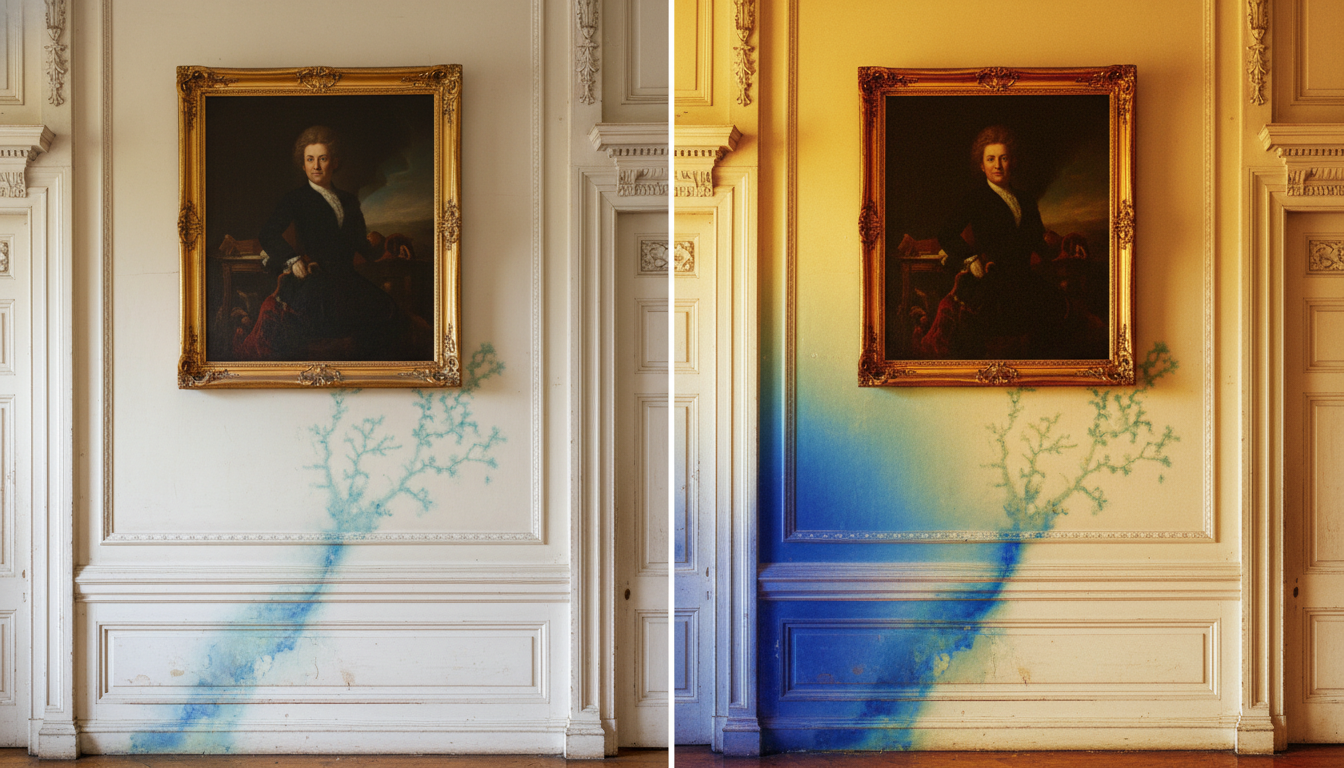
Infrared moisture mapping represents the intersection of physics and preservation. By utilizing high-resolution thermographic sensors, we can visualize what the human eye cannot: the thermal signatures of moisture migration through complex, multi-layered assemblies like lath and plaster, hand-carved millwork, and masonry. This article explores the scientific methodology of infrared diagnostics and its role in the surgical restoration of historic properties.
The Science of Thermography in Historic Contexts
A common misconception among property adjusters and owners is that infrared cameras “see through” walls. In reality, thermography is the science of detecting infrared radiation emitted from an object’s surface. In the context of moisture detection, we rely on the principle of evaporative cooling. As moisture evaporates from a substrate, it consumes energy, causing a localized drop in temperature. This creates a “thermal anomaly”—a cool spot that appears distinct from the surrounding dry materials.
In heritage mansions, this science becomes more nuanced. Historic lath and plaster walls possess significantly higher thermal mass than modern drywall. While this makes them excellent insulators, it also means they retain moisture longer. A Level III Thermographer must account for the emissivity of historic finishes—from gold-leafed wallpapers to lead-based paints—to ensure that the data collected is accurate. By mapping these temperature deltas, we can trace the “load-path” of moisture from a roof failure or a plumbing breach, even if the liquid has traveled three stories down through internal wall cavities before showing symptoms.
Furthermore, infrared technology identifies insulation failures that often accompany water damage. In many Wayzata estates, retrofitted cellulose or mineral wool insulation can become “compacted” when wet, losing its R-value and creating permanent thermal bridges. Infrared mapping identifies these hidden pockets of inefficiency, allowing for targeted remediation that restores both the dry state and the thermal envelope of the building.
Technical Diagnostic Capabilities
To provide a comprehensive diagnostic report for insurance adjusters and preservationists, a multi-modal approach is required. While thermography is the primary tool for broad-spectrum mapping, it is supported by other non-invasive technologies to confirm findings without the need for a sledgehammer.
| Technology | Detection Capability | Preservation Benefit |
|---|---|---|
| Infrared Thermography | Evaporative Cooling & Thermal Bridges | Zero-Demolition Mapping of moisture plumes |
| Acoustic Sensors | Pressurized pipe leaks behind masonry | Targeted structural access for plumbing repair |
| Borescope | Wall cavity & floor joist inspection | Minimal invasive testing (1/4″ access hole) |
The Diagnostic Sequence: A Stewardship-First Approach
When executing thermal imaging water leak detection in MN, specifically within a heritage environment, the sequence of operations is critical. We do not simply walk in and take a photo. The process is a controlled scientific experiment designed to yield actionable data for Restoring Historic Properties.
1. Baseline Environmental Stabilization
To maximize the “Delta-T” (temperature difference) required for clear imaging, we often manipulate the building’s interior climate. By creating a temperature differential of at least 15 to 20 degrees Fahrenheit between the interior and exterior, or between the wall cavity and the room, moisture signatures become significantly more pronounced.
2. Broad-Spectrum Scanning
The thermographer scans the entire affected area, including floors, ceilings, and interstitial spaces. This phase identifies the “moisture plume”—the full extent of water migration. In historic mansions, water rarely travels in a straight line; it follows the path of least resistance along hand-hewn joists and ancient masonry transition points.
3. Verification with Pinless Moisture Meters
Thermal anomalies are “candidates” for moisture, but they must be verified. We utilize electromagnetic moisture meters that provide deep-tissue readings without piercing the surface of delicate finishes. This ensures that a cool spot caused by a missing piece of insulation is not misidentified as an active leak.
4. Mapping and Reporting
The final output is a moisture map—a literal blueprint of the loss. For adjusters, this provides a “scope of work” based on empirical data rather than speculation. For the steward, it provides the peace of mind that only the necessary areas will be touched during the Architectural Reconstruction phase.
Case Comparisons: The Cost of Speculation vs. The Value of Precision
In a recent diagnostic survey of a 1920s Tudor revival in Wayzata, a suspected leak in a second-floor master bath had led to staining on the hand-plastered ceiling of the dining room below. A traditional restoration contractor proposed removing the entire dining room ceiling—a masterpiece of decorative plasterwork—to find the source.
By employing professional infrared moisture mapping, we identified that the leak was not originating from the bathroom directly above. Instead, a failed window flashing on the third floor was allowing water to track down a vertical structural post, bypassing the second floor entirely before pooling on the dining room’s decorative lath. Supporting Data: Thermal imaging can reduce exploration-related demolition costs by up to a significant majority in historic homes. In this specific case, the “surgical” repair required only a 12-inch square opening in an inconspicuous corner of the third-floor closet, leaving the priceless dining room ceiling completely untouched.
For insurance adjusters, this precision is invaluable. It reduces the “Total Incurred” on a claim by eliminating unnecessary debris removal, high-end finish replacement, and the extended “loss of use” period associated with major demolition.
Preserving the Patina of History
The philosophy of stewardship dictates that we should be “as invasive as necessary, but as non-invasive as possible.” Every time a lath and plaster wall is removed, a piece of the building’s history—and its structural damping characteristics—is lost forever. Modern drywall cannot replicate the acoustic density or the hygroscopic properties of original lime-based plaster.
Infrared moisture mapping allows us to treat these buildings with the reverence they deserve. It provides a bridge between the craftsmanship of the past and the technology of the future. Whether you are managing a private estate or adjusting a high-value loss, the goal remains the same: the preservation of architectural excellence through scientific precision.
Frequently Asked Questions
Can infrared see through walls?
It does not “see through” materials in the way an X-ray does. Instead, it detects heat signatures on the surface. Because moisture causes evaporative cooling or acts as a thermal bridge, it leaves a distinct “thermal footprint.” We use these signatures to map the exact extent of water migration behind the surface.
Is it effective for small, slow leaks?
Yes. Professional-grade infrared cameras are highly sensitive to even minute temperature deltas. This makes them ideal for detecting slow, “weeping” leaks that haven’t yet caused visible staining but are high enough in moisture content to encourage mold growth or structural rot within historic wall cavities.
Take the Scientific Approach to Restoration
Protecting a heritage property requires more than just a toolkit; it requires a commitment to architectural stewardship. If you suspect moisture intrusion in a high-value historic home, do not settle for “exploratory” destruction. Demand the precision of Level III Thermography to locate the source and map the damage with zero impact on your property’s finishes.
Contact our experts today to protect your architectural legacy.
Leave A Comment