
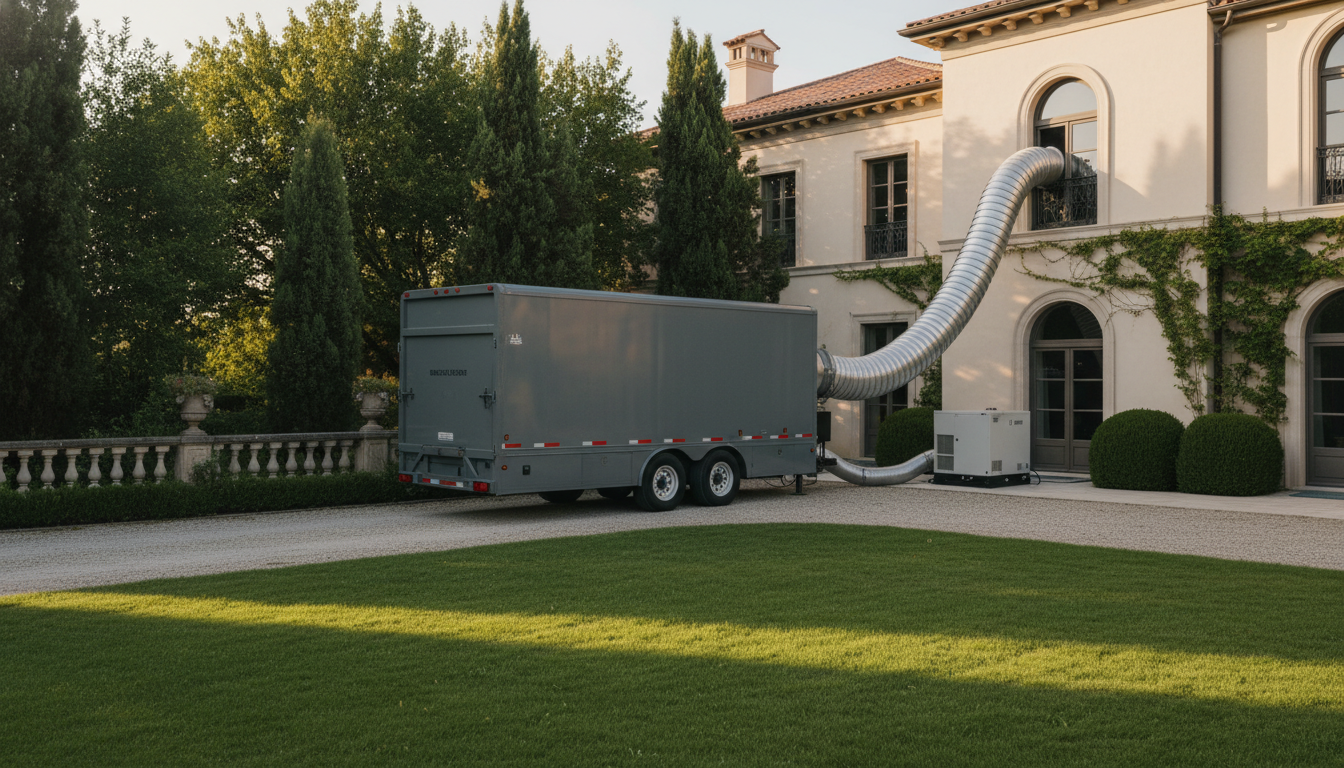
When a water intrusion event occurs within a luxury estate, the stakes transcend simple “flood cleanup.” For properties featuring custom architectural millwork, historic masonry, and expansive structural footprints, the restoration process is an engineering challenge that requires a sophisticated understanding of psychrometrics. As a Senior Technical Drying Specialist, I frequently consult with luxury homeowners and insurance adjusters who are forced to choose between traditional Low Grain Refrigerant (LGR) dehumidifiers and high-capacity desiccant trailers.
The decision is not merely one of convenience or cost; it is a decision based on the specific vapor pressure requirements of the building’s materials. While LGR units are the industry standard for suburban residential losses, the unique demands of desiccant trailer house drying become apparent when we move into the realm of estate-scale preservation. To protect the integrity of a high-net-worth asset, one must look beyond surface-level moisture and address the deep-seated humidity trapped within dense structural components.
The Fundamental Science: LGR vs. Desiccant Technology
To understand which technology is appropriate for an estate, we must first look at how they remove moisture from the environment. Both systems aim to lower the vapor pressure of the air, but they utilize vastly different physical principles to achieve that goal.
Low Grain Refrigerant (LGR) Dehumidifiers
LGR units are an evolution of standard refrigerant dehumidification. They work by chilling air below its dew point, causing water vapor to condense into liquid droplets, which are then pumped out of the building. The “Low Grain” designation refers to their ability to continue removing moisture even when the air has a low humidity ratio (measured in Grains per Pound, or GPP). However, LGRs have a physical limit. As the air becomes drier and cooler, the energy required to reach the dew point increases, and eventually, the coils will freeze or the efficiency will drop to zero. Typically, LGRs struggle to pull the relative humidity (RH) below a meaningful share or the GPP below 35.
Desiccant Trailer Systems
Desiccant technology does not rely on cooling or condensation. Instead, it utilizes an adsorption process, typically using a silica gel-impregnated “honeycomb” wheel. As moist air passes through the rotating wheel, the silica gel chemically attracts and binds the water molecules. A separate “reactivation” air stream—heated to high temperatures—then carries that moisture out of the building via a dedicated exhaust duct.
Because desiccants are not limited by the dew point of the air, they can achieve a level of dryness that LGRs simply cannot match. High-capacity desiccant trailer house drying setups can produce air with dew points as low as -40°F and relative humidity levels approaching a portion. In a luxury estate context, this “ultra-dry” air is the primary engine used to pull moisture out of dense materials like lath and plaster, solid oak flooring, and structural timbers.
Comparison Data: Engineering Specifications
When evaluating these technologies for a large-scale project, the following technical comparison illustrates the performance gap between portable LGR units and trailer-mounted desiccant systems.
| Feature | LGR Dehumidifier | Desiccant Trailer |
|---|---|---|
| Drying Depth | Surface/Gypsum/Carpet | Deep Structural/Hardwood/Masonry |
| Performance at Low Temps | Reduced (Efficiency drops below 60°F) | High (Exceptional performance in cold climates) |
| Operation | Recirculatory (Moves air within the room) | Vented/Exhaustive (Creates pressure differentials) |
| Airflow (CFM) | 250 – 400 CFM per unit | 2,000 – 10,000+ CFM per trailer |
| Vapor Pressure Differential | Moderate | Extreme (Maximized “Pull” from materials) |
The “Pull” Factor: Why Material Density Dictates Technology
For insurance adjusters managing a claim on a 15,000-square-foot property, the primary concern is the “Secondary Damage” caused by lingering moisture. In luxury construction, we often encounter materials with high hygroscopic potential—materials that hold onto water with significant force. Examples include:
- White Oak and Walnut Flooring: These dense hardwoods will cup and warp if the moisture in the subfloor is not removed rapidly through a high vapor pressure differential.
- Historic Brick and Mortar: Masonry acts like a sponge. LGRs often fail to dry the core of a brick wall, leading to efflorescence or structural degradation over time.
- Custom Millwork and Paneling: Integrated cabinetry and wainscoting are often backed by porous substrates that require the high CFM (Cubic Feet per Minute) of a desiccant trailer to reach.
By utilizing desiccant trailer house drying, we create an environment where the air is so thirsty for moisture that it effectively “vacuums” the water out of the cell structure of the wood and the pores of the stone. This is the hallmark of Technical Dehumidification. Without this extreme differential, drying remains surface-level, and the risk of permanent material distortion or microbial growth increases exponentially.
Residential Suitability: The Logistics of Estate Drying
One common concern among luxury homeowners in neighborhoods like Wayzata or Orono is the physical footprint and noise of industrial equipment. There is a misconception that a “trailer” implies a chaotic, noisy construction site. However, the engineering of high-end desiccant units has evolved to suit elite residential environments.
Sound Attenuation and Neighborhood Aesthetics
Modern desiccant trailers used in the Partners Reconstruction Protocol are sound-dampened. They are designed to operate within decibel levels that comply with strict municipal noise ordinances. Furthermore, the use of a single, centralized trailer parked discreetly on the property is often less intrusive than running fifty portable LGR units inside the home, which would require significant internal power distribution and create a labyrinth of hoses and cords throughout the living spaces.
Climate Considerations
In many regions, water damage occurs during winter months when ambient temperatures are low. LGR units rely on a temperature-dependent condensation process; if the estate’s HVAC system is compromised or if the ambient temperature is low, LGR efficiency plummets. Desiccants, conversely, excel in cold weather. In fact, the colder the air, the better a desiccant can perform, making it the only viable choice for structural drying during a winter pipe burst.
The Partners Reconstruction Protocol: Psychrometric Expertise
The choice of equipment is only half the battle. The other half is the engineering of the airflow. A desiccant trailer provides the “engine,” but the Partners Reconstruction Protocol provides the “navigation.” This involves calculated ducting to ensure that dry air reaches every vaulted ceiling and sub-basement crawlspace simultaneously.
By monitoring the GPP (Grains per Pound) at the intake and exhaust points, our specialists can calculate exactly how many pounds of water are being removed from the structure every hour. This data-driven approach provides insurance adjusters with the empirical evidence needed to justify the use of high-capacity equipment and provides homeowners with the peace of mind that their architectural investment is being preserved to scientific standards.
Frequently Asked Questions
Why is a desiccant faster than an LGR?
A desiccant is faster because it uses chemical attraction (adsorption) to moisture rather than temperature-dependent condensation. This allows it to dry air to almost a portion relative humidity, creating a much steeper vapor pressure gradient that forces moisture out of materials faster.
Is a desiccant trailer loud?
While any large mechanical system produces sound, we use specifically engineered, sound-dampened trailers designed for residential placement. These units are often quieter than the aggregate noise of dozens of small portable units running inside the home.
Can’t we just use more LGRs to get the same result?
No. Quantity does not equal quality in psychrometrics. You can put 100 LGRs in a room, but they will still be limited by the dew point of the air. They cannot reach the low GPP levels required to dry dense structural timbers or deep masonry.
Conclusion
For the luxury homeowner, the home is more than a shelter; it is a collection of rare materials and precise craftsmanship. When water threatens that investment, the engineering choice is clear. While LGR units have their place in standard restoration, the scale, material density, and architectural complexity of an estate demand the power of a desiccant trailer. By prioritizing high-CFM, low-vapor-pressure technology, we ensure that the “bones” of the house are dried to a standard that prevents future failure.
View our Technical Drying Equipment Specs: https://partnerscos.com/technical-dehumidification/
Leave A Comment