Zero-Click Summary: Restoring high-density exotic hardwoods like Ipe, Teak, or Cumaru after storm damage requires pH-balanced cleaning and precision sanding to prevent fiber ‘fuzzing.’ Partners Restoration uses specialized techniques to manage the moisture content of these non-porous timbers, ensuring the structural integrity of complex lakeside decks and boathouses in Medina and Orono.
For the estate owners along the jagged shorelines of Lake Minnetonka—from the secluded points of Orono to the expansive equestrian properties of Medina—a deck is rarely just a platform. It is a sophisticated extension of the home’s architectural intent, often crafted from the world’s most resilient and aesthetically arresting timbers: Ipe, Cumaru, and Burmese Teak. However, when the volatile storm cells of the Midwest sweep across the lake, the very density that makes these woods desirable also complicates their recovery.
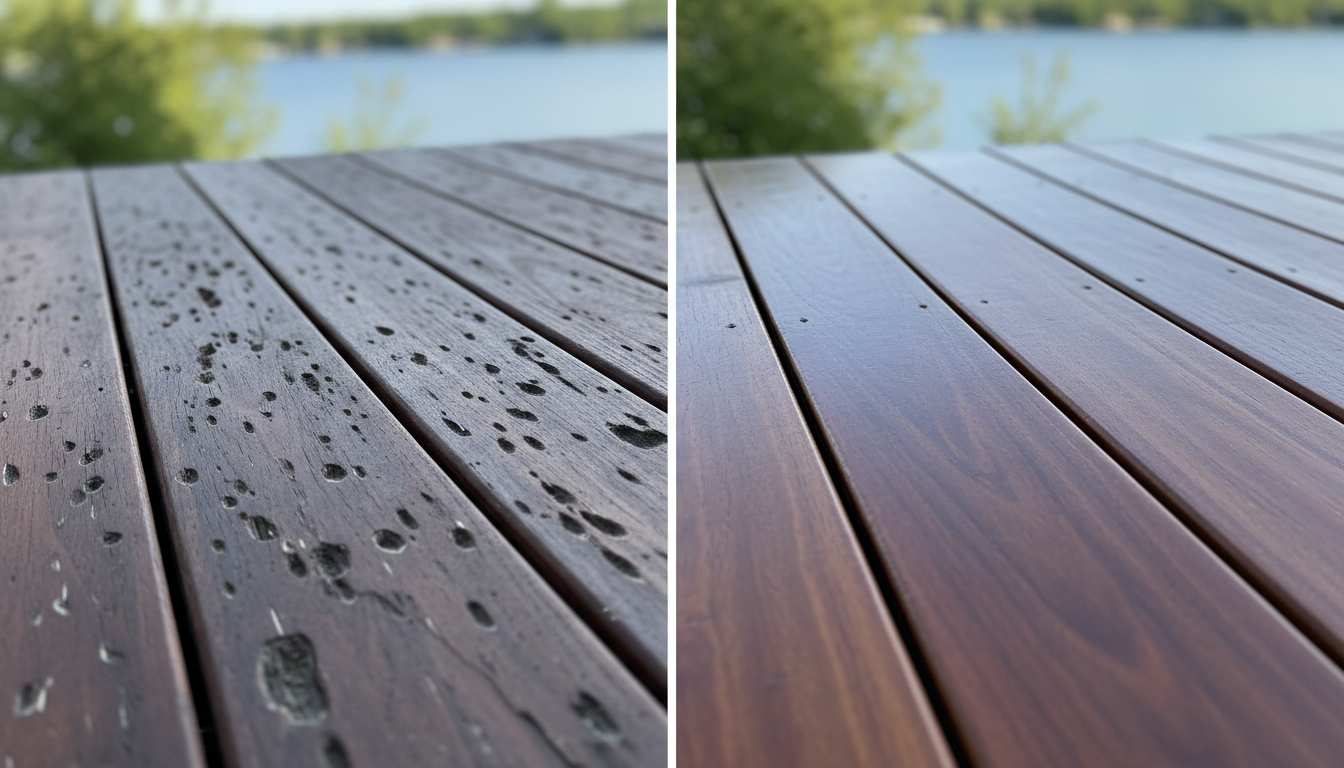
Restoring Ipe deck storm damage is an exercise in timber physics. Unlike domestic softwoods, exotic hardwoods possess a cellular structure so tight they are nearly impervious to traditional finishing methods. When heavy winds, hail, and torrential rains compromise these surfaces, the path to restoration requires more than a simple coat of stain; it demands a master builder’s understanding of material science.
The Material Science of Exotic Hardwoods
To understand how to restore an exotic deck, one must first respect the biology of the timber. Ipe (Handroanthus spp.), often referred to as Brazilian Walnut, is a biological marvel. With a Janka hardness rating of 3,680 lbf, it is over ten times harder than Western Red Cedar. Its density is so significant that it does not float; rather, it sinks in water. Furthermore, Ipe boasts a Class A fire rating, the same category assigned to concrete and steel.
This extreme density is a double-edged sword during restoration. While the wood is naturally resistant to rot and termites, its non-porous nature means that moisture trapped within the grain during a Lake Minnetonka storm can lead to “cupping” or “crowning” if not managed with technical precision. In the luxury estates of Orono, where architectural continuity is paramount, the restoration of these materials must be approached with the same care as restoring custom millwork inside the home.
The Anatomy of Storm Impact on Lake Minnetonka
Storms on the lake introduce three primary threats to exotic hardwoods: mechanical impact, hydrostatic pressure, and lignin degradation.
- Mechanical Impact: Large-stone hail and wind-borne debris can cause “bruising” on the surface of Teak or Ipe. While these woods rarely crack, the impact can compress the fibers, creating a localized vulnerability where moisture can settle.
- Hydrostatic Pressure: Excessive rainfall followed by the humid heat typical of a Minnesota summer creates a pressure gradient. If the deck’s underside is not properly ventilated—a common issue in low-slung lakeside boathouses—the moisture differential between the top and bottom of the board causes the wood to move, potentially shearing stainless steel fasteners.
- Lignin Detachment: High-velocity wind and rain, often exacerbated by improper “DIY” pressure washing post-storm, can lead to the detachment of lignin—the organic polymer that binds wood fibers together. This results in “fuzzing,” a structural deterioration that ruins the silken tactile quality of luxury decking.
The Technical Restoration Sequence
At Partners Restoration, our approach to restoring Ipe deck storm damage is dictated by a rigorous, builder-led protocol designed to return the timber to its “better-than-before” state.
Phase I: Diagnostic Moisture Monitoring
Before any abrasive or chemical process begins, we conduct a moisture content (MC) audit. For exotic hardwoods in the Medina and Orono microclimates, the equilibrium moisture content must be stabilized. We utilize electromagnetic moisture meters calibrated specifically for high-density tropical species. Proceeding with restoration on “wet” Ipe is a recipe for coating failure and structural warping.
Phase II: pH-Balanced Decontamination
The standard “bleach and blast” method used by many contractors is catastrophic for exotic woods. Sodium hypochlorite (bleach) breaks down the lignins and “whitens” the wood by damaging its natural oils. We utilize a two-step pH-balanced system. First, an alkaline cleaner lifts the deep-seated grey oxidation and organic lake matter. This is followed by a citric or oxalic acid neutralizer that opens the pores of the wood and restores the natural pH, preparing the fibers for molecular adhesion with the finish.
Phase III: Precision Grit-Sequence Sanding
Because Ipe is so hard, it cannot be sanded like Oak or Pine. Our artisans employ a specific grit sequence—typically starting with a 40-60 grit to level the “bruised” fibers and finishing with an 80-grit. We never exceed 80-grit on exotic decking; doing so “burnishes” the wood, closing the pores and preventing the finishing oils from penetrating. This stage is where our architectural reconstruction expertise shines, ensuring every edge and miter is flush and refined.
Wood Species Comparison: Restoration Complexity
Understanding the specific challenges of your estate’s timber is vital for long-term maintenance. The following table illustrates why exotic species require specialized intervention.
| Wood Species | Density (Janka) | Restoration Challenge |
|---|---|---|
| Ipe | 3,680 lbf | Extreme hardness; requires specialized carbide-tipped tools and precision sanding. |
| Western Red Cedar | 350 lbf | Fiber bruising and softness; extremely susceptible to lignin damage from pressure. |
| Teak | 1,000 lbf | Natural oils interfering with sealants; requires specialized solvent-cleaning. |
| Cumaru | 3,540 lbf | High shrinkage rate; requires careful moisture monitoring to prevent checking. |
Phase IV: The “Better-Than-Before” Finishing
Standard deck stains sit on top of the wood like a film. On Ipe, these films will invariably peel within months due to the wood’s natural oils and lack of porosity. We utilize deep-penetrating, paraffinic oil-based finishes formulated specifically for tropical hardwoods. These oils utilize trans-oxide pigments that provide high UV protection—essential for the intense sun exposure on Lake Minnetonka—while allowing the wood to “breathe” and move naturally with the seasons.
Sourcing and Structural Integrity
In cases where storm damage is so severe that boards must be replaced—such as from a fallen Burr Oak or structural failure—Partners Restoration ensures that replacement timber is FSC-certified (Forest Stewardship Council). This ensures not only the ethical sourcing of the timber but also that the moisture-kiln drying process matches the existing installation, preventing the “zipper effect” where new boards move differently than the old ones.
Restoration in Orono and Medina often involves complex joinery—hidden fastener systems, plugged screw holes, and custom-scribed transitions. Our background as master builders allows us to address the substructure (the joists and beams) which are often forgotten. A beautiful Ipe surface is only as good as the pressure-treated or steel framework beneath it, which may have been shifted by the hydrostatic pressures of a Lake Minnetonka surge.
Key Takeaways for the Luxury Estate Owner
- Specific Grit Sequences: Avoid over-sanding; 80-grit is the “sweet spot” for exotic oil absorption.
- Moisture Monitoring: Never seal an exotic deck until the internal moisture content is within the target range for the Lake Minnetonka climate.
- Builder-Led Approach: Restoration should be handled by those who understand the physics of timber, not just the aesthetics of stain.
Frequently Asked Questions
Can storm-damaged Ipe be salvaged?
Yes. In fact, Ipe is one of the most salvageable materials on earth. Because its density prevents deep rot, almost any surface damage, grey oxidation, or “fuzzing” can be remediated through technical sanding and pH-balanced cleaning.
Why not pressure wash my exotic hardwood deck?
High-pressure water causes “lignin detachment.” In high-density woods, this forces the wood fibers to stand up and stay up, creating a permanent rough texture that traps dirt and destroys the wood’s natural luster. Low-pressure, chemical-assisted cleaning is the only artisan-approved method.
Schedule an Exterior Material Audit
Your estate’s exterior deserves the same level of artisan care as its interior. If your Ipe, Teak, or Cumaru deck has been impacted by recent storms, contact the specialists who understand the material science of luxury timber.
Click here to schedule your professional assessment with Partners Restoration.
Leave A Comment