
In the quiet enclaves of Medina and along the pristine shorelines of Orono, a home is more than a mere residence; it is a curated collection of architectural intent. For the discerning estate owner, the soul of the home often resides in the details—the hand-carved mahogany library, the intricate wainscoting of a formal dining room, or the custom-milled crown moldings that provide a seamless transition between wall and ceiling. However, when water intrusion occurs—whether from a failing pipe or a structural breach—these artisanal features are the first to suffer.
As a Master Carpenter and Reconstruction Lead, I view custom millwork restoration after water damage not merely as a task of mitigation, but as a preservation of heritage. The restoration of high-end woodwork requires a delicate balance of material science, technical precision, and old-world craftsmanship. In this guide, we will explore the builder’s perspective on stabilizing and replicating the intricate timber elements that define your estate.
The Material Science: Why Custom Millwork is Unique
To understand why custom millwork requires a specialized approach, one must first understand the hygroscopic nature of fine hardwoods. Unlike the mass-produced, finger-jointed pine found in standard residential construction, custom millwork in luxury estates often utilizes solid hardwoods or exotic veneers. These materials are living histories, sensitive to the slightest fluctuations in their environment.
When water saturates a custom-milled piece, the wood fibers swell at a molecular level. This expansion is rarely uniform. Because wood is anisotropic—meaning it possesses different physical properties in different directions—it may cup, bow, or twist depending on the grain orientation. In high-value interiors, the joinery is often executed with such precision that even a millimeter of movement can compromise the structural and aesthetic integrity of an entire room.
Furthermore, many custom finishes—such as hand-rubbed oils, French polishes, or multi-layered glazes—react poorly to prolonged moisture. The “blushing” or clouding of a finish is often the first sign of deep-seated moisture issues. Our approach begins with a forensic analysis of the wood species and the finish type to determine the most non-invasive path toward restoration.
The Art of Stabilization: Advanced Drying Protocols
The instinct of many general contractors is to “rip and replace” upon discovering water damage. From a builder’s perspective, this is a last resort. The first priority is always stabilization. However, the drying of custom millwork cannot be rushed. Aggressive, high-heat drying can cause “case hardening,” where the exterior of the wood dries and shrinks while the interior remains saturated, leading to catastrophic splitting and checking.
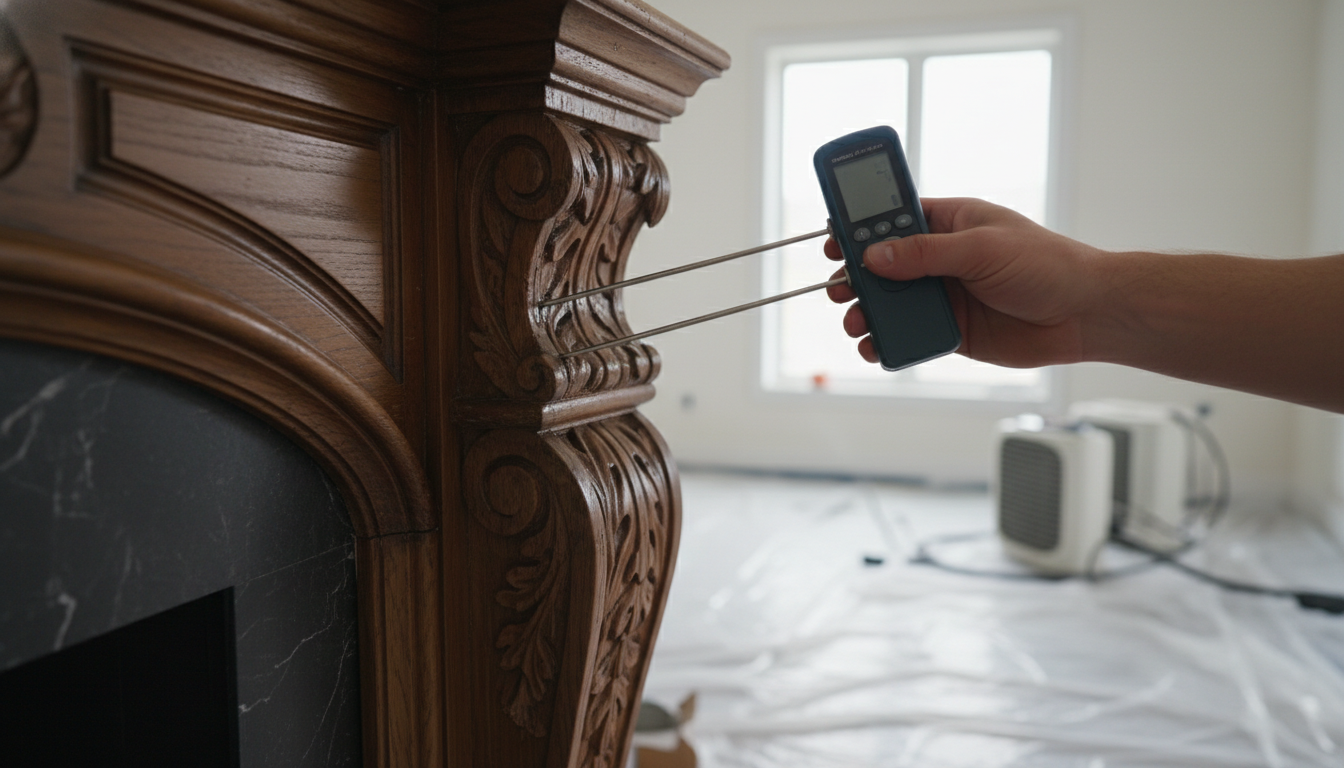
We utilize technical dehumidification to create a controlled micro-environment. This involves using LGR (Low Grain Refrigerant) or desiccant dehumidifiers to slowly draw moisture out of the wood fibers. By monitoring the “dry standard” of unaffected wood in other parts of the estate, we can calibrate our equipment to return the damaged millwork to its original equilibrium moisture content (EMC).
In cases where water is trapped behind ornate paneling, we employ “surgical” drying techniques. Rather than dismantling the entire installation, we may use injected airflow systems that deliver dry air into the wall cavities through discrete access points. This allows us to dry the substrate and the back-side of the millwork simultaneously, often saving thousands of dollars in replacement costs and preserving the original patina of the wood.
The following table outlines our strategic approach based on the specific wood species and their inherent sensitivities:
| Wood Type | Sensitivity | Restoration Strategy |
|---|---|---|
| Walnut/Oak | High | Slow, controlled desiccant drying to prevent checking. |
| Painted Poplar | Medium | Moisture monitoring and precise finish matching post-stabilization. |
| Exotic Veneers | Very High | Climate-controlled stabilization; vacuum-press re-bonding if delamination occurs. |
The Replication Process: When Restoration Becomes Reconstruction
Despite our best efforts at stabilization, there are instances where the cellular structure of the wood has been too severely compromised. This is where our roots in architectural reconstruction become our greatest asset. When a profile is no longer available “off the shelf”—which is almost always the case in West Metro estates—we transition from restorers to makers.
1. Profile Mapping
If a section of crown molding or a baseblock is unsalvageable, we take a cross-section of the original piece. Using digital calipers and traditional profile combs, we map the exact geometry of the molding. This ensures that the new piece will be indistinguishable from the 100-year-old original.
2. Tooling and Milling
In our dedicated millwork shop, we often grind custom knives to match unique architectural profiles. Whether it is a complex Greek Revival ogee or a contemporary minimalist reveal, we replicate the exact cutters required. We select our replacement timber not just by species, but by grain pattern and growth ring density to ensure a seamless visual match.
3. The Better-Than-Before Philosophy
Our goal is never just “good enough.” We aim for a “Better-Than-Before” result. This involves treating the back-sides of new millwork with moisture-resistant sealants—a step often missed during original construction—to provide an extra layer of protection against future incidents. When the new pieces are installed, our finishing specialists use forensic color-matching to blend the new timber with the existing, aged woodwork, accounting for the natural “ambering” that occurs over time.
The Economics of Restoration: Custom vs. Stock
Estate owners often ask about the cost-benefit analysis of restoration versus replacement. In a high-end environment, the “replacement” of a single room’s millwork often necessitates the replacement of the entire floor’s trim to maintain continuity. This can lead to astronomical costs.
- Stock Millwork: Replacement costs typically range from a meaningful amountto a meaningful amountper linear foot, including labor. However, the “hidden cost” is the loss of home value when architectural integrity is compromised.
- Custom Millwork: Replicating custom profiles can range from a meaningful amountto a meaningful amount+ per linear foot depending on the species and complexity. However, by utilizing custom millwork restoration water damage techniques to save even a substantial portion of the original material, the overall project cost is significantly reduced, and the home’s provenance remains intact.
Frequently Asked Questions
Will my crown molding need to be removed?
Not always. If the water intrusion is caught early, we can often save the molding in place. If the wall cavity can be dried through targeted injection drying, the molding can often be saved without ever pulling a nail. Our priority is minimal disruption to the original fabric of the room.
Can you match the stain of my 20-year-old cherry cabinets?
Yes. Wood changes color as it oxidizes and is exposed to UV light. We don’t just use the original stain formula; we create a custom tint that matches the current, aged state of your cabinetry, ensuring a perfect “invisible” repair.
Preserving the Legacy of Your Estate
Water damage is a traumatic event for any property, but for an estate defined by its custom interiors, the stakes are significantly higher. It requires more than a restoration company; it requires a team with the soul of a builder and the hands of a craftsman. By combining the latest in moisture-tracking technology with time-honored woodworking traditions, we ensure that your home’s most beautiful features are not just recovered, but meticulously preserved for the next generation.
If you are facing the challenge of water damage in a home with custom architectural details, do not settle for standard mitigation. Demand a builder’s perspective.
Ready to Restore Your Masterpiece?
Our specialists are ready to provide a forensic evaluation of your estate’s custom woodwork and develop a bespoke restoration plan.
Leave A Comment