“`html
The Stewardship of Wayzata’s Coastline: Navigating MCWD Permit Requirements
By: Wayzata Reconstruction Consultant
The Environmental Context: Preserving the Legacy of Lake Minnetonka
To own an estate in Wayzata is to hold a piece of Minnesota’s history. From the sweeping lawns of Ferndale to the secluded points of Bushaway Road, our properties are more than just real estate; they are the frontline of Lake Minnetonka’s ecological health. As stewards of these prestigious shorelines, we understand that the crystalline beauty of the water is not a guarantee—it is a result of meticulous management and an unwavering commitment to environmental equilibrium.
The Minnehaha Creek Watershed District (MCWD) serves as the primary arbiter of this balance. For the sophisticated homeowner, shoreline restoration is not merely a landscaping project; it is a sophisticated engineering endeavor that must reconcile architectural ambition with rigorous ecological standards. Whether you are addressing the slow creep of erosion or restoring an estate following significant storm damage, understanding the nuances of Wayzata shoreline restoration permits is the first step in protecting your investment and the lake’s legacy.
In Wayzata, the “shoreland zone” is viewed through a lens of long-term sustainability. The MCWD focuses heavily on reducing phosphorus loading and sediment runoff—the two primary culprits behind algae blooms and water quality degradation. When we approach a restoration project, we aren’t just looking at the view; we are looking at the root systems, the soil composition, and the hydrology of the entire parcel. This holistic view often intersects with historic preservation efforts, ensuring that as we modernize the shoreline’s resilience, we do not lose the classic character that defines our community.
Navigating the MCWD Permit Landscape: A Tiered Approach
For many Lake Minnetonka estate owners, the permit process can appear daunting. However, the MCWD’s regulatory framework is designed to ensure that any disturbance to the land is mitigated by a corresponding benefit to the water. The threshold for requiring a permit is lower than many realize. Essentially, any activity that moves earth, alters vegetation, or changes the structural integrity of the shoreline within 50 to 100 feet of the ordinary high-water level (OHW) will trigger a review.
The primary categories of oversight include Erosion and Sediment Control, Shoreline Stabilization, and Buffer Requirements. In Wayzata, where the topography can vary from gentle slopes to steep bluffs, the “Erosion Control” permit is almost always a prerequisite for restoration. This ensures that during the construction phase, no silt or debris enters Wayzata Bay. Furthermore, if your project involves more than 50 cubic yards of earthwork—a common occurrence when leveling a lawn or installing a tiered retaining wall—the MCWD’s scrutiny increases significantly.
A sophisticated restoration plan does more than just meet the minimum requirements; it integrates native vegetation that acts as a natural filter. The MCWD mandates that a “buffer” of native plants be established in most restoration scenarios. This isn’t merely a strip of wild grass; in a high-end estate context, it is an opportunity for exquisite naturalistic planting design that uses deep-rooted sedges and flowering perennials to anchor the soil while providing a lush, private aesthetic.
Implementation: From Blueprint to Bedrock
The transition from a permitted design to a physical reality requires a specialized touch. In Wayzata, the challenges are unique: tight access points for heavy machinery, the need to protect century-old oaks, and the requirement for immediate stabilization of disturbed soils. As your reconstruction consultants, we manage the intersection of these complexities. We treat the shoreline as a piece of living architecture.
The 2024 MCWD permit processing timelines suggest a 30 to 60-day window for standard reviews, though complex variances can extend this. To maintain your project timeline, it is essential that the engineering and ecological assessments are performed concurrently. We utilize advanced topographic mapping and soil analysis to ensure that the permit application is bulletproof upon first submission. This proactive approach prevents the costly “stop-work orders” that can occur when a builder lacks the specific expertise in watershed regulations.
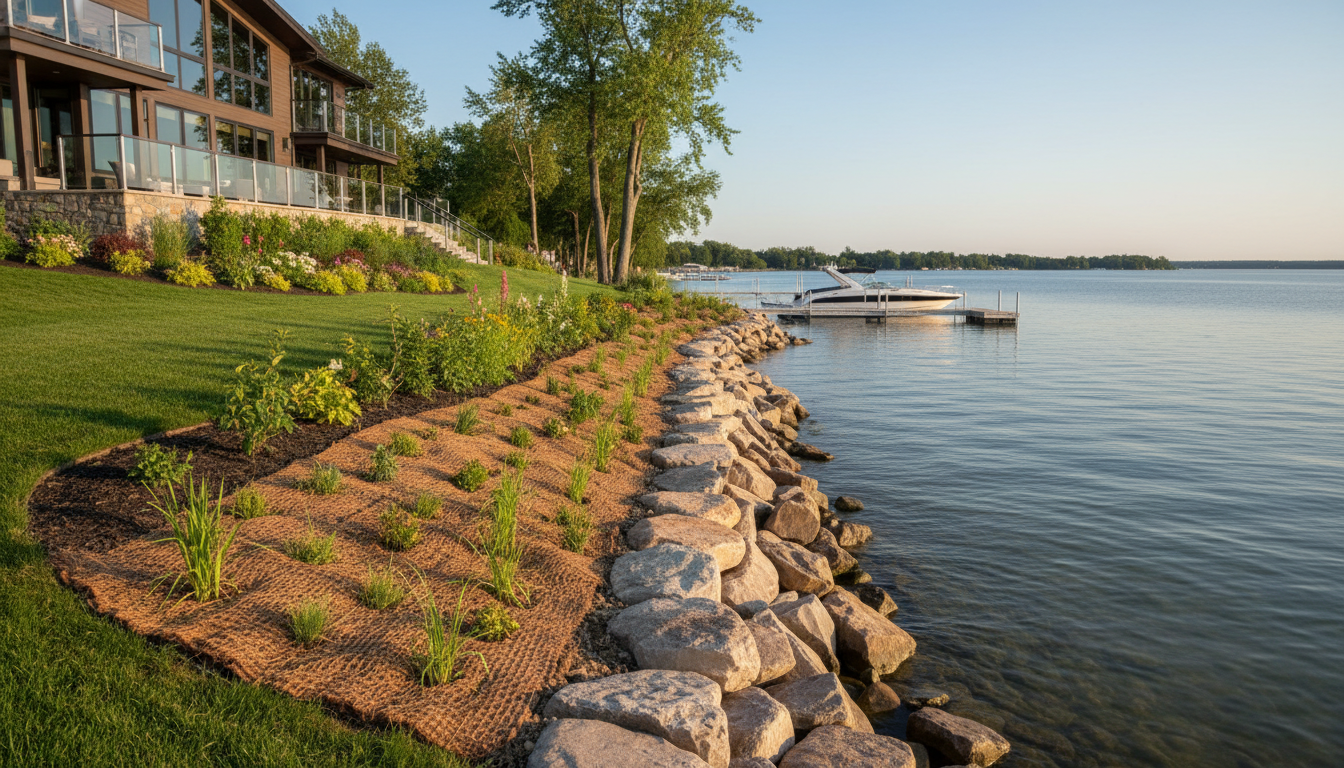
During implementation, we prioritize “soft armoring” techniques. While traditional rip-rap (rock) has its place, many of Wayzata’s most beautiful estates are moving toward bio-engineered solutions. These involve using coconut fiber coir logs, live stakes, and fieldstone to create a shoreline that looks natural and absorbs wave energy from passing watercraft, rather than reflecting it and causing further erosion down-shore.
Permit Thresholds and Action Requirements
Understanding the specific triggers for MCWD involvement is vital for estate planning. The following table outlines the common thresholds for property owners in the Wayzata area.
| Permit Type | Threshold | Required Action |
|---|---|---|
| Erosion Control | >50 cubic yards of earth or >5,000 sq ft of disturbance | Silt fencing, bio-logs, and formal MCWD filing. |
| Shoreline Stabilization | Any work below or at the Ordinary High Water (OHW) mark | Biological or structural reinforcement design. |
| Shoreline Buffer | Any major shoreline disturbance or new construction | Restoration with native vegetation (deep-rooted species). |
| Waterbody Crossing/Structures | Docks, boat houses, or stairs within the shoreland zone | Detailed structural engineering and impact mitigation. |
The Partners Restoration Advantage
At Partners Restoration, we do not view environmental compliance as a hurdle, but as a blueprint for excellence. Our specialty lies in the high-stakes environment of Lake Minnetonka estate reconstruction. We understand that a Wayzata homeowner expects a seamless transition from the mahogany decks of their home to the natural stone of their shoreline. Our team handles the bureaucratic weight of the MCWD and city permits, allowing you to focus on the aesthetic and functional vision for your property.
Whether your project is a preventative measure to ensure the longevity of your land or a necessary response to the shifting climate and increased storm intensity, we bring a level of sophistication that matches the caliber of your estate. By integrating builder-led teams with ecological experts, we ensure that every square foot of your shoreline is both a sanctuary for you and a filter for the lake we all cherish.
Frequently Asked Questions
- Do I need an MCWD permit for a dock house?
Yes, if the project involves structural stabilization or any earth moving within the shoreland zone. Even if the structure itself is permitted by the city, the “land-side” impact usually falls under MCWD jurisdiction. - How long does the permit process take in 2024?
Typically, you should allow for 45 days. However, by having a pre-application meeting and submitting a complete package, we can often streamline the internal review cycles. - Can I use traditional lawn turf up to the water’s edge?
Under current MCWD rules for restoration projects, a native buffer is almost always required. We can, however, design these buffers to be aesthetically pleasing and integrated with your manicured lawn areas.
Ensure Your Estate’s Compliance and Beauty
Don’t navigate the complexities of Lake Minnetonka regulations alone. Protect your property with an expert evaluation.
“`
Leave A Comment