
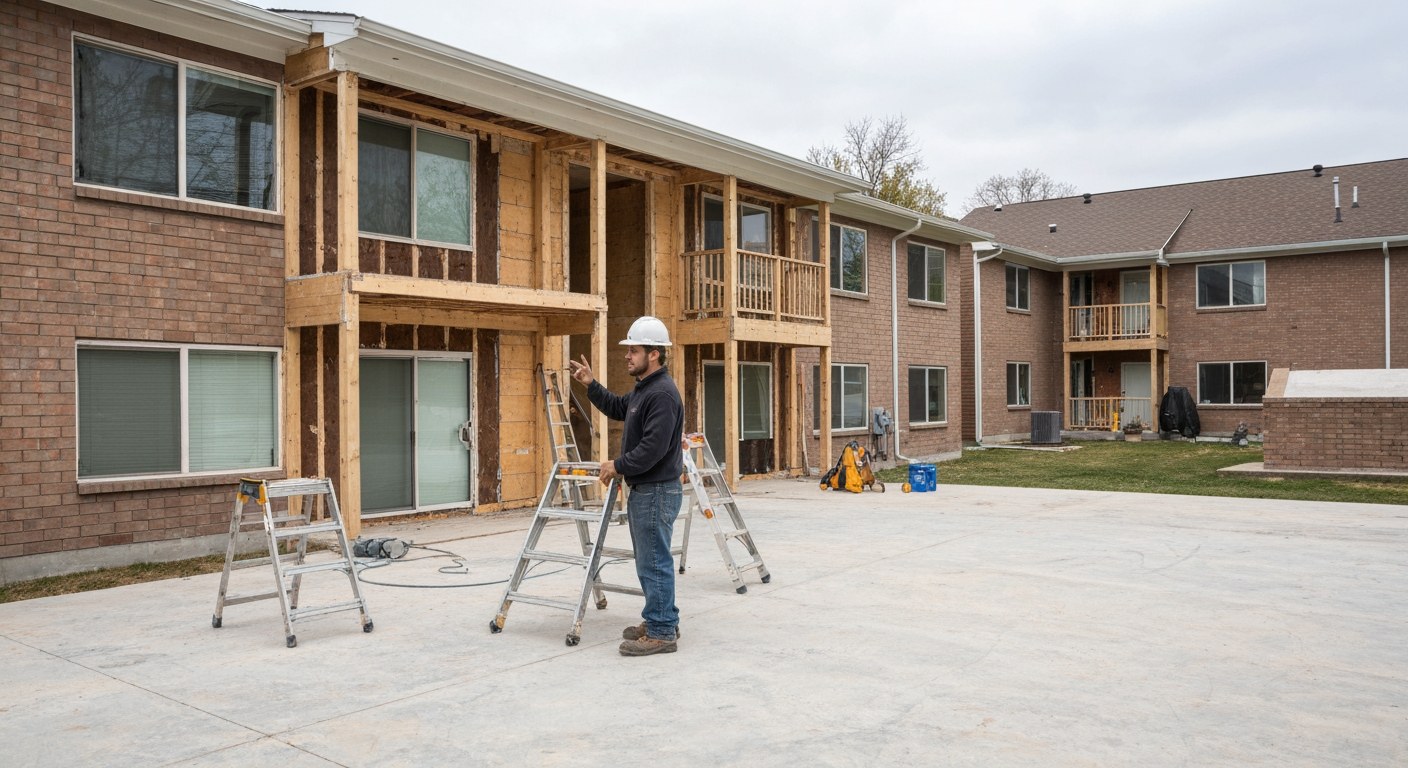
St. Louis Park has a dense and diverse multi-family housing stock — everything from 1960s garden-style apartment complexes to newer mid-rise condos along the Highway 100 corridor. Renovation and restoration projects in this market require a different operational approach than single-family residential work: tenant coordination, phased occupancy management, commercial permit requirements, and the ability to execute at scale without disrupting building operations.
Common Multi-Family Renovation Scopes in St. Louis Park
Water Damage Restoration Across Multiple Units
A pipe failure in a multi-family building rarely affects just one unit. When water migrates through floor assemblies, it can affect the unit of origin plus multiple units below, adjacent corridor framing, and building mechanical chases. The scope of work — extraction, drying, demolition, restoration — must be coordinated across all affected units simultaneously, with proper containment to protect unaffected areas.
Unit Renovation and Turnover
Turnover renovation in multi-family buildings — flooring, paint, kitchen and bath updates between tenants — requires a contractor who can work on a tight timeline without impacting occupied adjacent units. Noise, dust, and access scheduling all need to be managed in coordination with building management.
Common Area and Corridor Restoration
Lobbies, corridors, stairwells, and common mechanical rooms in multi-family buildings are high-use areas with specific code requirements for fire-rated assemblies, egress lighting, and accessibility. Restoration or renovation in these areas requires understanding the building code provisions that apply to common areas versus individual dwelling units.
Permit Requirements for St. Louis Park Multi-Family Work
St. Louis Park administers its own building permit process through the Community Development Department. Multi-family renovation projects are typically subject to Minnesota State Building Code Chapter 1309 (Existing Buildings), which sets different standards than new construction for how repairs and renovations must be performed. Work affecting fire-rated assemblies, structural elements, or egress paths requires specific permit documentation and inspection.
Insurance-driven restoration work still requires permits. Carriers do not exempt insurance claims from local permit requirements, and unpermitted restoration work can create problems at future sale or with subsequent insurance claims.
Insurance Claims on Multi-Family Properties
Multi-family insurance claims involve commercial property policies rather than standard homeowner’s policies, and the claim process is materially different. Commercial adjusters evaluate business income loss, loss of rents, and the cost of relocating displaced tenants — in addition to the physical damage scope. IICRC-certified documentation of the water or fire damage scope is still the standard that commercial adjusters use, but the overall claim structure is more complex.
Property managers navigating a large multi-family loss often benefit from a restoration contractor who can serve as a single point of coordination — managing subcontractors, providing daily progress reports, coordinating tenant re-entry, and maintaining the documentation trail the carrier needs to close the claim.
Partners Restoration for St. Louis Park Multi-Family Projects
Partners Restoration works with property owners and managers on multi-family restoration and renovation projects across the western Minneapolis suburbs, including St. Louis Park, Hopkins, and Minnetonka. Our team is IICRC-certified for water damage and mold remediation, licensed for residential and commercial construction, and experienced with insurance claim coordination on commercial property policies. Contact us for an assessment on any multi-family project.
Frequently Asked Questions
Do I need a permit for interior renovation in a St. Louis Park apartment building?
In most cases, yes. Work affecting structural elements, plumbing, electrical, or fire-rated assemblies requires permits regardless of whether the project is insurance-driven or owner-initiated. Contact St. Louis Park Community Development for project-specific requirements.
Who is responsible for damage to tenant belongings in a multi-family water loss?
This is a liability question that depends on the cause of loss, the lease terms, and respective insurance policies (building owner’s commercial policy vs. tenant’s renter’s insurance). Document the cause and origin of the loss carefully from the outset.
Can you do phased renovation in an occupied building?
Yes, with proper planning. Phased renovation in occupied buildings requires containment barriers, coordinated access scheduling, noise management, and clear communication with building management and tenants. It’s a standard approach for multi-family renovation.
Leave A Comment