
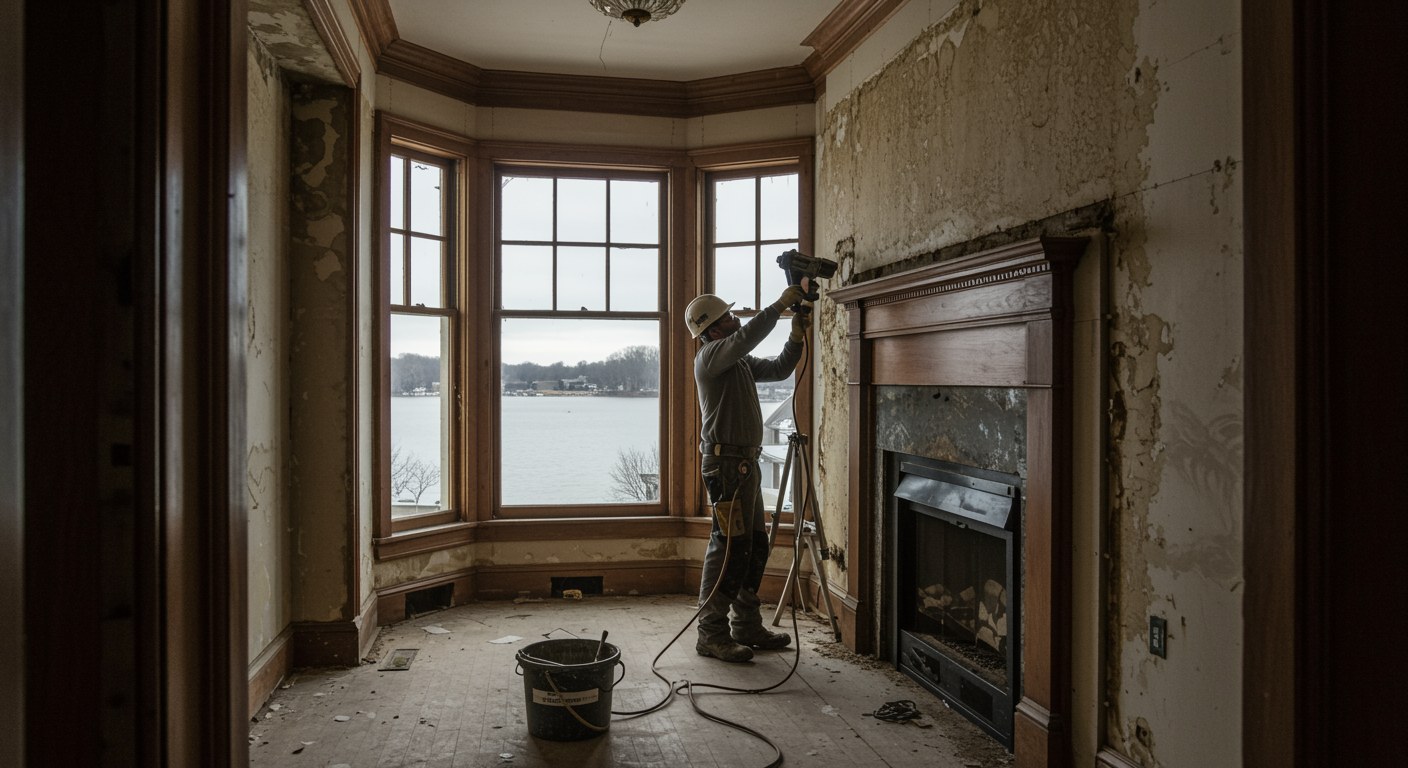
Mold remediation in a Wayzata estate is not the same project as mold remediation in a 1990s suburban home. The materials at stake — original plaster, century-old hardwood, custom millwork, period tile — cannot be replaced with commodity products. The moisture sources are specific to the lakefront environment and the age of the construction. And the documentation requirements, for both insurance and potential real estate transactions, need to meet a higher standard. This is what we’ve learned working on Wayzata properties.
Lake Minnetonka’s Water Table: The Constant Pressure on Wayzata Foundations
Wayzata Bay is at the northeast corner of Lake Minnetonka — 14,004 acres of water whose level fluctuates substantially with seasonal conditions. The Minnehaha Creek Watershed District manages outflow through Gray’s Bay Dam, but the lake still rises significantly in wet years. When the lake rises, the groundwater table around shoreline and near-shore properties in Wayzata rises with it.
For Wayzata’s older estates — particularly those on the north shore along Ferndale Road and Bushaway Road — this means that the moisture pressure against their foundations has existed for as long as the home has stood. Original masonry foundations from the 1920s and 1930s weren’t waterproofed with modern membranes. They relied on thickness and drainage to manage water. In dry years, they manage fine. In high-water years, they transmit moisture into lower levels at rates that older plaster and wood framing were not designed to handle indefinitely.
Where Mold Appears in Wayzata Homes: A Material-Specific Guide
Masonry Foundation Walls and Stone Basements
Original masonry foundations in Wayzata’s oldest estates — fieldstone, brick, or early concrete block — are porous by modern standards. Moisture transmission through these walls is not a defect; it’s a characteristic of the material. Over decades, this persistent moisture produces efflorescence (white mineral deposits) on the wall surface and, in spaces with inadequate ventilation, mold on organic materials stored near the walls. In finished lower-level spaces, moisture transmission through original masonry can produce mold behind wood paneling, on carpet backing, and on the framing of any wall built against the original foundation.
Original Plaster Walls
Plaster has different moisture absorption and vapor transmission characteristics than gypsum drywall. It’s also bonded to metal lath or wood lath rather than paper-faced gypsum core. Mold in plaster walls can penetrate into the plaster body rather than staying on the surface — making surface cleaning ineffective. But plaster is also more forgiving of minor moisture events than drywall, which fails rapidly when wet. Assessment of plaster mold requires understanding the material’s specific behavior, not applying drywall remediation assumptions to a different substrate.
Period Hardwood Floors
Wide-plank hardwood floors in Wayzata’s older estates are typically nailed directly to the subfloor over a paper underlayment. Mold in this assembly — on the underside of the flooring, in the paper, or in the subfloor — comes from moisture rising from below (crawl space or basement humidity) rather than spilling from above. By the time visible cupping or musty odor indicates a problem, the paper underlayment and the underside of the flooring have often been colonized for years. Assessment requires checking moisture content in the flooring from below, either through a crawl space or a small test opening.
The Remediation Approach for Historic Materials
Standard mold remediation protocol defaults to removal: cut out the drywall, bag it, dispose of it. That’s appropriate for commodity construction. It’s not always appropriate for Wayzata’s historic materials, and in some cases it causes more damage than the mold itself.
For Wayzata estates, we assess each element individually:
- Original plaster — in cases of surface mold without deep penetration, cleaning, HEPA vacuuming, and antimicrobial treatment can be performed without removal. Full removal is appropriate when the lath is contaminated or the plaster body is deeply colonized.
- Custom millwork and built-ins — period millwork can often be carefully disassembled, treated, and reinstalled. This requires someone who knows how to disassemble it without damaging it and how to reassemble it properly. We don’t default to tearout when preservation is achievable.
- Original hardwood floors — mold remediation in the subfloor assembly beneath original hardwood typically doesn’t require removing the floor. We access from below where possible, treat the affected assembly, and replace the subfloor if necessary while preserving the hardwood above.
Documentation for Wayzata Properties: Real Estate and Insurance Implications
Mold remediation in a high-value Wayzata estate has two downstream documentation requirements that don’t apply the same way to standard properties: insurance claim support and real estate disclosure. For insurance claims, documentation of the scope, the standard followed (IICRC S520), and the clearance testing results supports a complete settlement. For real estate, documentation that remediation was performed to standard — with independent clearance testing — is the difference between a disclosed-and-remediated situation that doesn’t affect a transaction and an undocumented situation that creates liability.
Partners Restoration provides complete remediation documentation packages for Wayzata properties: scope of work, before and during photos, clearance testing results, and a remediation certificate. This documentation is prepared in a format suitable for both insurance adjusters and real estate disclosures.
Frequently Asked Questions — Mold Remediation in Wayzata, MN
Why are Wayzata’s historic lakefront homes particularly vulnerable to mold?
Wayzata’s oldest estates — many built in the early to mid 20th century along Ferndale Road and Bushaway Road — were constructed with materials and methods that predate modern vapor management. Original masonry foundations lack waterproofing membranes. Original plaster walls have different moisture absorption characteristics than modern drywall. And the proximity to Lake Minnetonka means the surrounding soil is persistently moist, with groundwater that tracks lake levels. These factors combine to create chronic moisture stress on building assemblies that have been in service for 60 to 100 years.
How does Lake Minnetonka’s water level affect mold risk for shoreline properties?
When Lake Minnetonka is at high water — driven by a wet spring or sustained rainfall in the upper watershed — the groundwater table around shoreline properties rises directly with the lake. This elevated groundwater increases vapor pressure against lower-level foundations and below-grade spaces. In homes where basement or lower-level waterproofing is inadequate or aging, this produces chronic moisture conditions that support mold growth even without any rain event or plumbing failure.
Can original plaster and historic millwork be preserved during mold remediation?
Yes, with the right approach. Historic plaster and period millwork require a different remediation strategy than modern drywall. Plaster can sometimes be cleaned and treated without full removal — depending on the extent of contamination and the depth of mold penetration into the substrate. Custom millwork and built-ins can often be disassembled, treated, and reinstalled. The key is working with a contractor who understands these materials and doesn’t default to tear-out when preservation is feasible. Partners Restoration assesses each element individually.
What mold testing should Wayzata homeowners request before and after remediation?
Before remediation, air sampling establishes a baseline mold count and identifies spore types present. After remediation, clearance testing by an independent industrial hygienist confirms that mold levels are within acceptable range before reconstruction begins. For high-value Wayzata properties, we recommend independent post-remediation testing — not testing performed by the remediation contractor themselves — to provide documentation that’s unimpeachable in the context of a real estate transaction or insurance claim.
How long does mold remediation take in a Wayzata estate?
Timeline depends on scope and material complexity. A contained bathroom or utility room issue may take two to three days. Mold in multiple rooms or throughout a finished lower level may take one to two weeks. Projects involving historic materials that require careful disassembly and treatment rather than tear-out take longer but preserve materials that may be irreplaceable. We provide a project timeline after the initial assessment.
Mold concern in a Wayzata property? Contact Partners Restoration for an assessment. Based in Medina, 10 minutes from Wayzata. Call 952.500.2426.
Also see: Mold remediation services in Wayzata | All restoration and remodeling services in Wayzata, MN | Water damage restoration in Wayzata
Leave A Comment