
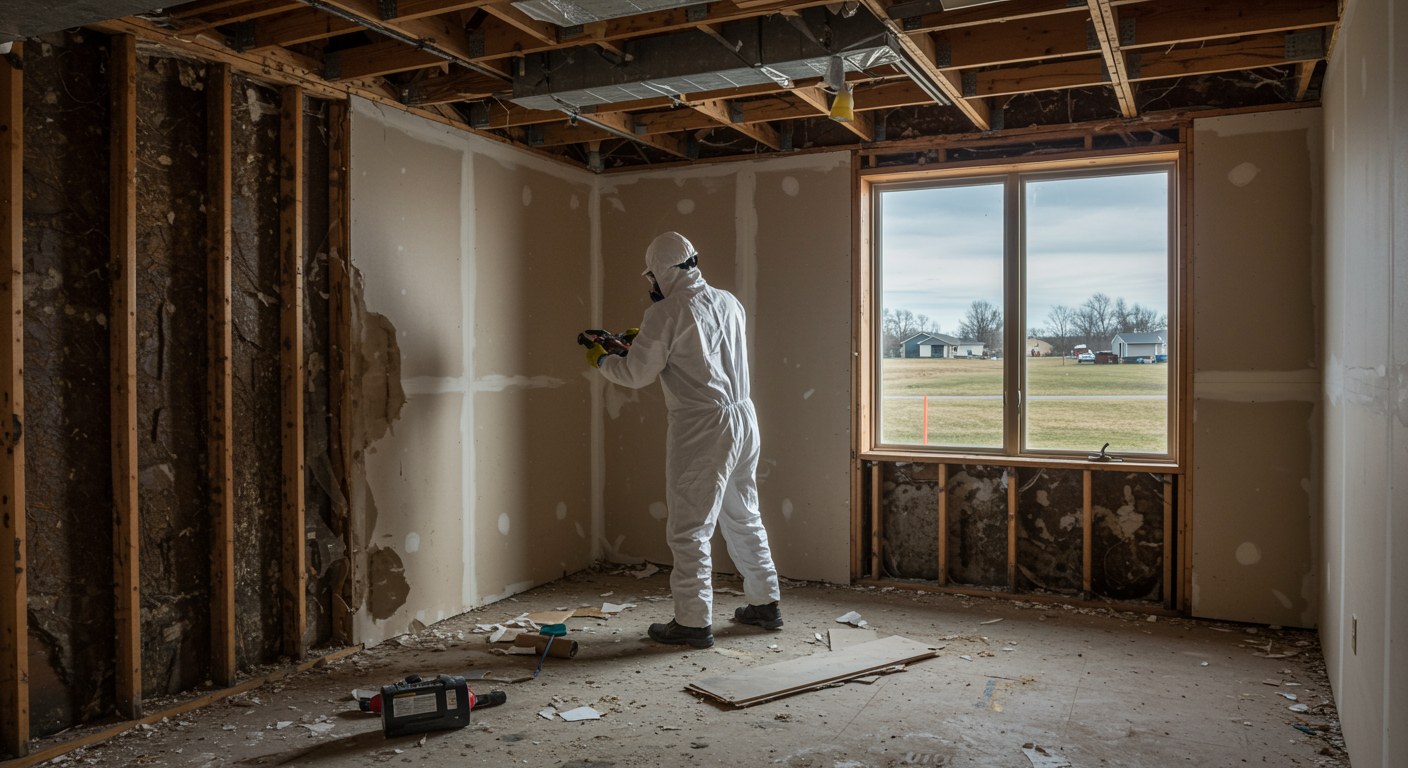
The mold pattern in Maple Grove is remarkably consistent: homeowners opening up a finished basement for renovation — in a home that’s never had a visible water event — find wall cavities with significant mold coverage on the back face of the drywall, in the insulation, and on the framing. No leak to point to. No stain on the ceiling. Just 25 to 35 years of vapor transmission doing its work in a pond-adjacent lot where the soil moisture has always been elevated. This is the dominant mold scenario in Maple Grove, and it requires understanding what caused it before you can fix it correctly.
The Mechanics: How Vapor Transmission Creates Mold Without a Leak
Concrete foundation walls are not vapor barriers. They transmit moisture vapor from surrounding soil into the wall assembly continuously. The rate of transmission depends on soil moisture — and in Maple Grove’s pond-adjacent neighborhoods, soil moisture is persistently elevated because stormwater ponds maintain a higher water table in adjacent properties year-round.
In the standard 1990s basement wall assembly — 2×4 framing against the concrete, fiberglass batt insulation between studs, drywall — moisture vapor enters from the concrete side, passes through the insulation, and reaches a temperature differential where it condenses. In Minnesota’s heating season, the condensation point is typically the cold face of the insulation or the back face of the drywall. Over years, this condensation produces moisture accumulation on organic materials. The paper face of drywall and the wood framing are cellulose substrates. Mold is patient. It establishes, spreads, and colonizes wall-length sections in the time it takes to complete a bathroom renovation.
The symptom is the musty smell. The diagnosis is moisture meter readings showing elevated moisture in the wall assembly without any obvious source. The finding, when walls come open, is often extensive — not a small patch but a long run of contamination across the entire wall-to-concrete interface.
Eagle Lake and Pond-Adjacent Properties: Elevated Baseline, Elevated Risk
Eagle Lake’s documented water quality struggles — placed on the state’s impaired waters list in 2008 — reflect the same dynamic driving mold risk in adjacent homes: high nutrient and phosphorus loading from residential stormwater runoff. The lake receives significant inflow from Maple Grove’s developed neighborhoods, and the stormwater management infrastructure that routes that runoff affects the groundwater table in properties near the lake and the connecting pond network.
Properties within a few hundred yards of Eagle Lake, Fish Lake, Rice Lake, and Maple Grove’s extensive pond system have demonstrably elevated soil moisture compared to properties on the upland portions of Maple Grove’s suburban grid. This elevated moisture isn’t dramatic — it doesn’t flood basements or create obvious problems. It just keeps the soil slightly wetter, raises the groundwater table slightly higher, and increases the vapor transmission rate through foundation walls slightly more. Over three decades, “slightly” compounds into significant mold presence in wall cavities throughout the affected neighborhoods.
Mold in Maple Grove’s Attics: The Insulation Quality Variable
Maple Grove’s 1990s housing was built with variable attic insulation quality — better than the 1960s housing stock in comparable suburbs, but by no means consistent. Homes where air sealing at the attic floor was inadequately completed have been losing warm household air into the attic for three decades. This warm, humid air hits cold roof sheathing, condenses, and over time produces mold on the sheathing and in the insulation. The pattern shows up in two places: a musty smell when the HVAC runs (mold in the attic wicking into the air distribution system through ceiling penetrations), and visible mold on roof sheathing when a roofing contractor removes the first course of shingles.
Attic mold remediation in Maple Grove requires removing affected insulation, treating sheathing and rafters with HEPA vacuuming and antimicrobial treatment, and addressing the air sealing problem before reinstalling insulation. Replacing the insulation without fixing the air leakage will reproduce the same conditions.
Frequently Asked Questions — Mold Remediation in Maple Grove, MN
What causes mold in Maple Grove basements that have never had a water leak?
Vapor transmission through concrete foundation walls is the primary cause. Concrete is porous — it transmits moisture vapor from surrounding soil continuously. In Maple Grove’s pond-adjacent homes, soil moisture is persistently elevated. When moisture vapor enters a wall cavity built against the foundation — the standard 1990s construction method — it condenses on cooler surfaces and accumulates over years. After 25 to 35 years, the paper face of drywall, the insulation, and the wood framing in these cavities are often colonized with mold, with no leak event to point to.
How do I know if I have hidden mold in my Maple Grove basement?
The most reliable indicator before visible mold appears is a musty odor, especially when the HVAC runs or when the basement is closed up in summer. Other signs include allergy-like symptoms when spending time in the lower level, unexplained discoloration at baseboards or on the lowest courses of drywall, and condensation on basement windows or walls during summer. Professional assessment using moisture meters and thermal imaging can identify moisture accumulation zones without destructive testing.
Is mold in Maple Grove basement walls covered by homeowners insurance?
Mold from chronic vapor transmission and condensation — the most common type in Maple Grove’s 1990s housing — is generally not covered by standard homeowners insurance. It’s classified as a maintenance issue, not a sudden and accidental event. Mold that develops within 48 hours of a covered water damage event — burst pipe, appliance failure — may be covered under the original claim. The distinction matters enormously for who pays, which is why documenting the specific cause at the time of discovery is critical.
What does correct basement wall reconstruction look like after mold remediation in Maple Grove?
After IICRC S520 remediation, the correct reconstruction addresses the moisture pathway rather than just replacing like-for-like. The standard approach for Maple Grove basements includes: dimple mat drainage board against the concrete foundation wall (creates a drainage plane so moisture runs down rather than accumulating in the wall cavity), closed-cell spray foam insulation on the concrete face (vapor barrier at the cold surface, eliminating the condensation point), moisture-resistant paperless drywall, and whole-home dehumidification. Rebuilding with standard drywall and batt insulation without these changes will produce the same mold problem again.
How long does mold remediation take in a Maple Grove basement?
A typical contained mold issue in one or two wall sections takes two to four days. Whole-basement remediation involving multiple walls, subfloor, and HVAC takes one to two weeks. We provide clearance testing after remediation before reconstruction begins. Partners Restoration answers 24/7 at 952.500.2426.
Mold concern in your Maple Grove home? Contact Partners Restoration for a moisture assessment and mold inspection. Call 952.500.2426.
Also see: Mold remediation services in Maple Grove | All restoration and remodeling services in Maple Grove, MN | Water damage restoration in Maple Grove
Leave A Comment