
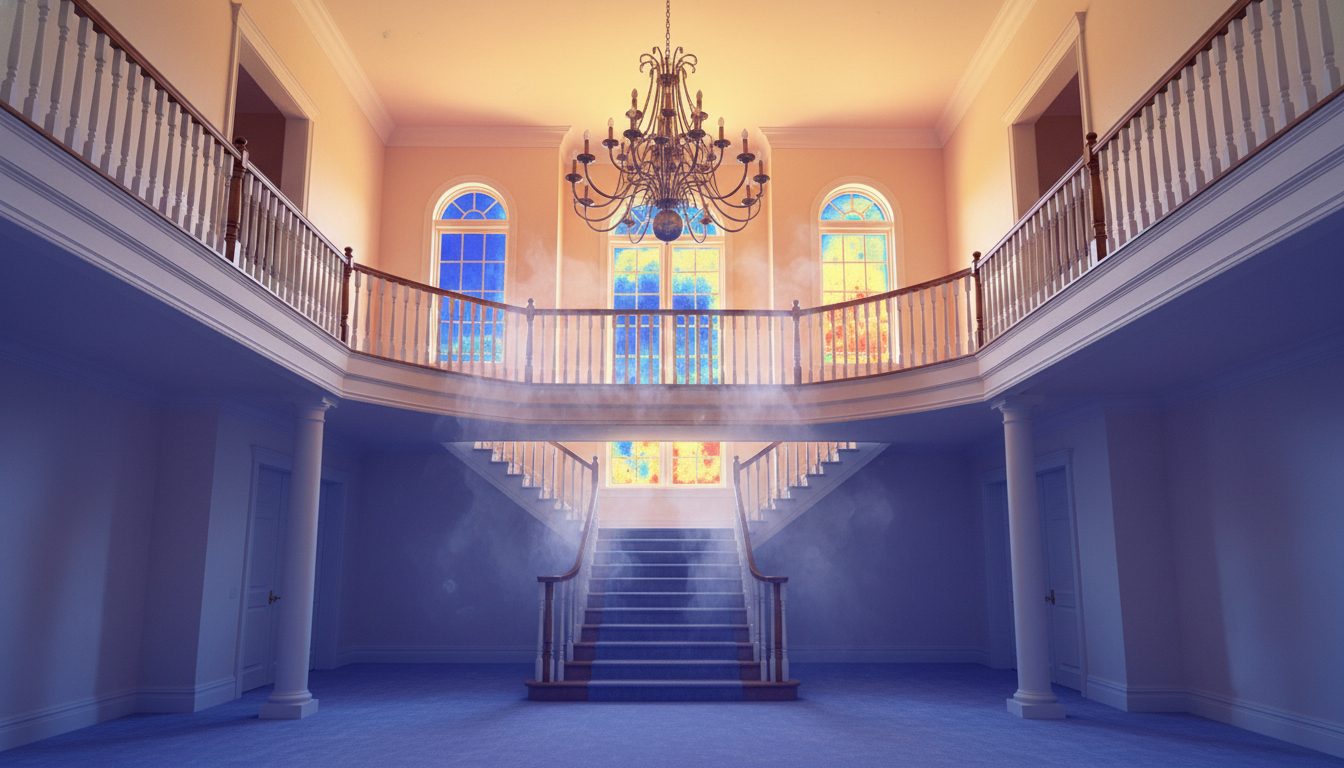
Introduction: The Physics of Atmospheric Volume in Luxury Estates
For the owners of high-net-worth estates, a grand foyer is more than an entrance; it is an architectural statement defined by soaring verticality, premium materials, and vast atmospheric volume. However, when a water intrusion event occurs—whether from a pressurized pipe failure on an upper gallery or a structural envelope breach—these high-volume spaces present a unique set of thermodynamic challenges. Conventional restoration tactics designed for standard residential rooms fail in these environments because they ignore the fundamental laws of psychrometrics.
As an IICRC Certified Master Water Restorer, I have observed that drying high ceiling house water damage requires a paradigm shift from surface-level moisture extraction to advanced atmospheric management. In a foyer with a 25-foot ceiling, we are not merely drying a floor; we are managing a microclimate. Failure to account for the psychrometric variables within these large volumes often leads to secondary damage: the warping of hand-carved millwork, the delamination of custom murals, and the silent proliferation of microbial growth in high-cavity interstitial spaces.
Scientific Principles: Vapor Pressure and the Stack Effect
The Role of Vapor Pressure Differential
The primary driver of evaporation in any restoration project is vapor pressure. In technical terms, moisture moves from areas of high vapor pressure (wet materials) to areas of low vapor pressure (dry air). In a grand foyer, the sheer volume of air acts as a massive reservoir for water vapor. If the ambient humidity is not aggressively managed, the air quickly reaches a state of equilibrium with the wet materials, causing evaporation to stall.
To facilitate rapid drying, we must maintain a significant vapor pressure differential. This is achieved by lowering the Grains Per Pound (GPP) of the air—a measure of the specific weight of water vapor in the air mass. In high-volume estates, standard dehumidifiers often lack the “lift” or the “grain depression” capability required to move moisture out of dense materials like marble-backed mahogany or thick-set plaster.
Thermal Stratification and the “Stack Effect”
One of the most overlooked aspects of drying high ceiling house water damage is thermal stratification. Because warm air is less dense than cold air, heat rises, carrying moisture with it. This creates a “stack effect” where the relative humidity at the 20-foot mark may be significantly higher than at floor level.
Without intervention, this moisture-laden air clings to the ceiling, where it can be absorbed by porous crown molding or fine art installations. Effective restoration requires the mechanical disruption of these layers to ensure that the dry, processed air reaches every cubic inch of the vertical space. This is where 3D moisture mapping becomes essential, identifying “pockets” of stagnant, humid air that are invisible to the naked eye.
Equipment Deployment: Beyond Standard Restoration
The Necessity of Desiccant Dehumidification
In high-volume luxury environments, Refrigerant (LGR) dehumidifiers often reach their physical limits. While LGRs are efficient in moderate temperatures and humidity levels, desiccant dehumidifiers are the gold standard for large-scale estate recovery. Desiccant units use a chemical attraction (silica gel rotors) to strip moisture from the air, capable of producing extremely low vapor pressure even in cool environments.
For a grand foyer exceeding 10,000 cubic feet, we typically deploy trailer-mounted desiccant systems. These units allow us to “pressurize” the home with ultra-dry air, forcing moisture out of complex architectural assemblies. This methodology is often integrated with our Technical Dehumidification protocols, ensuring that the structural integrity of the estate is preserved without the need for invasive demolition.
Vertical Air Movement and Ducting
Airflow is the engine of evaporation. However, simply placing axial fans on a marble floor will not suffice for a 30-foot foyer. We utilize high-velocity axial air movers paired with vertical ducting systems. By “piping” dry, desiccant-processed air to the highest point of the ceiling and allowing it to cascade down, we ensure a continuous exchange of air. This prevents the “dead air” zones that typically lead to mold growth on high-reaching architectural features.
Furthermore, in cases where water has entered wall cavities or decorative columns, we use targeted air-injection systems. These systems allow us to dry the internal framing without removing the expensive finishes, a critical requirement for HNW property managers who must balance restoration efficacy with the preservation of historical or high-value aesthetics.
Scaling Equipment for Atmospheric Volume
The following table outlines the technical requirements for air exchange and equipment scaling based on total cubic volume. Note that high-volume spaces require significantly higher exchange rates to prevent stagnation.
| Volume (Cubic Feet) | Equipment Needed | Estimated Air Exchange |
|---|---|---|
| 2,500 | 2 LGR Dehumidifiers | 4 per hour |
| 5,000 | 4 LGR Dehumidifiers / 1 Small Desiccant | 6 per hour |
| 10,000+ | 1 Large Desiccant Trailer | 12 per hour |
Result Verification: The Metrics of Success
Advanced Moisture Mapping
Verification in a high-volume drying project goes beyond a “dry to the touch” assessment. We utilize infrared thermography to identify evaporative cooling—a signature of moisture hidden behind stone or wood panels. By visualizing the thermal profile of the foyer, we can confirm that the drying air is reaching the upper reaches of the room. Any “cold spots” on a 20-foot wall indicate that moisture is still present, necessitating a recalibration of our airflow vectors.
Monitoring Equilibrium Moisture Content (EMC)
For estates featuring rare hardwoods or antique flooring, the goal is not just “dry,” but “stable.” We monitor the Equilibrium Moisture Content (EMC) to ensure that the wood returns to its pre-loss state without over-drying. Over-drying can be just as damaging as moisture, leading to cracking and checking in expensive timber. Our Master Water Restorers use precision probes to track the drying curve of these materials daily, adjusting the desiccant output to mimic the natural climate of the home.
This level of precision is also applied in Fire Damage Recovery, where the interplay between soot particles and humidity can create corrosive acids. In both water and fire scenarios, controlling the psychrometrics of the grand foyer is the only way to prevent long-term degradation of the asset.
Why High-Volume Spaces Require Specialized Expertise
The complexity of drying high ceiling house water damage cannot be overstated. Standard restoration companies are often equipped for 8-foot ceilings and 1,500-square-foot floor plans. They lack the specialized ducting, the industrial-grade desiccants, and the Master-level certification required to calculate the enthalpy of a 15,000-cubic-foot foyer.
At Partners Restoration, our USP lies in our technical dehumidification mastery. We treat the air as a tool, manipulating temperature and vapor pressure to achieve results that others deem impossible. Our equipment is specifically curated for the unique demands of premium estates, ensuring that even the most delicate finishes—from gold leafing to silk wallcoverings—are protected throughout the drying process.
Supporting Data and Standards
According to IICRC S500 standards, air exchange rates in high-volume spaces must be up to 3x higher than standard rooms to prevent microbial growth. This is due to the increased surface area of the walls and the tendency for air to stagnate in high corners. By maintaining an air exchange rate of 12 times per hour in large foyers, we create a dynamic environment where moisture has no place to hide.
Frequently Asked Questions
- Why is ceiling height a problem? Heat and moisture rise, creating a ‘stack effect’ that concentrates damage at the top. In high foyers, the air at the ceiling can remain at a large majority relative humidity while the floor is at a meaningful share, leading to hidden mold growth and structural decay.
- Can you dry it without scaffolding? Yes. We use targeted air-injection systems and high-reach ducting for high-cavity drying. This minimizes the footprint of the restoration and preserves the grand aesthetic of the foyer during the process.
- How long does the process take? While every loss is unique, our use of desiccant technology typically reduces drying times by 30-a substantial portion compared to standard refrigerant methods by maintaining a superior vapor pressure differential.
Protect your investment with precision psychrometrics. If your estate has suffered a water intrusion event, do not settle for standard restoration. Consult with a Master Water Restorer to ensure your property is dried to the highest technical standards.
Leave A Comment