In the industrial corridors of Medina, Minnesota, time is more than just a metric—it is the direct corollary to solvency. For an operations manager or a facility owner, a pipe burst, a roof failure, or a localized fire is not merely a maintenance headache; it is a catastrophic threat to the supply chain. When a production line halts, the financial hemorrhaging begins instantly. Industry data suggests that medium-to-large industrial operations lose an average of a considerable sumper day during a total closure. In the high-stakes world of Medina manufacturing, waiting for a standard residential-grade restoration company is a strategic failure.
The Medina MN industrial restoration services provided by Partners Restoration (License BC794459) are engineered around a singular objective: revenue recovery. We understand that your priority is not just “cleaning up”—it is maintaining output. Our protocol focuses on isolating the damage, protecting precision assets, and utilizing industrial-scale technology to ensure that while one section of your facility is under reconstruction, the rest of your production floor remains operational and profitable.
The Industrial Risk Profile: Beyond Surface Damage
Industrial environments in Hennepin County face unique risks that standard commercial properties do not. When water or smoke enters a manufacturing plant, the clock starts on several simultaneous degradation processes. High-value CNC machines, robotic assembly arms, and sensitive electronics are susceptible to micro-corrosion. Even a slight increase in relative humidity can flash-rust exposed steel components, leading to thousands of dollars in recalibration costs or total asset loss.
Furthermore, the structural complexity of Medina’s industrial zones—ranging from the precision medical device shops to heavy equipment fabricators—requires a sophisticated understanding of building codes and environmental safety. Dust, soot, and moisture are migratory. Without immediate intervention, a small fire in a loading bay can contaminate a cleanroom on the opposite side of the building through the HVAC system. This is why a “wait and see” approach is the most expensive decision a facility manager can make.
The Revenue Recovery Workflow: Isolation and Stabilization
Our approach to Medina MN industrial restoration services is dictated by the “Isolation Protocol.” We recognize that a total facility shutdown is rarely necessary if the recovery is managed with surgical precision. Our workflow is divided into three critical phases designed to save up to a significant majority of the projected revenue loss associated with property damage.
1. Tactical Isolation and Negative Pressure
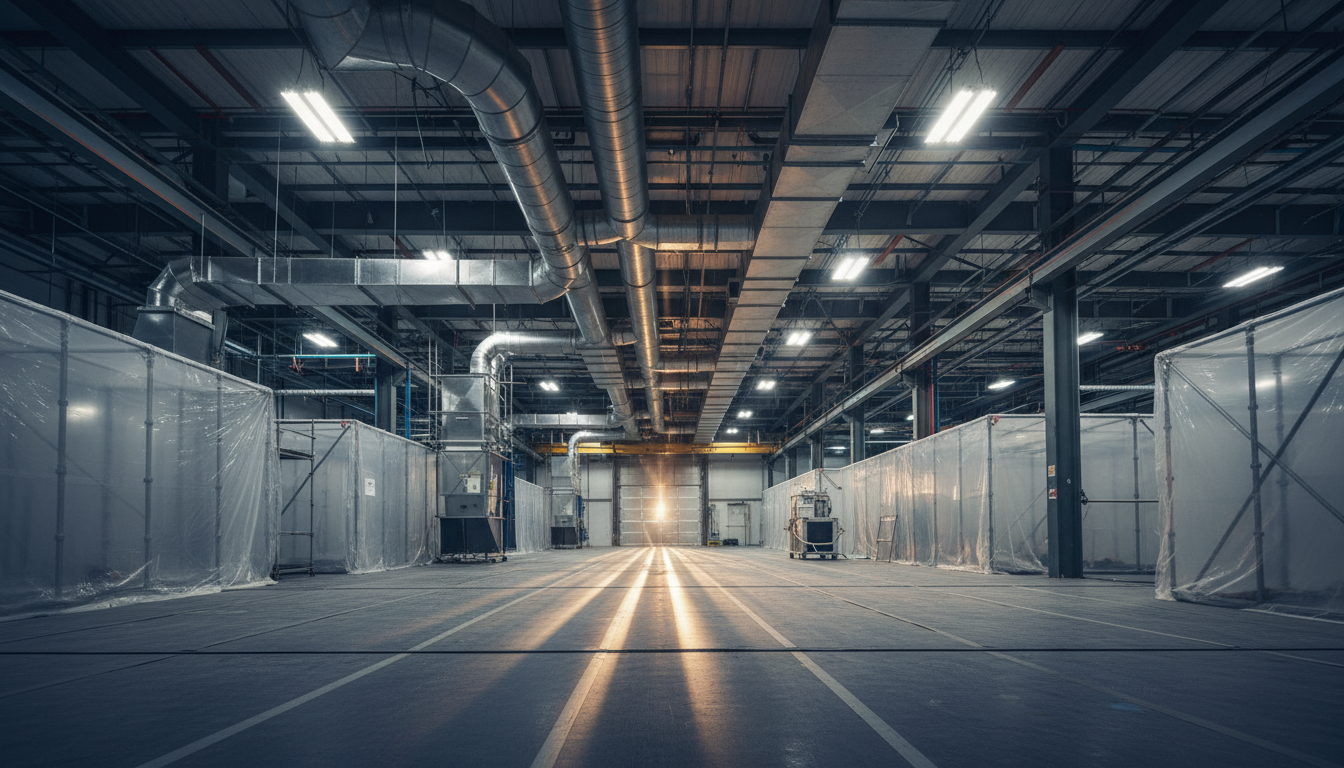
The first step is the immediate physical and environmental separation of the affected area from the production floor. We utilize opaque, pressure-sealed barriers and industrial HEPA-filtered air scrubbers to create a negative pressure environment. This ensures that dust, mold spores, or smoke odors are physically incapable of migrating into your clean zones. This allows your staff to continue work in adjacent bays without violating OSHA safety standards or compromising product quality.
2. Technical Dehumidification and Asset Protection
Moisture is the silent killer of industrial machinery. Standard refrigerant dehumidifiers often fail in the large open volumes of a warehouse or a high-ceiling manufacturing plant. Partners Restoration deploys high-capacity desiccant trailers—the gold standard in technical dehumidification. Desiccants work by using chemical attraction to pull moisture from the air, achieving much lower grains per pound (GPP) than standard equipment. This ultra-dry air is piped directly into sensitive areas to prevent the corrosion of precision tooling and electronic control panels.
3. Builder-Led Reconstruction
Because we hold license BC794459, our recovery process transitions seamlessly from mitigation to commercial reconstruction in Medina. We don’t just dry the space; we rebuild it to meet or exceed current industrial codes. Our project directors manage the complex logistics of working around active production schedules, ensuring that the “hammers and nails” phase of recovery does not interfere with your shipping deadlines.
Operational Standards by Facility Type
Different industrial assets require different recovery metrics. The following table outlines our specialized approach based on the specific needs of Medina’s diverse industrial base:
| Facility Type | Recovery Focus | Equipment Standard |
|---|---|---|
| Manufacturing | Cleanliness & Dust Control | Opaque Pressure-Sealed Barriers |
| Warehouse | Moisture Removal | High-Capacity Desiccant Trailers |
| Cold Storage | Thermal Envelope Integrity | Vapor Barrier Restoration & IR Scanning |
| Precision Labs | Particulate Mitigation | HEPA-Filtered Negative Pressure Zones |
Advanced Mitigation: Protecting Precision Machinery
In many Medina facilities, the building is often less valuable than the equipment housed within it. Our restoration protocol includes specialized measures for high-value assets. When precision metal surfaces are exposed to corrosive soot or high humidity, we employ nitrogen purging and specialized oil-based inhibitors to displace moisture at the molecular level.
By controlling the micro-climate around a specific machine tool or server rack, we can often prevent the need for a total teardown and rebuild of the equipment. This “micro-environment” approach is a key component of our Medina MN industrial restoration services, focusing on the assets that actually drive your company’s EBITDA.
Case Examples: Revenue Recovery in Action
Scenario A: The Warehouse Water Main Burst
A 40,000-square-foot distribution center in Medina experienced a main line failure overnight. Instead of a general drying strategy, we deployed our desiccant trailer fleet. By focusing on rapid moisture extraction from the concrete slab and pallet racking, we prevented secondary mold growth on cardboard packaging, allowing the facility to resume shipping operations within 24 hours while the final drying of structural elements continued behind sealed barriers.
Scenario B: Small Scale Fire, Large Scale Soot
A localized electrical fire in a CNC shop threatened to contaminate the entire facility with acidic soot. Our team arrived and immediately established negative pressure. We utilized dry ice blasting for non-abrasive cleaning of the affected machinery, removing the soot without the use of water or harsh chemicals that could damage the sensitive electronics. Production in the unaffected half of the shop never stopped.
Why Builder-Led Recovery Matters
Most restoration companies are “cleaners.” Partners Restoration is a “builder.” This distinction is critical for industrial operations. We understand the load-bearing requirements of warehouse racking, the electrical demands of heavy machinery, and the stringent requirements of Medina’s local building inspectors. Our project managers handle the permits, the structural engineering, and the final fit-out, providing a single point of accountability that minimizes the “lost time” often found when handoffs occur between different contractors.
Frequently Asked Questions
- How do you protect precision machinery during restoration? We use a combination of nitrogen purging to displace oxygen and moisture, along with desiccant drying to maintain ultra-low humidity levels. This prevents the chemical reaction of corrosion on exposed metal surfaces.
- Can you handle large square footage facilities? Yes. Our desiccant trailer fleet is designed specifically for facilities exceeding 20,000 square feet, providing the high-volume air exchange necessary to stabilize large industrial environments quickly.
- Is your work compliant with local Medina codes? Absolutely. As a licensed contractor (BC794459), we ensure all reconstruction work meets or exceeds Hennepin County and Medina municipal building codes.
Strategic Conclusion: The Path to Normalcy
In the industrial sector, “normalcy” is defined by the resumption of the production schedule. Every decision made in the first four hours of a property loss event will dictate the financial trajectory of the next four months. By prioritizing isolation, utilizing industrial-grade desiccant technology, and leveraging builder-led reconstruction expertise, Medina manufacturers can protect their bottom line even in the wake of a disaster.
The cost of inaction is a considerable suma day. The cost of a strategic recovery is an investment in your company’s resilience.
Secure Your Facility’s Future
Minimize downtime and protect your production revenue with a specialized industrial assessment.
Leave A Comment