
“`html
As an IICRC Master Water Restorer, I have navigated the complexities of high-value property restoration across the Pacific Northwest’s most prestigious enclaves. When water compromises a grand foyer in a Medina estate, the challenge is not merely one of surface moisture; it is a battle against the physics of volume and the nuances of atmospheric science.
In the world of luxury restoration, the “standard” drying protocol—typically designed for eight-foot residential ceilings—is fundamentally inadequate for the grand architecture of a 20-foot vaulted foyer. While a standard technician may focus on the marble flooring or the damp baseboards, a psychrometric specialist views the space as a singular, massive atmospheric column. To dry these spaces effectively, one must move beyond the floor and master the air itself. Drying high ceiling house water damage requires a sophisticated understanding of thermal stratification and the aggressive deployment of desiccant technology.
The Physics of Volume: Why Square Footage is Deceptive
In most restoration scenarios, equipment requirements are calculated based on square footage. However, in a grand foyer with 20-foot or 25-foot ceilings, the square footage remains the same while the cubic volume triples or quadruples. This “volumetric load” changes the entire psychrometric equation. If you have 500 square feet of floor space with an 8-foot ceiling, you are managing 4,000 cubic feet of air. In a vaulted Medina estate with 25-foot ceilings, that same 500 square feet represents 12,500 cubic feet of air.
This massive volume acts as a reservoir for moisture. As water evaporates from the flooring or the subfloor, it enters the air. In a low-ceiling environment, dehumidifiers can cycle that air quickly. In a vaulted space, the moisture often escapes the “reach” of standard floor-based dehumidification. To stabilize the environment, we must treat the space through the lens of Technical Dehumidification and Psychrometrics. We are not just drying a floor; we are drying a three-story column of air that is constantly interacting with delicate finishes, from gold-leaf crown molding to imported silk wallcoverings.
Thermal Stratification: The Invisible Barrier
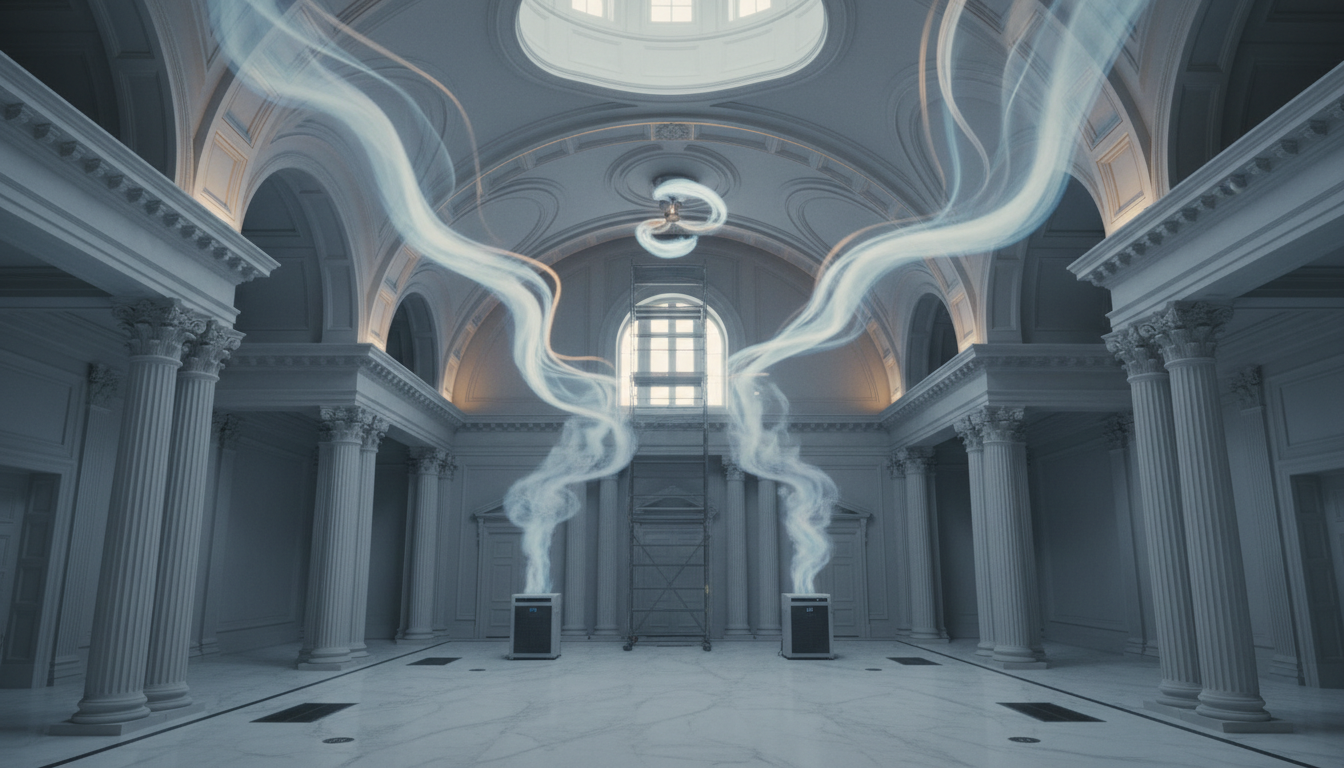
One of the most significant obstacles in high-ceiling restoration is thermal stratification. Because warm air is less dense than cool air, it rises. In a water damage event, this rising air carries moisture with it—a phenomenon known as the “stack effect.” In a foyer, this creates a microclimate where the air at the 20-foot mark is significantly warmer and more humid than the air at the floor level.
Without mechanical intervention, this humid air stagnates against the ceiling. This is where the most insidious damage occurs. While the floor might feel dry to the touch, the high-altitude humidity is silently saturating the upper-level drywall, framing, and architectural details. If the dew point at the ceiling level is reached, secondary damage—such as mold growth or structural warping—becomes inevitable. Professional restoration requires disrupting this stratification to bring that moist air down to where it can be processed by dehumidification equipment.
The Data: Air Exchange Requirements
The following table illustrates the dramatic shift in mechanical requirements when moving from a standard room to a vaulted foyer. These figures represent the minimum air exchange rates needed to maintain a “drying environment” where the vapor pressure of the air remains lower than the vapor pressure of the wet materials.
| Metric | Standard Room (8ft Ceiling) | Grand Foyer (25ft Vault) | Requirement Difference |
|---|---|---|---|
| Cubic Volume (500 sq ft) | 4,000 cu. ft. | 12,500 cu. ft. | +a large majority Volume |
| Air Exchanges Per Hour (ACH) | 4 – 6 ACH | 12 – 18 ACH | 3x Increase |
| Dehumidification Type | LGR (Refrigerant) | Large-Scale Desiccant | Specific Humidity Focus |
| Vertical Air Movement | Optional/Low | Mandatory/High-Velocity | Mechanical Disruption |
Note: Supporting data indicates that vertical air exchange must be at least 3x higher in vaulted spaces to prevent ceiling-level condensation and microbial growth.
Disruption Strategies: Forcing Atmospheric Equilibrium
To successfully dry a high-volume space, we utilize two primary strategies: Vertical Air-Exchange Ducting and High-Grain Depression via Desiccants.
1. Vertical Air-Exchange Ducting
Standard air movers (fans) placed on the floor only circulate air in a horizontal “donut” around the room. To address a 20-foot ceiling, we utilize weighted “lay-flat” ducting or rigid “snout” extensions. We physically duct dry, processed air from the dehumidifier up to the highest point of the vault. This creates a positive pressure zone at the ceiling, forcing the humid, stagnant air downward toward the intake of our machines. This mechanical disruption ensures the entire volume of air is filtered and dried, not just the bottom three feet.
2. The Power of Desiccant Trailers
For Medina estates, standard portable dehumidifiers often lack the “pulling power” to lower the Specific Humidity (measured in Grains Per Pound or GPP) fast enough to prevent damage to hardwoods. We frequently deploy trailer-mounted desiccant dehumidifiers. Unlike refrigerant models, desiccants use a chemical attraction to pull moisture out of the air, allowing us to achieve extremely low vapor pressures. This creates a “vapor pressure deficit,” essentially “sucking” the water out of the structural materials and into the thirsty air we have created.
Vertical Monitoring: Precision Restoration
In a high-value foyer, we do not guess; we measure. Traditional restoration involves placing a sensor on the floor. Our protocol involves “vertical monitoring.” We place remote hygrometers at multiple elevations: floor level, mid-point (10 feet), and the highest point of the vault.
By monitoring the GPP and Temperature at the ceiling, we can adjust our ducting and desiccant output in real-time. If the ceiling-level humidity begins to rise, it is a signal that our vertical exchange is insufficient. This data-driven approach is the hallmark of Technical Dehumidification and Psychrometrics. We manage the atmosphere as a single, cohesive volume to protect the structural integrity of the home.
Key Takeaways for the Estate Owner
- Floor fans are insufficient: Standard air movers cannot overcome the thermal stratification of a 20-foot space.
- Stack effect drives moisture upward: The most significant risk of mold and structural failure is often at the ceiling, not the floor.
- Desiccants are mandatory: To achieve the grain depression required for large volumes and dense materials (like hardwoods and plaster), desiccant technology is the gold standard.
- Volume vs. Area: Restoration plans must be based on cubic footage, not just square footage.
Frequently Asked Questions
Why is my foyer still humid even though there are fans running?
This is likely due to thermal stratification. Warm, moist air has risen to your vaulted ceiling and is trapped there. Without vertical ducting to disrupt this layer, the floor-level fans are simply circulating the same damp air without addressing the “reservoir” at the top.
Do I need to remove my chandelier or upper-level art?
In most cases, no. We use targeted vertical ducting to manage the atmosphere around these assets. By controlling the Relative Humidity and preventing the air from reaching its dew point, we can protect chandeliers and fine art in situ.
The Partners Group: Specialists in Atmospheric Volume Management
When dealing with the architectural complexities of a Medina estate, you require more than a restoration company; you require a psychrometric partner. Our expertise in vertical moisture management ensures that your grand foyer is dried with scientific precision, preserving both its beauty and its structural integrity.
Ready to protect your estate?
“`
Leave A Comment