As the winter frost begins to settle over the rolling hills and expansive landscapes of Medina, Minnesota, the aesthetic beauty of the season brings with it a unique set of challenges for the local estate owner. For properties that boast intricate gables, sprawling rooflines, and multi-zoned mechanical systems, the harsh Hennepin County winter is more than a seasonal change—it is a rigorous test of architectural integrity. As the West Metro Technical Lead, I have spent years assessing the vulnerabilities of these high-end residences. I understand that your home is not just a structure; it is a legacy, an investment, and a sanctuary that requires a specialized approach to winterization.
Standard winterization techniques often fall short for the complex footprints found in Medina estates. When you are managing ten thousand square feet of living space, the margin for error disappears. A single insulation gap in a decorative dormer or a minor pressure fluctuation in a secondary HVAC zone can lead to catastrophic results. This guide explores the sophisticated strategies necessary for Medina estate winter restoration and prevention, ensuring your property remains as pristine in February as it was in June.
The Seasonal Risks: Why Complex Estates Are Vulnerable
In our region, the climate is defined by its volatility. Historical data for Hennepin County shows that we experience an average of 60 to 70 freeze-thaw cycles per season. This constant fluctuation—where snow melts during the day and refreezes at night—is the primary engine behind ice dam formation. For a standard suburban home, this is a nuisance. For a Medina estate with complex valleys and custom masonry, it is a structural threat.
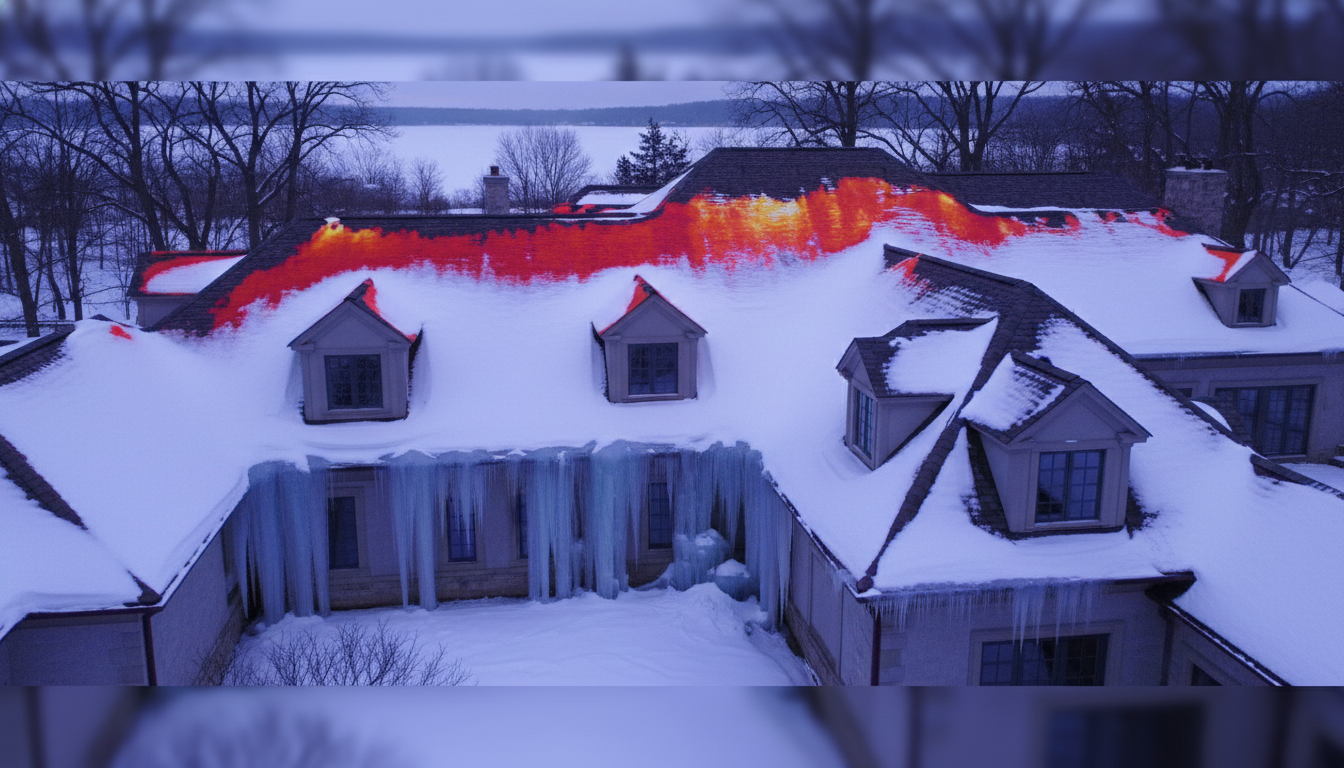
The primary culprit is often found in the “architectural envelope.” High-vaulted ceilings, common in great rooms and master suites, create a significant thermal gradient. If the attic bypasses are not perfectly sealed, warm air escapes, heating the roof deck and melting the bottom layer of snow. This water runs down to the cold eaves and freezes, forming a dam that forces water back under the shingles and into your custom millwork. Similarly, multi-zone plumbing systems, while providing comfort, often feature long pipe runs through unconditioned spaces or along exterior walls. Without constant circulation, these lines are the first to succumb to pipe bursts during a deep arctic blast.
Technical Solutions: The Science of Prevention
Prevention for a luxury estate must be data-driven. We move beyond simple visual inspections and employ professional thermal imaging. By using infrared thermography during the first cold snap, we can visualize the exact points where heat is escaping. These “hot spots” are the blueprints for future ice dams. Identifying an insulation void behind a decorative soffit before the first major blizzard can save hundreds of thousands of dollars in Medina estate winter restoration costs.
Furthermore, structural stabilization is key. In many custom builds, the very features that make the home beautiful—such as wrap-around porches or complex roof intersections—are the very areas where snow accumulates most heavily. We look for architectural flaws, such as improper ventilation at the eaves, which can be corrected through precision adjustments. Our approach is “Better-Than-Before,” meaning we don’t just patch a problem; we re-engineer the area to exceed the original builder’s specifications for thermal performance.
Risk Mitigation Data
The following table outlines the specific strategies we employ to protect the unique features of Medina properties:
| Risk Factor | Mitigation Strategy | Professional Tool |
|---|---|---|
| Complex Valleys | Heat Tape/Insulation Upgrades | Thermal Imaging |
| Multi-Zone Plumbing | Circulator Pumps/Sensors | Pressure Monitoring |
| High-Vaulted Foyers | Attic Bypass Sealing | Blower Door Testing |
| Custom Masonry Chimneys | Flashing & Waterproofing | Visual Endoscopy |
The Recovery Plan: Addressing Compromised Envelopes
Despite the best preventive measures, Minnesota winters can be unpredictable. If your estate’s architectural envelope is compromised, the response must be immediate and technical. When water enters a luxury home, it doesn’t just damage the drywall; it threatens high-end finishes, hardwood floors, and sensitive electronics. This is where technical dehumidification becomes essential. We utilize industrial-grade desiccant dehumidifiers that can pull moisture from dense materials like lath-and-plaster or solid oak, preventing the mold growth that often follows a winter leak.
Our recovery process also accounts for the unique aesthetic of Medina homes. We understand that finding matching materials for 20-year-old custom cabinetry or imported stone is difficult. Our restoration team specializes in sourcing and replicating historical and high-end materials, ensuring that any repairs are invisible. Whether you are dealing with significant storm damage from a heavy ice load or a localized pipe burst, the goal is total restoration to the home’s original grandeur.
Expert Guidance and Historical Context
Reflecting on the historical freeze-thaw cycles in Hennepin County, we see a trend toward more extreme “polar vortex” events followed by rapid thaws. This puts immense pressure on the mechanical systems of an estate. A property that functioned perfectly five years ago may now be at risk because of settling, insulation compression, or the degradation of weather stripping. As specialists in builder-led winterization, we look at the house as a holistic system—where the HVAC, the roof, and the insulation must work in perfect harmony to survive the Minnesota winter.
Frequently Asked Questions
-
How do I prevent ice dams in custom homes?
Proper attic ventilation and insulation at the eaves are critical. Because custom homes often have irregular roof shapes, standard venting won’t suffice. It often requires architectural adjustments and the use of closed-cell spray foam in tight “hot roof” areas to ensure the roof deck remains at the same temperature as the outside air.
-
When is the best time to start the winterization process?
Ideally, an audit should be performed in late autumn, before the first significant snowfall. This allows time for thermal imaging to identify heat loss while the heating system is running but before the roof is covered in snow.
Protecting a Medina estate requires more than a handyman; it requires a partner who understands the intersection of luxury architecture and harsh-climate physics. By prioritizing prevention and employing technical recovery methods, you can ensure your home remains a source of pride and comfort through the coldest months of the year.
Secure Your Estate Today
Don’t wait for the first ice dam to form. Ensure your home’s integrity with a comprehensive thermal evaluation by the West Metro’s leading restoration experts.
Leave A Comment