Large-Span Structural Stabilization: Shoring for Open-Concept Great Rooms
In the architectural landscape of high-net-worth estates—particularly those found in the lakeside enclaves of Medina and Orono—the “Great Room” serves as the structural and aesthetic centerpiece. These expansive, open-concept spaces often feature vaulted ceilings, floor-to-ceiling glazing, and spans exceeding 25 feet. While visually breathtaking, these designs rely on a delicate equilibrium of load paths. When a catastrophic event occurs—be it a localized fire, a vehicle impact, or a structural failure due to heavy snow loads—the integrity of these large-span areas is immediately compromised. For homeowners and insurance adjusters, the priority shifts from aesthetic preservation to structural shoring for large estates.
As a lead reconstruction builder (License BC794459), my perspective is rooted in the physics of stabilization. Unlike standard residential framing, high-value estates utilize complex engineering, including Glulam beams, Parallams, and integrated steel moment frames. When these components are damaged, the risk is not just a localized sag, but a progressive collapse that can threaten the entire second-story bedroom wing or the architectural core of the home. Professional stabilization is the only way to arrest this movement and provide a safe environment for forensic engineering and eventual reconstruction.
The Physics of Large Spans and Load Path Disruption
To understand the necessity of engineered shoring, one must first understand the physics of the “tributary area.” In a traditional compartmentalized home, loads are distributed across numerous interior load-bearing walls. In an open-concept estate, the tributary area—the surface area of the floor or roof supported by a single beam or column—is significantly larger. When a central support member fails, thousands of pounds of dead load (the weight of the structure itself) and potential live loads (snow or furniture) must find a new path to the foundation.
Structural failure in large-span rooms typically manifests in three ways: Deflection, Rotation, and Lateral Translation. Deflection is the “sag” often seen in wood members under stress. However, in large-span estates, the more dangerous element is often lateral translation—the tendency for the walls to “kick out” once the horizontal tension of the ceiling joists is lost. Without immediate structural stabilization, the lateral forces can compromise the masonry or timber-frame exterior, leading to irreparable damage.
The 2x Safety Factor in Fire Restoration
It is a critical industry standard that large-span beams (those exceeding 20 feet) require twice the standard safety factor for temporary shoring during restoration. Why? Because fire compromises the molecular integrity of both wood and steel. Wood chars, reducing its cross-sectional strength, while steel loses its yield strength at temperatures common in house fires. Our stabilization protocols account for this “weakened state” by over-engineering the temporary support systems to ensure that even if the primary member fails completely during the debris removal phase, the shoring system remains absolute.
Advanced Stabilization Methods for HNW Estates
Stabilizing a high-value property requires a surgical approach. We cannot simply “prop up” a beam with timber posts and expect the house to remain stable. The process involves custom-designed vertical support systems that interface with the existing architectural features without causing secondary damage. At Partners Restoration, we prioritize builder-led engineering to ensure every post is placed over a verified load-bearing point in the sub-structure or basement.
Hydraulic Post-Shoring and LVL Headers
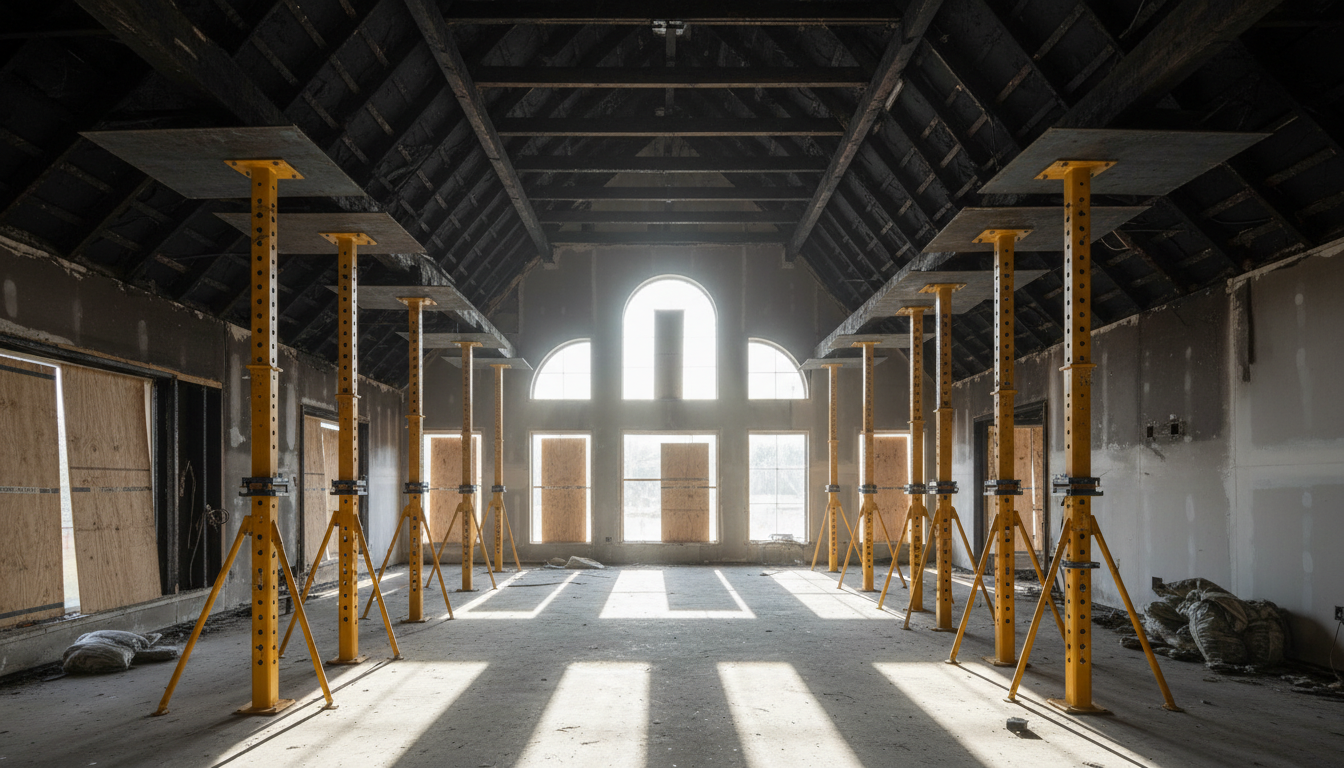
For spans exceeding 25 feet, we utilize hydraulic post-shoring systems. These allow for precise, incremental loading of the shoring structure, ensuring we “catch” the load without inducing “heave”—a condition where over-jacking causes cracks in the upper-level finishes. These posts are paired with LVL (Laminated Veneer Lumber) beams that act as temporary headers, distributing the weight across multiple points rather than a single concentrated area.
Table: Shoring Solutions by Span and Risk Profile
| Span Length | Standard Joist Risk | Partners Shoring Solution |
|---|---|---|
| 25+ Feet | Deflection/Sag and Beam Shear failure | Hydraulic Post-Shoring with LVL Beams |
| Open Foyer (Multi-Story) | Lateral Sway and Column Buckling | Cross-Braced Steel Scaffolding |
| Cantilevered Decks/Balconies | Rotational Failure at the Rim Joist | Cribbing Towers with Pressure-Treated Headers |
Protecting High-End Finishes
A common concern for homeowners in Medina or Orono is the preservation of custom flooring—be it reclaimed wide-plank oak, imported marble, or heated limestone. Standard shoring can mar these surfaces. To combat this, we utilize sacrificial load-spreading pads. These are composite layers placed beneath the shoring base plates that distribute the axial load across a wider surface area, preventing indentation and cracking while maintaining the necessary friction for lateral stability.
The Reconstruction Path: From Shoring to Permanent Core
Shoring is a temporary bridge to architectural reconstruction. Once the estate is stabilized, the “true” work begins: the integration of permanent structural members. In large-span rooms, this often involves the installation of custom-fabricated steel I-beams or complex truss systems designed to restore the open-concept feel while meeting modern seismic and wind-load codes.
The transition from temporary shoring to permanent structural steel is a choreographed sequence. We use a “load transfer” protocol where the weight of the house is slowly eased onto the new permanent members. This process is monitored with laser leveling to ensure that the house returns to its original datum point. This meticulous attention to detail is what distinguishes a builder-led restoration firm from a standard mitigation company. We are not just cleaning up; we are re-engineering the home’s skeleton.
Regulatory Compliance and City Inspections
In high-end jurisdictions, city officials and structural engineers must sign off on the shoring plan before any significant interior work continues. Our team manages the permit process, providing the necessary calculations and stamped drawings to satisfy municipal requirements. This ensures that the insurance claim remains on track and that the property’s value is protected through documented, code-compliant repairs.
Why Builder-Led Stabilization Matters
Many restoration companies focus solely on “drying out” or “cleaning up.” However, in large-span estates, the structural integrity is the foundation of the entire claim. If the shoring is inadequate, the subsequent repairs—drywall, cabinetry, fine finishes—will eventually fail as the house continues to settle or shift. By choosing a builder-led team (License BC794459), you are ensuring that the professionals stabilizing your home understand the complex load-path stabilization required for modern luxury architecture.
Frequently Asked Questions
How long does shoring stay in place?
Shoring remains a vital part of the site safety plan until the permanent structural beams are installed, bolted, and inspected by city officials. Depending on the complexity of the steel fabrication, this can range from a few weeks to several months.
Will it damage my wood floors?
No. We use specialized sacrificial load-spreading pads and protective barriers to protect custom flooring during stabilization. Our goal is to stabilize the structure without creating a secondary loss in your high-end finishes.
Protect your investment with precision engineering. If your estate has suffered a structural failure or fire, do not wait for the structure to shift further. Ensure the safety of your home and the integrity of your reconstruction.
Request a Structural Load Assessment from Partners Restoration Today
Leave A Comment