
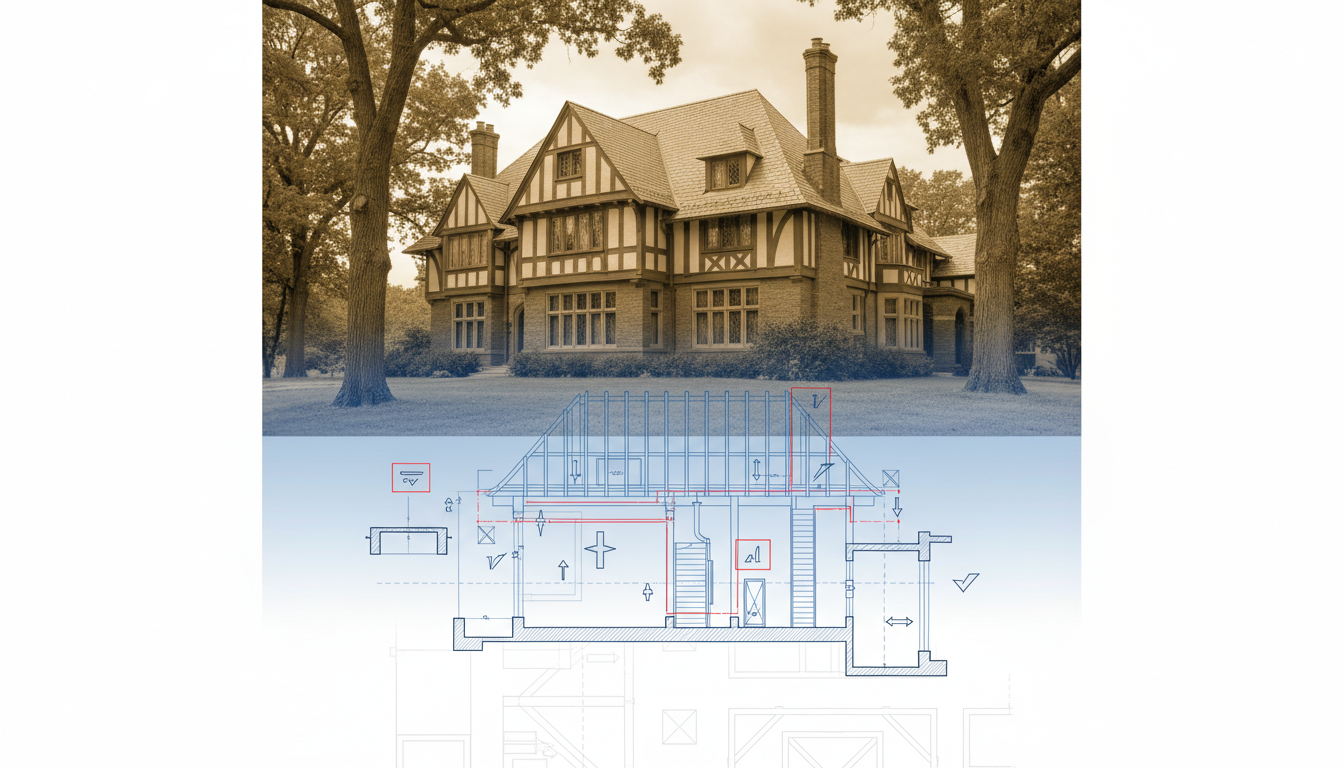
In the prestigious neighborhoods of Edina, particularly within the historic Tudor estates of Country Club and White Oaks, a property loss involves far more than simple structural repair. For the high-net-worth policyholder and the specialized adjuster, the challenge lies in the intersection of architectural preservation and modern municipal mandates. When a fire, water, or storm event strikes these iconic homes, the “restoration” process is immediately governed by a complex regulatory mechanism known as the a substantial portion Rule.
As an IICRC Master Restorer and Licensed Builder, I have seen firsthand how standard claims processing fails when applied to Edina’s unique building stock. Forensic valuation is the only path to ensuring a claim is settled accurately. This process goes beyond identifying damaged substrate; it involves a meticulous audit of the “gap” between restoring a home to its pre-loss condition and the mandatory upgrades required by the Minnesota State Building Code and Edina’s local ordinances. Navigating an Edina a substantial portion Rule Insurance Claim requires a technical mastery of both the policy language and the local Construction Management Plan (CMP).
The a substantial portion Threshold Defined: The Catalyst for Full Compliance
The “a substantial portion Rule” is a regulatory trigger used by the City of Edina to ensure that substantially damaged or improved buildings are brought up to current safety and energy standards. Formally known as the “Substantial Damage” or “Substantial Improvement” provision, it dictates that if the cost of repairs or improvements exceeds a substantial portion of the market value of the structure, the entire building must be brought into full compliance with the current Minnesota State Building Code.
For an Edina Tudor estate, this is a monumental shift in the scope of work. What begins as a kitchen fire mitigation can quickly evolve into a whole-home electrical overhaul, the installation of a modern HVAC system with Energy Recovery Ventilators (ERV), and the reinforcement of the building’s thermal envelope. From an insurance perspective, this transition moves the claim from a standard Coverage A (Dwelling) repair into the complex territory of Ordinance or Law coverage.
Forensic valuation identifies this tipping point before the first permit is pulled. By performing a granular cost analysis of the proposed repairs against the structure’s depreciated value, we can predict whether the a substantial portion threshold will be breached. This proactive approach prevents the common “mid-project stall” where a building official denies a permit because the scope of work fails to account for mandated code upgrades.
Why Land Value is the Deciding Factor in Forensic Valuation
One of the most frequent errors in an Edina a substantial portion Rule Insurance Claim is the use of total property value as the benchmark. In Edina, land value is exceptionally high, often representing a substantial portion to a significant majority of the total real estate price. However, for the purposes of the a substantial portion Rule, the City of Edina and FEMA guidelines explicitly state that land value must be excluded from the calculation.
Consider a Tudor estate valued at a meaningful amount. In a standard market appraisal, the land might be worth a substantial six-figure sumleaving a structure value of a substantial six-figure sum. Under these conditions, the a substantial portion threshold for code triggers is a significant investment. If an adjuster mistakenly uses the a meaningful amount figure, they would incorrectly assume the threshold is a substantial six-figure sum. This a significant investmentdiscrepancy is the “forensic gap.”
As experts in Insurance Advocacy, we utilize independent appraisals and Hennepin County assessor data to isolate the “Market Value of the Structure” accurately. By narrowing the denominator, we often find that code triggers are met much earlier than expected. This ensures that the policyholder’s Ordinance or Law limits are accessed appropriately, preventing the out-of-pocket expenses that occur when code mandates are discovered too late in the reconstruction phase.
Triggering Ordinance or Law: Bridging the Financial Gap
Once the a substantial portion threshold is breached, the insurance policy’s Ordinance or Law (O&L) coverage becomes the primary vehicle for funding the restoration. O&L is typically divided into three parts:
- Coverage A: Loss of Value to the Undamaged Portion of the Building (if the city requires the entire structure to be demolished).
- Coverage B: Demolition and Debris Removal of the undamaged portion.
- Coverage C: Increased Cost of Construction (the “Code Upgrade” coverage).
In Edina, Coverage C is where the most significant forensic work occurs. Data shows that the average code-triggered overrun in Edina is a portion above the initial mitigation baseline. These costs are not “luxury upgrades” but “mandated requirements.” For example, if a fire affects only the second floor but triggers the a substantial portion rule, the city may require the entire home to be retrofitted with hard-wired, interconnected smoke alarms, AFCI protection on all circuits, and modern R-value insulation throughout the exterior walls—even in rooms untouched by the fire.
Forensic valuation meticulously documents these requirements. We work alongside structural engineers and code consultants to provide the adjuster with a line-item variance report. This report clearly distinguishes between the “Like Kind and Quality” (LKQ) replacement and the “Mandated Code Increment,” allowing for a seamless transition between Dwelling and O&L coverage buckets.
The CMP Permit Path: Navigating Edina’s Regulatory Landscape
Restoring a Tudor estate in Edina requires more than just a standard building permit; it requires adherence to the Construction Management Plan (CMP). The CMP is a rigorous set of rules designed to minimize the impact of construction on the community. For significant restoration projects, particularly those crossing the a substantial portion threshold, the CMP requirements can add tens of thousands of dollars to the soft costs of a claim.
The CMP governs everything from erosion control and tree protection to neighborhood parking plans and noise mitigation. A forensic valuation of the claim must include these “general condition” costs. For instance, the specialized equipment needed for Architectural Reconstruction—such as cranes for heavy timber framing or specialized masonry scaffolding—must be accounted for within the framework of Edina’s strict street-usage permits.
Our mastery of the Edina CMP ensures that the insurance carrier understands these costs are not discretionary. They are legal requirements for securing a permit in the city. By integrating CMP costs into the initial estimate, we avoid the friction that occurs when supplemental claims are submitted months after the project has started.
Threshold Analysis: Market Value vs. Code Upgrade Costs
The following table illustrates how forensic valuation isolates the structure value to determine the a substantial portion threshold and the resulting impact on the insurance claim.
| Property Metric | Standard Appraisal | Forensic Valuation (Structure Only) | Delta/Impact |
|---|---|---|---|
| Total Property Market Value | a seven-figure sum | N/A (Excluded) | – |
| Land Value (Edina Average) | a substantial six-figure sum | N/A (Excluded) | – |
| Structure Market Value | a substantial six-figure sum | a substantial six-figure sum | The Critical Baseline |
| a substantial portion Compliance Threshold | a substantial six-figure sum(Incorrect) | a significant investment(Correct) | a significant investmentGap |
| Avg. Code Upgrade Cost (a portion) | N/A | a significant investment | Mandated O&L Trigger |
Technical Case Study: The Hidden Cost of Electrical and Mechanical Upgrades
In many Edina Tudor estates, the electrical system is a hybrid of original knob-and-tube and various generations of ungrounded Romex. When a fire claim triggers the a substantial portion rule, the City of Edina will not allow a “patch and repair” approach to the wiring. The entire structure must be brought to current NEC (National Electrical Code) standards. This often means “opening up” undamaged walls to run new home-run circuits, upgrading the service panel to 200 or 400 amps, and installing whole-home surge protection.
Similarly, the mechanical systems (HVAC) are often grandfathered into older homes. Full compliance mandates specific air-exchange rates and energy efficiencies. In the tight thermal envelopes required by modern codes, an old boiler system might require the addition of a mechanical ventilation system to prevent moisture issues. Forensic valuation captures these “consequential upgrades”—costs that are the full scope code-driven and essential for the legal occupancy of the building post-restoration.
Brand USPs: Mastery of Local Construction Management Plans (CMP)
What sets our approach apart is our dual-lens expertise. As both IICRC Master Restorers and Licensed Builders, we don’t just estimate damage; we engineer the reconstruction. Our deep familiarity with the Edina Building Department and the specific nuances of the CMP allows us to provide adjusters with “permit-ready” documentation. We ensure that every line item in the estimate is backed by both a code reference and a market-realistic cost, reducing the cycle time for claim approval and ensuring the integrity of the historic Tudor architecture is maintained.
Key Takeaways
- Structure value excludes land: The a substantial portion threshold is based solely on the market value of the building, making it much easier to trigger in high-land-value areas like Edina.
- Coverage B/C are critical: Ordinance or Law coverage is the primary mechanism for funding the a portion average cost increase associated with code mandates.
- Builders ensure permit approval: Forensic valuation must include CMP-related “soft costs” to ensure the city approves the restoration permits without delay.
Frequently Asked Questions
Does land value count toward the a substantial portion rule?
No. Only the market value of the structure itself is considered. Land value must be professionally appraised and subtracted from the total property value to establish the correct threshold.
What happens if I ignore code upgrades?
If the a substantial portion threshold is met and code upgrades are ignored in the scope of work, the City of Edina will deny the building permit. This can lead to significant project delays and potential legal liability for both the contractor and the homeowner.
Are “soft costs” like CMP fees covered by insurance?
Yes, provided they are accurately documented as a legal requirement for the repair. These fall under the general conditions of the reconstruction and are essential for a successful settlement.
Ensure Your Restoration Meets Edina Standards
Don’t let hidden code mandates derail your property restoration. Download our expert guide to navigating municipal requirements.
Leave A Comment