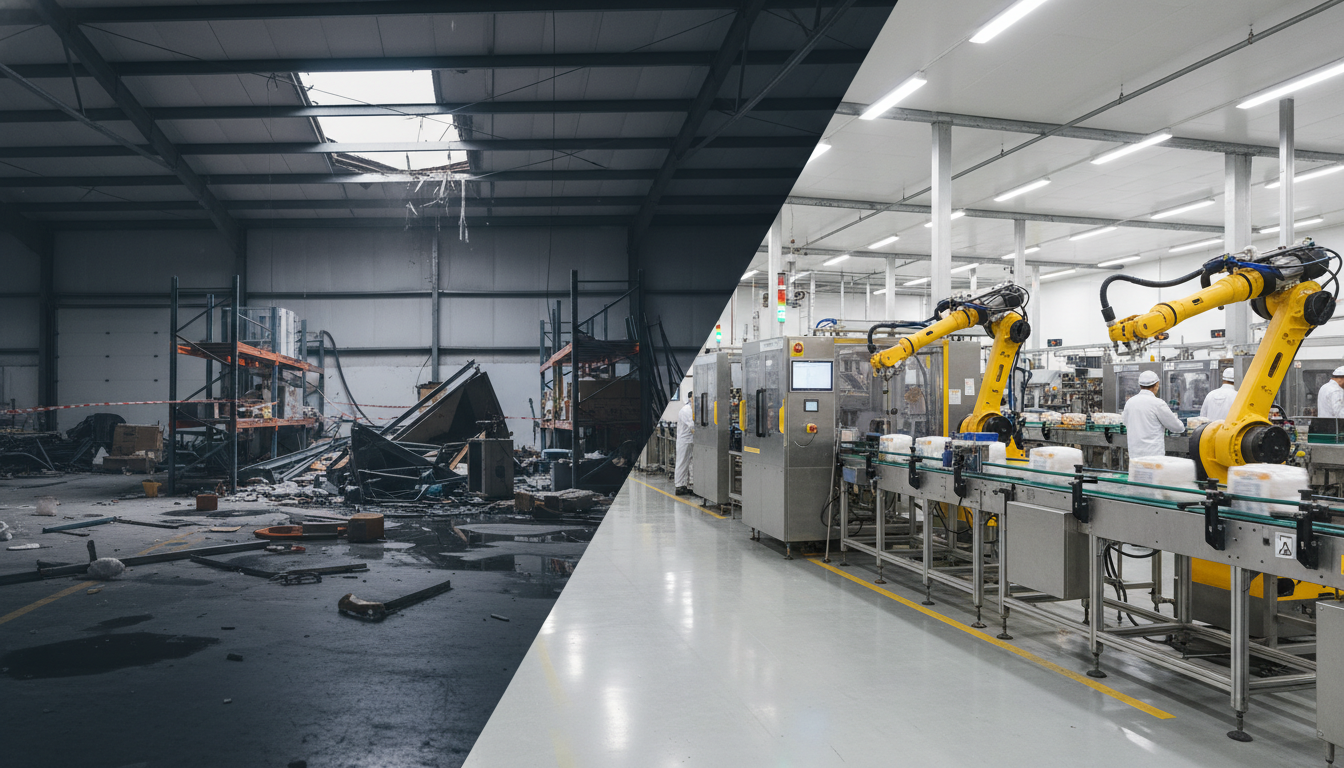
For a business in Medina, Minnesota, a disaster is not merely a physical event; it is a financial crisis measured in hours. Whether it is a burst sprinkler line in a retail showroom or structural damage to a manufacturing plant, the stopwatch starts the moment the sirens stop. The reality of commercial recovery is stark: according to industry data, businesses that fail to resume operations within five days of a catastrophe face a a substantial portion higher probability of permanent closure within one year. This “five-day window” is the crucible in which the future of your company is decided.
In the traditional restoration model, recovery is a linear, fragmented process. A mitigation company dries the building, a separate consultant assesses the damage, and eventually, a general contractor is hired to rebuild. This “hand-off” model is the primary driver of extended downtime. At Partners Restoration (BC794459), we operate under a different mandate. We utilize a builder-led, fast-track recovery model specifically designed for Medina MN business interruption restoration. By integrating structural engineering and reconstruction into the initial mitigation phase, we bypass the traditional bottlenecks, allowing your facility to regain operational status while the heavy lifting of reconstruction continues behind the scenes.
The Downtime Crisis: Why Traditional Restoration Fails Medina Businesses
The core failure of the standard restoration industry is a lack of strategic alignment with the business owner’s bottom line. Most restoration vendors focus exclusively on “drying the box.” While moisture removal is essential, it does nothing to address the immediate need for revenue generation. For a property manager or business owner in Medina, every day the building is cordoned off is a day of lost lease payments, missed production quotas, and eroding customer loyalty.
The downtime crisis is compounded by the “waiting game” inherent in sequential workflows. In a traditional scenario, reconstruction cannot begin until the mitigation phase is the full scope complete and signed off by an adjuster. This can result in two to three weeks of “dead air” where no work is being performed on-site. When the daily cost of downtime for an industrial facility can reach six figures, this delay is unacceptable.
Our approach shifts the focus from simple cleanup to strategic asset stabilization. As a licensed builder (BC794459), we have the authority to make structural decisions and file for permits the moment we arrive on-site. We don’t just mop water; we assess how to partition your space so that a substantial portion of your staff can return to work within 48 hours. This is the difference between a contractor who sees a flood and a partner who sees a balance sheet.
The Parallel Workflow Strategy: Re-imagining the Recovery Timeline
The cornerstone of our Medina MN business interruption restoration service is the Parallel Workflow Strategy. Instead of treating mitigation and reconstruction as two separate chapters in a book, we treat them as simultaneous tracks. This concurrent engineering model typically reduces total downtime by a meaningful share to a substantial portion.
1. Immediate Structural Stabilization and Permit Filing
Because we are a builder-led firm, our project directors are trained to identify structural compromises immediately. While the drying equipment is being staged, we are already coordinating with local Medina building officials for expedited emergency permits. This allows Commercial Reconstruction in Medina to begin the moment the environment is stabilized, rather than weeks later.
2. Advanced Technical Dehumidification
Traditional dehumidifiers are often insufficient for large-scale commercial volumes. We employ high-capacity Technical Dehumidification using industrial-grade desiccant trailers. These units deliver ultra-low grain-refrigerant air that can dry a building in half the time of standard equipment. By rapidly lowering the vapor pressure, we protect sensitive electronics and inventory that would otherwise be lost to secondary damage (mold or corrosion).
3. Isolated Work Zones (The “Pop-Up” Strategy)
The most effective way to minimize business interruption is to keep the business running. We utilize high-pressure plastic barriers, negative air machines, and HEPA filtration to create “clean zones” within a damaged facility. By isolating the work area, we can conduct heavy reconstruction in one wing while your sales or administrative staff operate safely in another. We don’t wait for the building to be “perfect” before you reopen; we make it “functional” first.
| Industry | Downtime Cost (Daily) | Partners Fast-Track Advantage |
|---|---|---|
| Retail | a meaningful amountk – a meaningful amountk | 48-hour partial opening with isolated sales floor |
| Industrial | a meaningful amountk – a meaningful amountk | On-site mobile desiccant trailers & temporary power arrays |
| Office/Medical | a meaningful amountk – a meaningful amountk | Phased re-entry with HEPA-isolated clean zones |
Operational Case Studies: Aggressive Downtime Minimization
To understand the impact of builder-led recovery, one must look at the specific logistical challenges of Medina’s diverse commercial landscape. In a recent industrial recovery project, a water main break threatened to halt production for a month. While traditional vendors suggested a full facility shutdown, our team deployed three desiccant trailers and constructed a 20-foot-high temporary wall. This isolated the drying process to the warehouse, allowing the production line to resume within 72 hours. The reconstruction of the damaged offices was handled as a “night shift” operation, ensuring zero interference with daytime manufacturing.
In retail environments, the aesthetics of the recovery are just as important as the speed. A “closed for repairs” sign is a signal to customers to shop elsewhere. Our strategy involves creating “pop-up” retail footprints within the undamaged sections of a store. By managing the Medina MN business interruption restoration through a phased approach, we ensure that the brand remains visible and active, even while structural repairs are underway.
The Importance of Loss-of-Use Documentation
Minimizing downtime is not just about moving fast; it’s about ensuring that your insurance carrier recognizes the complexity of the recovery. Our Project Directors work directly with adjusters to provide verified project timelines and “Critical Path” schedules. By documenting our efforts to mitigate further loss (such as preventing mold growth through rapid technical drying), we provide the necessary evidence to support substantial business interruption and loss-of-use claims.
Strategic Benefits of a Single-Source Partner
When you hire Partners Restoration, you are eliminating the “blame game” that often occurs between different vendors. If a reconstruction project is delayed because the building wasn’t dried properly, who is responsible? In the traditional model, the owner is caught in the middle. In our model, we own the entire timeline. Our self-performing crews handle everything from the initial water extraction to the final architectural finishes.
- Reduced Overhead: One management team, one invoice, one point of contact.
- Structural Expertise: As a licensed builder (BC794459), we provide the structural sign-offs required by code officials, preventing delays in occupancy permits.
- Aggressive Timelines: We operate with the urgency of a business owner because we understand that your revenue is the ultimate metric of our success.
Frequently Asked Questions
Can we operate during reconstruction?
Yes. We utilize high-pressure plastic barriers, negative air pressure, and HEPA filtration to completely isolate work zones. This allows your employees to remain in the building without being exposed to dust, noise, or contaminants. We can also schedule heavy construction during off-hours to ensure zero operational disruption.
How do you handle loss-of-use claims?
We provide insurance adjusters with detailed, verified project timelines and “Critical Path” documentation. By demonstrating a proactive, builder-led approach to minimizing downtime, we provide the necessary evidence to support your business interruption claims, ensuring you receive the maximum coverage for lost revenue.
Why is a builder’s license important for restoration?
Many restoration companies are only licensed for “cleaning.” Without a builder’s license (like our BC794459), they cannot legally perform structural repairs, move load-bearing walls, or pull the necessary permits for reconstruction. This forces them to sub-contract the work, which adds weeks of delay to your recovery.
Strategic Recovery for Medina Commercial Properties
The difference between a minor setback and a total business failure often comes down to the partner you choose in the first 24 hours. Don’t settle for a vendor who only knows how to clean up a mess. Choose a partner who knows how to rebuild a business. Our builder-led model is engineered to keep your doors open and your revenue flowing.
Review our Commercial Recovery Case Studies: https://partnerscos.com/commercial/
Leave A Comment