Water damage restoration is the professional process of extracting standing water, drying structural materials to documented moisture content, and restoring a property to pre-loss condition. In Minnesota’s climate, speed is critical: mold colonization begins within 24–48 hours of a water intrusion event.
Partners Restoration provides emergency water damage restoration across Minneapolis and the western suburbs — Medina, Wayzata, Minnetonka, Orono, Plymouth, Eden Prairie, Edina, and surrounding lake communities. We respond 24/7, deploy IICRC-certified technicians, and work directly with your insurance carrier from first notice of loss through final reconstruction.
What Happens During Water Damage Restoration
Water damage restoration follows a defined sequence governed by IICRC S500 standards — the authoritative standard for professional water damage restoration published by the Institute of Inspection, Cleaning and Restoration Certification. Every project at Partners moves through the same documented protocol.
1. Emergency water extraction
Truck-mounted or portable extraction units remove standing water immediately. The faster water is removed, the less it migrates into wall cavities, subfloors, and insulation. For a finished basement with 2 inches of standing water across 1,000 square feet, extraction typically takes 2–4 hours before drying equipment can be positioned.
2. Moisture mapping and documentation
Pin-type and pinless moisture meters document moisture content across all affected surfaces before drying begins. This baseline reading — recorded in a drying log — establishes the scope of damage for your insurance adjuster and tracks drying progress to a documented goal. IICRC S500 defines dry standard as returning materials to pre-loss moisture content (typically 6–12% for wood framing, 0.5% for concrete).
3. Structural drying
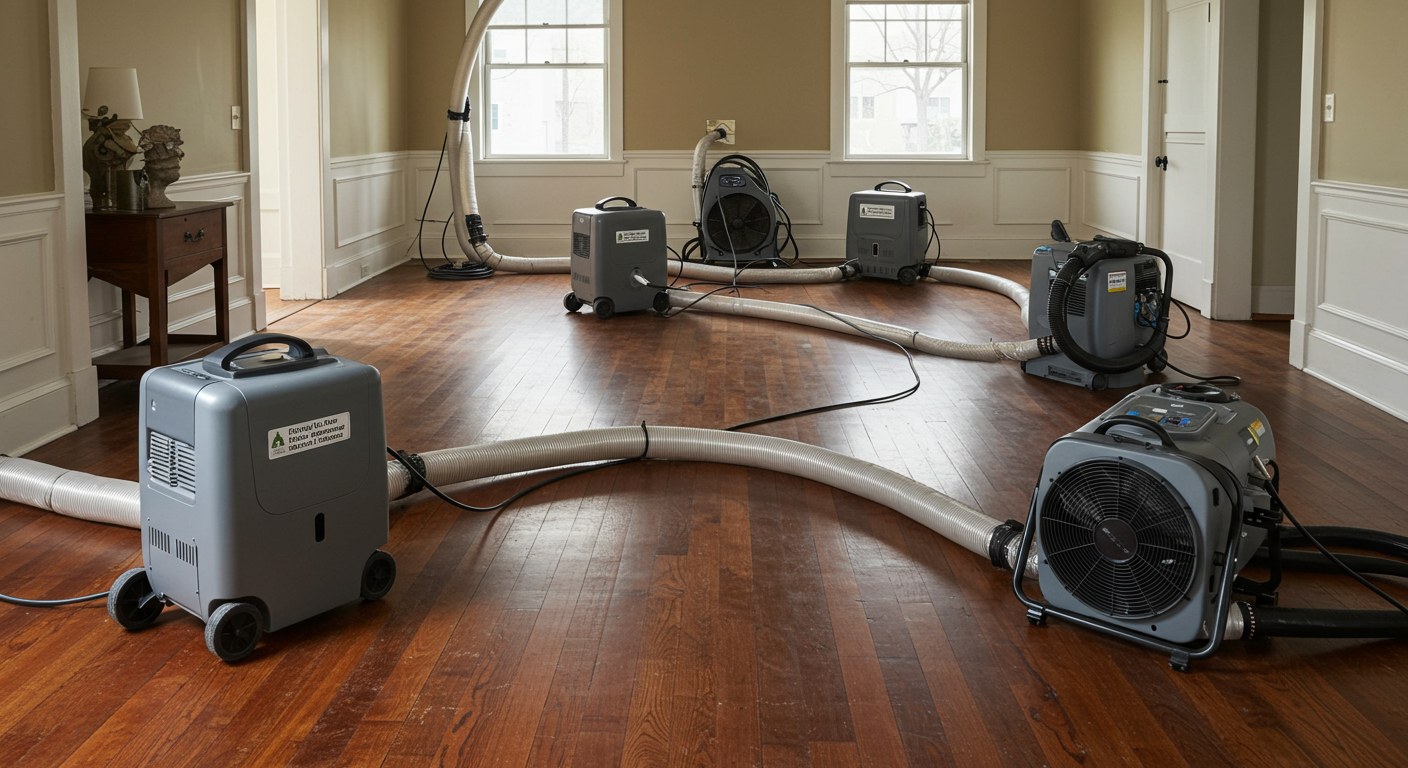
Low-grain refrigerant (LGR) dehumidifiers and high-velocity air movers create a controlled drying environment. Equipment count and placement follow IICRC psychrometric calculations — not guesswork. A typical water loss in a single room requires 3–5 days of continuous operation with daily moisture readings. Our technicians revisit every 24 hours to document progress and adjust equipment placement.
4. Antimicrobial treatment
EPA-registered antimicrobial products are applied to all affected surfaces after extraction and before drying is complete. This is particularly important in Minnesota where Category 2 (gray water) and Category 3 (black water/sewage) losses are common due to sump pump failures, ice dam infiltration, and municipal backup events.
5. Selective demolition if required
Saturated drywall, insulation, and flooring that cannot be dried in place must be removed to prevent mold growth behind finished surfaces. Our crews perform controlled demolition — cutting drywall at measured heights, saving structurally sound framing, and protecting salvageable finishes. For high-value homes with custom millwork or imported tile, we work with your architect or designer before any material is removed.
6. Reconstruction
Partners handles full reconstruction in-house — we do not subcontract the rebuild. From drywall and insulation to hardwood floor refinishing, custom millwork replacement, and painting, a single project manager coordinates all trades. This eliminates the gap that homeowners often experience when mitigation contractors hand off to a separate rebuild contractor.
Common Water Damage Sources in Minnesota Homes
Minnesota’s climate creates water intrusion risks that differ substantially from warmer states. Understanding the source category determines how aggressively the damage must be treated.
- Ice dam infiltration: Ice dams form when heat escapes through the roof deck, melting snow that refreezes at the cold eave. Water backs up under shingles and infiltrates wall cavities and ceilings. Ice dam damage is covered by most homeowner policies as a sudden and accidental event.
- Sump pump failure: The Minneapolis metro sits on glacial lake bed soils with high water tables. During heavy rainfall or spring thaw, a failed sump pump can flood a finished basement in under an hour. Battery backup systems are strongly recommended for any home with a finished lower level.
- Burst pipes: Minnesota averages 35 days per year below 0°F in the Twin Cities metro. Pipes in exterior walls, unheated garages, and vacation properties are high-risk. A 1/8-inch crack in a pipe can release 250 gallons per day.
- Roof leak infiltration: Damaged or missing shingles, failed flashing at chimneys and skylights, and deteriorated valley material are common in the post-hail season (May–September). Roof leaks often go undetected until moisture appears at ceiling level — by which point significant structural saturation may have occurred.
- Appliance and plumbing failures: Dishwasher supply line failures, refrigerator ice maker lines, washing machine hose failures, and water heater tank ruptures account for a significant share of residential water losses. These are typically Category 1 (clean water) losses that are more straightforward to restore.
- Sewage backup: Municipal sewer backup during heavy rain events is a known issue in parts of the Twin Cities. Sewage backup is Category 3 contaminated water requiring full PPE, antimicrobial treatment, and disposal of porous materials that cannot be decontaminated.
Water Damage Restoration for High-Value Homes
Partners Restoration was built to serve the western suburbs — communities where homes routinely feature custom hardwood floors, plaster walls, stone countertops, handcrafted cabinetry, and finished lower levels with home theaters and wine rooms. Restoration in these environments requires a different standard than production-line mitigation.
Our approach in high-value properties:
- Pre-loss photo documentation before any work begins
- Consultation with your interior designer or architect before selective demolition
- Hardwood floor evaluation by a certified flooring specialist — drying in place versus replacement is a materials-specific decision, not a default
- Custom millwork match and fabrication when replacement is required
- Stone and tile wet handling to prevent secondary damage during restoration
- Climate-controlled contents storage during restoration
Working With Your Insurance Company
Most water damage events in owner-occupied homes are covered by standard homeowner insurance policies as sudden and accidental losses. Partners works directly with all major carriers operating in Minnesota — State Farm, Travelers, Nationwide, Chubb, and others — and our documentation meets carrier requirements for fast claim processing.
What we provide to your adjuster: complete moisture logs from initial assessment through dry standard, photographic documentation of all affected areas before, during, and after restoration, itemized scope of work aligned with Xactimate pricing, and a final moisture certification confirming the structure has been returned to pre-loss condition.
You have the right to choose your own restoration contractor. Your insurance carrier cannot require you to use a preferred vendor list contractor.
Service Area: Minneapolis Western Suburbs
Partners Restoration is based in Medina, MN and serves the full western and southwestern Minneapolis metro. Our service area includes Wayzata, Orono, Minnetonka, Plymouth, Maple Grove, Eden Prairie, Edina, Deephaven, Excelsior, Shorewood, Chanhassen, and surrounding communities. We maintain response times under 60 minutes for emergency calls within our primary service area.
Frequently Asked Questions
How quickly does mold grow after water damage?
Mold colonization can begin within 24–48 hours under favorable conditions — temperatures between 40°F and 100°F, relative humidity above 60%, and an organic food source (drywall paper, wood framing, carpet backing). This is why emergency extraction and drying must begin immediately, not after waiting for an adjuster to inspect.
Does homeowner insurance cover water damage?
Standard homeowner policies cover sudden and accidental water damage — burst pipes, appliance failures, ice dam infiltration, and roof leaks. They do not cover flood damage from rising groundwater (which requires separate NFIP flood insurance) or damage from neglected maintenance. Sewer backup is sometimes covered under a separate endorsement; check your declarations page.
How long does water damage restoration take?
Structural drying to IICRC dry standard typically takes 3–5 days for a Category 1 loss in a single room. Larger losses, Category 2 or 3 contamination, or losses involving finished basements with multiple rooms may require 5–10 days of drying. Reconstruction time after drying varies by scope — from a few days for drywall repair to several weeks for full room rebuilds.
Can hardwood floors be saved after water damage?
Solid hardwood floors can often be dried in place if treated within 24–48 hours and the moisture content hasn’t exceeded the point of permanent deformation (cupping, buckling, or crowning). Engineered hardwood has lower tolerance for moisture intrusion. Our flooring specialist assesses each situation individually — there is no universal answer, and the decision affects both cost and schedule significantly.
What is IICRC certification and why does it matter?
The Institute of Inspection, Cleaning and Restoration Certification (IICRC) is the internationally recognized standards body for the restoration industry. IICRC S500 (water damage), S520 (mold remediation), and S770 (sewage) are the governing standards insurance carriers expect contractors to follow. Working with a non-certified contractor may complicate your claim and can result in inadequate drying that leads to mold growth months later.
Do you provide emergency service on weekends and holidays?
Yes. Water damage does not follow business hours. Partners Restoration provides 24/7 emergency response 365 days per year. Call 952.500.2426 any time for immediate dispatch.
Leave A Comment