
Roof leak repair in the context of water damage restoration addresses both the exterior source — the failed roofing component allowing water entry — and the interior damage that resulted from it. A roof leak that is repaired at the surface without addressing the saturated wall cavity, ceiling assembly, and any resulting mold growth will produce interior damage symptoms for months and create the conditions for a costly mold remediation project that could have been avoided.
Partners Restoration handles roof leak water damage restoration across the Minneapolis western suburbs — interior assessment, structural drying, mold prevention, and full reconstruction of affected ceiling and wall assemblies. Exterior roof repair is coordinated with your roofing contractor or insurance-approved roofer. This work is part of our broader water damage restoration Minneapolis service, and often connects to our storm damage restoration scope when the roof failure was weather-related.
Common Roof Leak Sources in Minnesota
Flashing failures are the leading source of roof leak water damage in existing homes. Flashing — the metal strips that seal transitions between roofing and vertical surfaces — fails at chimneys, skylights, dormers, pipe penetrations, and wall-roof intersections. Flashing failures are often gradual, leaking during heavy rain events or wind-driven rain but not in all conditions, making them difficult to trace and easy to miss until significant interior damage has accumulated.
Shingle damage from hail, wind, age, and physical impact creates direct water entry points. Minnesota’s hail season (May–September) produces granule loss and underlying mat damage that accelerates shingle degradation. Wind events can lift and break shingles at ridge lines, hips, and eave edges. Age-related shingle failure — cracking, cupping, and granule loss from UV exposure — produces widespread low-level water infiltration before visible failure is apparent.
Valley failures occur at the V-shaped intersections where two roof planes meet. Valleys handle higher water volume than flat roof sections and are subject to debris accumulation, shingle wear, and ice dam formation. Valley failures often produce large-volume interior water damage because the concentrated water flow can overwhelm the degraded valley material quickly.
Skylight failures — from failed perimeter seals, cracked curb flashing, or failed glazing seals — produce interior damage that is often incorrectly attributed to condensation rather than infiltration, delaying appropriate response. Water entry at skylights tracks down walls and can appear at floor level, far from the skylight above.
Why the Interior Damage Is the Priority
A repaired roof surface does not reverse the damage already done to the interior. Saturated insulation retains moisture for weeks and provides ideal mold growth conditions. Wet wall framing at the top plate and in wall cavities stays wet long after the exterior leak is sealed. Drywall that absorbed water during the infiltration period remains a mold risk until professionally dried to standard.
The most common mistake homeowners make after a roof leak is stopping at the exterior repair and assuming the interior is fine once the ceiling stops dripping. Our inspection frequently finds active mold growth in wall and ceiling assemblies that were wetted by roof leaks repaired weeks or months earlier — dry on the surface but wet and moldy inside the assembly.
Roof Leak Restoration Process
Thermal imaging and moisture mapping
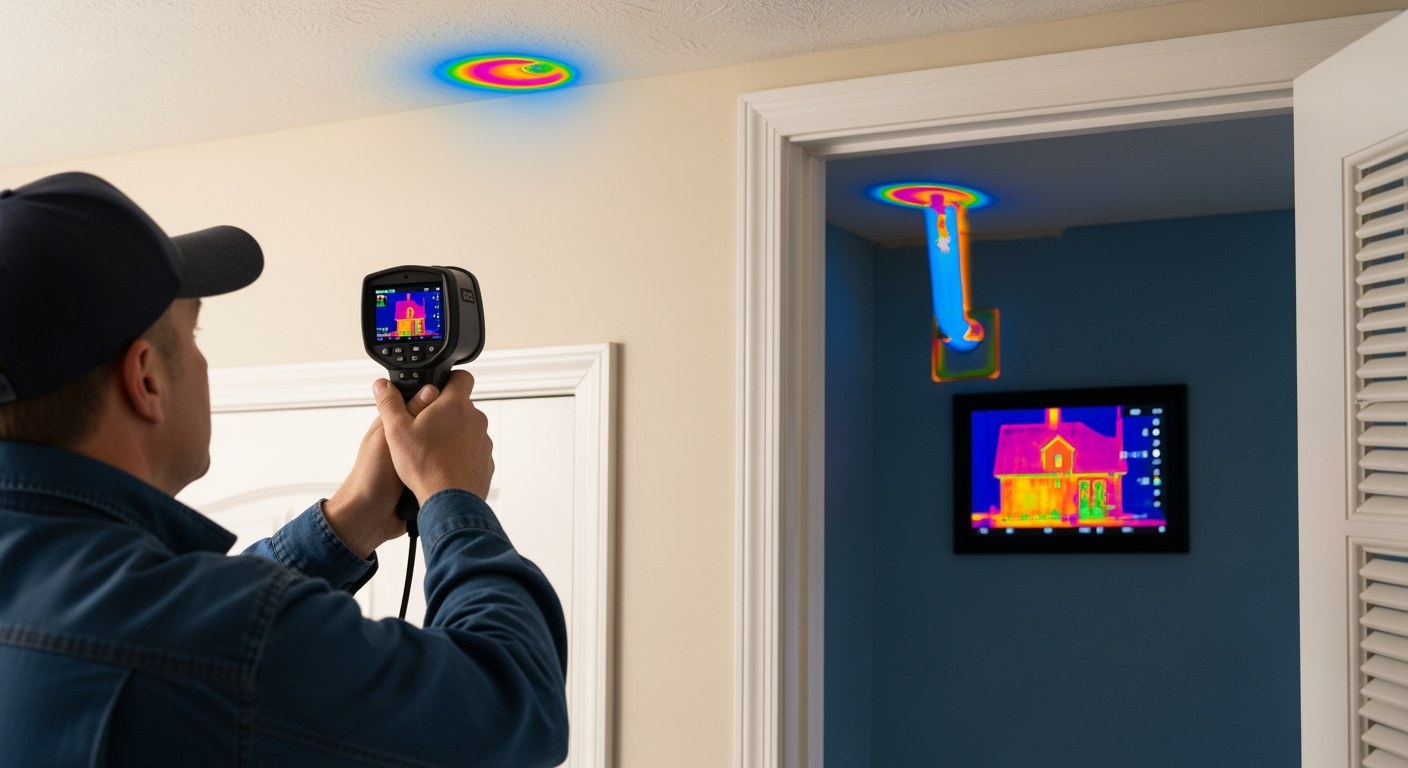
Infrared thermal imaging reveals the temperature differentials caused by wet insulation — identifying the full extent of moisture infiltration in ceiling and wall assemblies without destructive investigation. A roof leak that produced a 12-inch ceiling stain may have saturated a 4×8-foot section of the attic floor insulation and the wall cavity below the eave for the full width of the affected rafter bay. Thermal imaging reveals this; visual inspection does not.
Attic inspection
For roof leak losses, the attic inspection is the most informative diagnostic step. The attic reveals where water entered, how far it traveled, whether insulation is saturated, whether sheathing or framing shows mold growth, and whether structural damage has occurred. Our inspector documents all findings with photographs before any work begins.
Selective demolition and drying
Saturated insulation is removed and replaced — wet batt insulation does not dry effectively in place. Saturated ceiling drywall is removed to the nearest framing member. Structural framing is dried to IICRC S500 dry standard — typically 3–5 days — with drying logs documenting daily moisture readings. When mold is present, S520-compliant remediation precedes reconstruction.
Reconstruction
New insulation, new drywall, texture matching, and painting complete the interior restoration. For high-value homes, we coordinate with interior designers for texture and color matching of specialty finishes. Air sealing at attic penetrations is addressed during reconstruction to reduce future leak risk and improve energy performance.
Frequently Asked Questions
My roof was fixed — do I still need interior restoration?
Almost certainly yes, if any interior water symptoms were visible. A repaired roof stops new water entry but does not remove moisture already absorbed by insulation, framing, and drywall. Professional moisture assessment determines whether the interior assembly dried adequately on its own or requires intervention. Do not assume it dried — verify.
How long does a roof leak have to run before causing mold?
Mold colonization of wet building materials can begin within 24–48 hours under favorable temperature conditions. A slow roof leak — dripping into insulation during every rain event over several weeks — creates sustained moisture conditions that are essentially ideal for mold growth. Any roof leak that has been active for more than a few days should be assumed to have initiated mold growth in the affected assembly until a professional inspection proves otherwise.
Does insurance cover roof leak water damage?
Interior water damage from a sudden roof leak — shingle failure in a storm, flashing damage from wind or hail — is covered as a sudden and accidental loss. Damage from a slow, gradual roof leak resulting from deferred maintenance may be contested. The distinction often comes down to whether the condition was sudden and whether the homeowner could reasonably have known about and addressed the leak before significant damage occurred. Document all symptoms promptly and report to your carrier immediately.
Leave A Comment