
Mold remediation is the professional process of containing, removing, and treating mold growth in a building to levels that are normal for the outdoor environment. Remediation differs from mold removal — no legitimate contractor can guarantee a mold-free environment, since mold spores exist naturally in all air. The goal is to eliminate the active colony and address the moisture source that caused it.
Partners Restoration provides mold remediation across Minneapolis and the western suburbs — Medina, Wayzata, Minnetonka, Orono, Plymouth, Eden Prairie, Edina, and surrounding communities. Our technicians hold IICRC Applied Microbial Remediation Technician (AMRT) certification and follow IICRC S520 standards on every project.
What Does Mold Remediation Actually Involve?
The IICRC S520 Standard and Reference Guide for Professional Mold Remediation defines the protocol that professional contractors follow. At Partners, every remediation project moves through these stages.
1. Inspection and moisture source identification
Remediation without addressing the moisture source will fail. Before any mold is touched, our inspector identifies and documents the water intrusion event — whether that is a past roof leak, chronic condensation on cold surfaces, plumbing seepage, or elevated humidity from an improperly ventilated crawl space. Mold growth in a finished basement that has never flooded is almost always a ventilation or vapor barrier deficiency, not a one-time event.
2. Containment
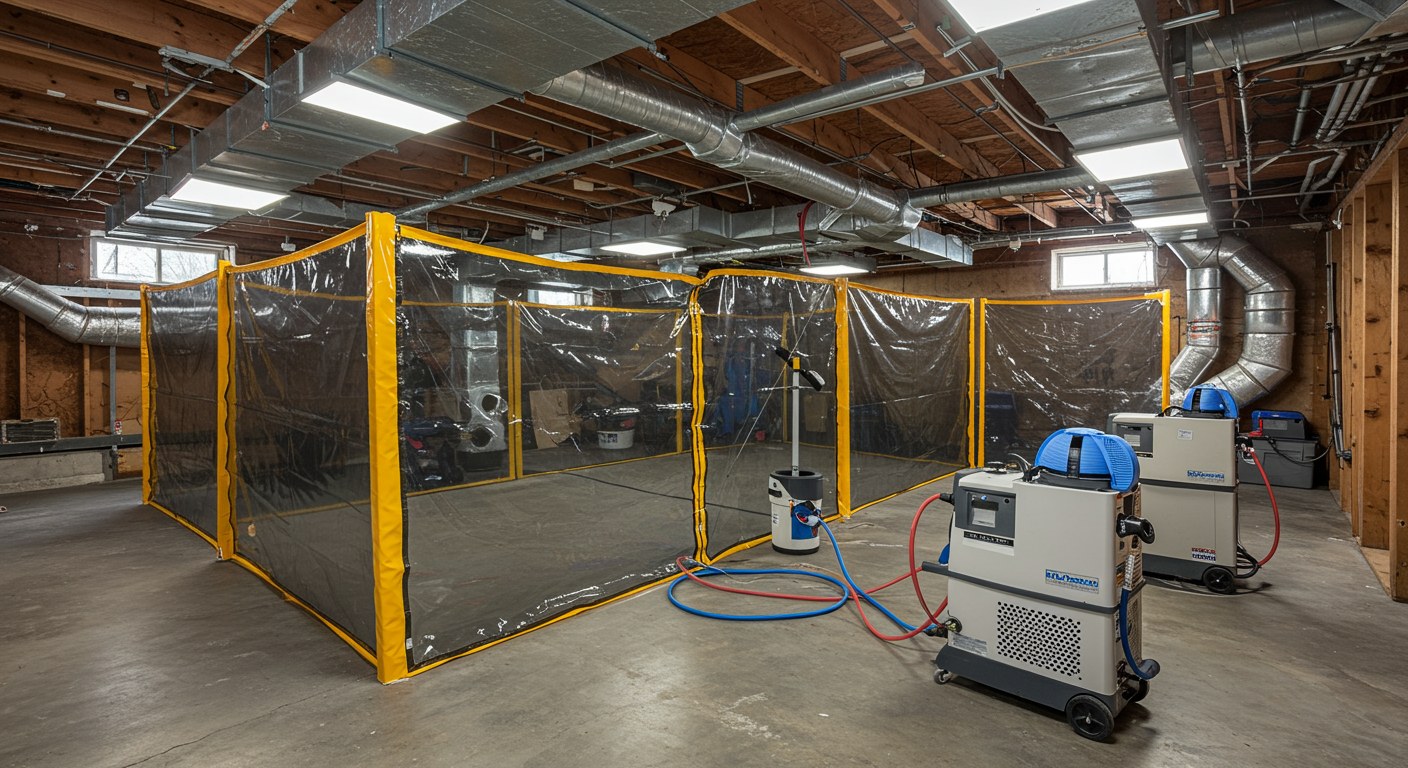
Poly sheeting containment barriers and negative air pressure prevent cross-contamination of unaffected areas during remediation. For large or complex projects — finished lower levels, HVAC systems, multi-room contamination — we establish full critical barriers with HEPA-filtered negative air machines exhausting to the exterior. This step is what separates professional remediation from homeowner attempts that spread spores throughout the structure.
3. HEPA vacuuming and physical removal
Visible mold colonies on non-porous surfaces (concrete, metal, glass) are HEPA-vacuumed and then wiped with EPA-registered antimicrobial solution. Porous materials (drywall, insulation, wood framing with surface growth that cannot be sanded clean) that are contaminated beyond remediable limits are removed and properly disposed of in sealed poly bags. IICRC S520 defines the threshold for when removal versus cleaning is appropriate.
4. Structural wood treatment
Exposed wood framing with surface mold growth is HEPA-vacuumed, wire-brushed or sanded to remove surface colonies, treated with EPA-registered biocide, and then encapsulated with antimicrobial sealant. This is standard practice for crawl spaces, rim joists, and subfloor decking affected by moisture infiltration — common in Minnesota homes with inadequate vapor barriers or vented crawl spaces in high-humidity summer conditions.
5. Post-remediation clearance testing
After remediation is complete, an independent third-party industrial hygienist (IH) or certified mold inspector performs clearance testing — air sampling and sometimes surface sampling — to confirm that spore levels in the remediated area are at or below the outdoor baseline. Partners does not perform its own clearance testing; independent verification protects you and validates the work. We provide all documentation required for your insurance claim and for disclosure in a future property sale.
High-Risk Mold Zones in Minnesota Homes
Minnesota’s climate creates specific mold risk patterns. Cold winters drive condensation on thermal bridges; warm, humid summers drive moisture into crawl spaces and basement walls. These are the areas we inspect first.
Crawl spaces
Vented crawl spaces were standard construction practice in Minnesota for decades, but they are chronically problematic in the Upper Midwest climate. Warm, humid summer air enters through foundation vents, contacts cool soil and framing, and condenses. Without a proper vapor barrier and dehumidification strategy, wood framing in a vented crawl space commonly develops visible mold growth within a few years. Converting to a conditioned crawl space with a sealed vapor barrier and supply air or dehumidifier is the permanent solution.
HVAC systems
Mold in ductwork, air handling units, and drain pans is a serious indoor air quality concern because the HVAC system distributes spores throughout the entire structure during operation. HVAC mold typically originates from a dirty evaporator coil or clogged condensate drain — both maintenance items that are frequently overlooked. Remediation requires cleaning and treating the air handler, coil, and duct interior surfaces, not just the visible mold at supply registers.
Finished basements
A finished basement that has experienced water intrusion — even a small amount, even once — is a mold risk if drying was incomplete. Mold behind drywall and inside wall cavities is invisible until the surface shows staining or the occupants notice musty odor. By the time odor is detectable, the colony is typically well-established. Any basement that has had standing water should receive a professional inspection regardless of whether the water was cleaned up promptly.
Post-ice-dam interiors
Ice dam water infiltration typically enters wall cavities and ceiling assemblies where it is invisible and where it stays wet for weeks. Homeowners who had ice dam damage in winter often discover mold in the following spring or summer when insulation and framing that were never dried properly begin showing growth. If you had ice dam water entry and did not have professional drying performed at the time, a mold inspection is warranted.
Mold Remediation for High-Value Homes
The western suburbs of Minneapolis — Wayzata, Orono, Minnetonka, Deephaven — include some of the highest-value residential real estate in Minnesota. Mold remediation in these properties demands attention to detail that goes beyond standard protocols.
Our approach in high-value properties includes pre-work photography of all finishes adjacent to the work area, selective demolition with care for salvageable custom materials, coordination with the homeowner’s interior designer on material specifications for reconstruction, and full documentation suitable for real estate disclosure or insurance records.
Does Insurance Cover Mold Remediation?
Mold coverage depends on the cause of growth. If mold resulted from a covered water damage event — a burst pipe, appliance failure, roof leak — most standard homeowner policies will cover the associated mold remediation as part of the water damage claim. Mold that resulted from long-term moisture issues, neglected maintenance, or gradual seepage is typically excluded.
Some policies include a specific mold sublimit (often $10,000–$50,000) regardless of cause. Review your declarations page or call your agent before assuming coverage. Partners works with all major Minnesota carriers and our documentation meets carrier requirements for claim processing.
Frequently Asked Questions
How do I know if I have mold behind my walls?
Musty odor is the most reliable indicator of hidden mold — spores release microbial volatile organic compounds (MVOCs) that have a distinctive earthy smell. Other indicators include unexplained allergy or respiratory symptoms that improve when you leave the building, visible staining on drywall surfaces, or a history of water intrusion that was not professionally dried. A professional mold inspection with moisture mapping can identify active growth behind finished surfaces.
Can I stay in my home during mold remediation?
For small, contained remediation projects (a single bathroom or closet), remaining in the home is typically fine with proper containment in place. For larger projects involving multiple rooms, HVAC systems, or the full basement level, temporary relocation is recommended — both for your comfort and to avoid exposure during active remediation. Your homeowner’s insurance may cover temporary housing costs if the remediation is part of a covered claim.
What is the difference between mold testing and mold inspection?
A mold inspection is a visual examination by a trained professional using moisture meters and sometimes borescope cameras to identify moisture conditions and visible or suspected mold growth. Mold testing (air sampling or surface sampling) provides laboratory data on spore species and concentrations. Testing is most useful for clearance verification after remediation, for establishing baseline before purchasing a property, or when occupants have health symptoms that require documentation. Not every situation requires formal testing — a qualified inspector can often make a remediation recommendation based on visual findings alone.
How long does mold remediation take?
A straightforward remediation of a single affected area — bathroom, closet, rim joist — typically takes 1–2 days. A finished basement with multiple affected rooms, or an HVAC system requiring duct cleaning in addition to air handler treatment, may take 3–5 days. Projects requiring extensive selective demolition followed by reconstruction are scoped individually. Post-remediation clearance testing results are typically available within 24–48 hours of sampling.
What causes mold in a new home?
New construction mold most commonly results from framing lumber or OSB sheathing that got wet during construction and was enclosed before drying to acceptable moisture content, HVAC systems commissioned before the building envelope was dry, or inadequate vapor barriers in crawl spaces or basement walls. New homes in Minnesota that sat through a wet construction season should have a mold inspection before drywall is closed.
Leave A Comment