Kitchen fire damage repair addresses one of the most common and most misunderstood residential fire losses. Kitchen fires — whether from unattended cooking, grease ignition, or appliance failure — produce a specific damage profile: concentrated structural char near the ignition point, protein-based smoke residue (from burning food and grease) coating every surface in the kitchen and adjacent spaces, and heat damage to materials that never burned. The protein residue is nearly invisible but intensely pungent and penetrates porous surfaces deeply.
Partners Restoration handles kitchen fire damage repair across the Minneapolis western suburbs as part of our comprehensive fire damage restoration Minneapolis service. We assess the full scope — structural, smoke, and contents — coordinate with your insurance carrier, and restore the kitchen and affected adjacent spaces to pre-loss condition.
Why Kitchen Fires Are Uniquely Damaging
Kitchen fires produce protein smoke — residue from burning food, grease, and organic material — that behaves differently from the dry or wet smoke produced by structural fires. Protein residue is nearly transparent, leaving surfaces that look clean but smell intensely of smoke. It bonds tenaciously to hard surfaces including painted walls, cabinet interiors, appliance surfaces, and ceiling finishes. Standard cleaning with water or basic detergents does not remove it — it requires specific enzymatic or chemical cleaning agents applied by trained technicians.
The HVAC system distributes protein smoke residue to every room in a forced-air heated home within minutes of a kitchen fire. Homeowners are often surprised to find that rooms on a different floor or at the opposite end of the house from the kitchen smell strongly of smoke — this is the result of HVAC distribution, not direct smoke travel. The HVAC system itself — the air handler, coil, and ducts — requires treatment as part of kitchen fire restoration.
Scope of Kitchen Fire Damage
Structural damage
The structural scope of a kitchen fire depends on the fire’s duration and intensity before suppression. A contained grease fire suppressed quickly by occupants or automatic suppression may produce only surface char on the cooking surface area and adjacent cabinet faces. A kitchen fire that spread to cabinet carcasses, the ceiling above the range, or adjacent wall framing before suppression requires structural assessment and selective demolition of charred materials. Charred wood framing has reduced load capacity and must be removed and replaced — it cannot be encapsulated in place.
Cabinet and countertop assessment
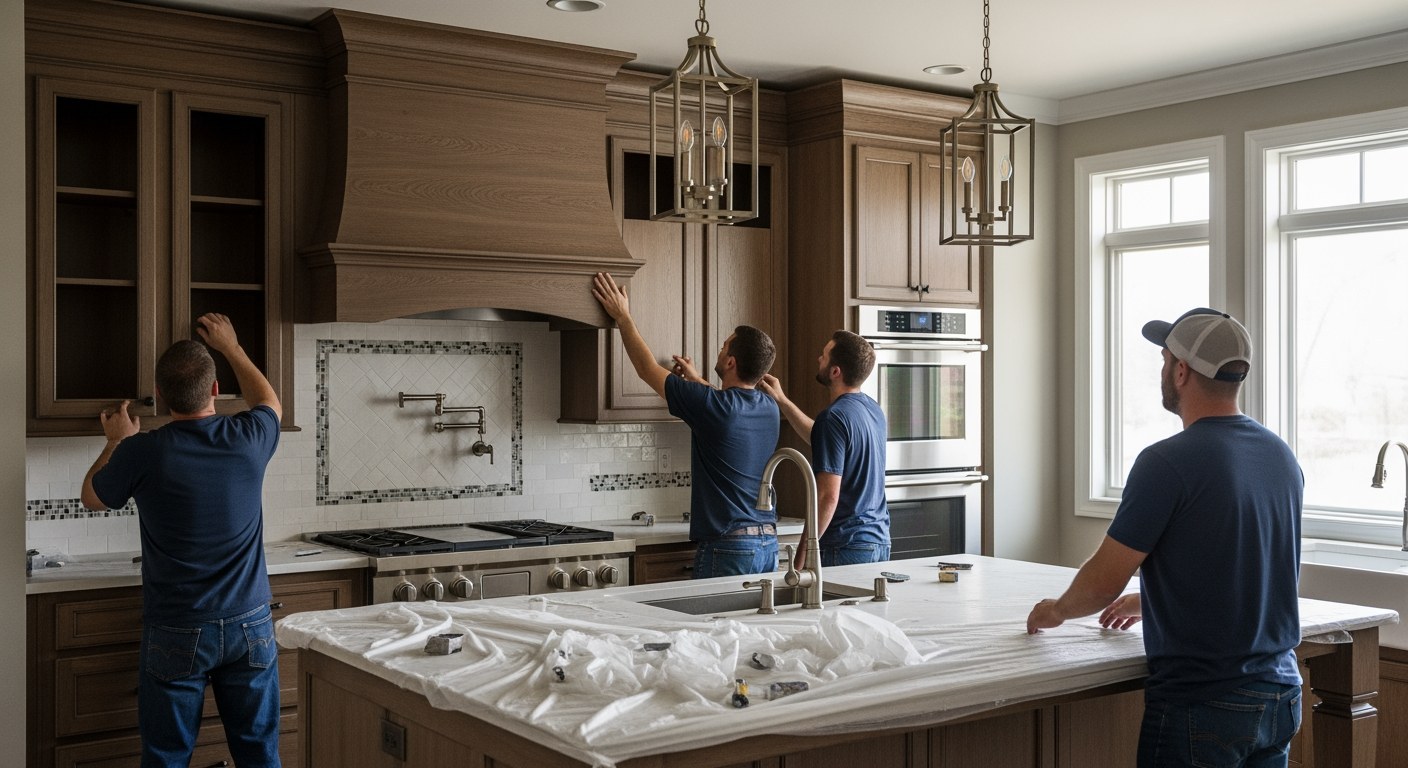
Custom cabinetry in high-value homes represents a significant portion of the kitchen’s replacement value and is often the most contentious element of a kitchen fire insurance claim. Cabinets adjacent to the fire origin with direct heat exposure or char are clearly non-salvageable. Cabinets further from the fire origin that sustained smoke odor penetration into the wood substrate and cabinet interiors are more nuanced — professional cleaning and sealing can restore some cabinets, while others with penetrating odor in the wood itself require replacement. For custom or semi-custom cabinetry, we document the manufacturer, species, door style, and finish specifications to support replacement value claims.
Appliance damage
Appliances in the fire zone — range, hood, refrigerator, dishwasher — typically require replacement rather than cleaning. High-end appliances (Sub-Zero, Wolf, Thermador, Miele) have replacement costs that must be documented separately in the insurance claim. Smoke odor that has penetrated appliance insulation and interior cavities makes cleaning impractical and often impossible to the standard required by the homeowner. We inventory and photograph all appliances before any are removed from the property.
Contents pack-out
Dishes, cookware, pantry items, small appliances, and kitchen contents are inventoried, packed out to our climate-controlled facility, and assessed for restorability. Porous contents (wood cutting boards, unsealed ceramics, fabric-covered items) that absorbed protein smoke odor may be non-restorable. Hard-surface items (pots, pans, china, glassware) are cleaned using ultrasonic cleaning equipment. A detailed contents inventory is provided for the insurance claim.
Kitchen Fire Restoration in High-Value Homes
Kitchens in Wayzata, Orono, Minnetonka, and Edina homes are frequently the highest-cost room in the house — with custom cabinetry, imported stone countertops, professional-grade appliances, specialty tile, and designer lighting that require craftsmen who work at this level regularly. Restoration to pre-loss condition — not to a functional but downgraded approximation — requires sourcing materials from the same suppliers and trades that built the kitchen originally.
Partners maintains relationships with the kitchen designers, cabinet makers, stone fabricators, and appliance showrooms serving the western suburbs market. When full replacement is required, we coordinate with the homeowner’s designer or use the original designer if available to ensure continuity of specification. We do not substitute production-line cabinets for custom cabinetry and document any instances where an exact match is unavailable for the insurance claim record.
Frequently Asked Questions
Can kitchen cabinets be cleaned after a fire?
In some cases, yes. Cabinets that were not directly exposed to heat and sustained only surface smoke residue — not penetrating odor into the wood substrate — can be professionally cleaned and sealed. The test is whether residual odor remains after professional cleaning and sealing with odor-blocking primer. Cabinets that retain odor after this treatment must be replaced. The distinction affects claim value significantly and should be determined by a qualified restoration professional, not by the homeowner or the carrier’s adjuster alone.
How long does kitchen fire restoration take?
Emergency stabilization, cleaning, and odor treatment of the affected area is completed within the first few days. Custom cabinet fabrication — when replacement is required — typically has a 6–12 week lead time from a custom cabinet maker. Countertop fabrication adds 2–4 weeks after cabinet installation. A complete kitchen fire restoration involving full cabinet and countertop replacement typically takes 10–16 weeks from loss to completion, with most of that time in the fabrication queue rather than on-site work.
Does insurance cover full kitchen replacement after a fire?
Yes — if your policy provides replacement cost value (RCV) coverage, the carrier pays for like-kind-and-quality replacement of all fire-damaged kitchen components. For custom kitchens, “like-kind-and-quality” means custom replacement, not production-line substitution. Documenting the original specifications — cabinet manufacturer, door style, species, finish, countertop material, appliance models — is essential for supporting a full replacement value claim. Partners provides this documentation as part of our scope assessment.
Leave A Comment