What is Smoke and Soot Removal for Air Quality?
Smoke and soot removal is the specialized process of neutralizing microscopic carbon particles and volatile organic compounds (VOCs) that remain after a fire. Professional restoration involves soot cleaning of surfaces and HEPA air scrubbing to filter airborne contaminants, ensuring air quality restoration that meets health and safety standards for residential living.
The Invisible Threat: Why Post-Fire Soot Cleaning is Critical
In my fifteen years as a restoration specialist, I have witnessed how homeowners often underestimate the persistence of smoke. While the flames are gone, the particulate matter—often smaller than 2.5 microns (PM2.5)—remains deeply embedded in porous materials like drywall, upholstery, and carpets. These particles are small enough to enter the bloodstream via the lungs, making professional smoke damage cleanup a medical necessity, not just a cosmetic one.
Our data from residential projects in various suburban neighborhoods shows that without professional intervention, indoor air quality can remain at hazardous levels for months, even if the smell of smoke seems to have dissipated. This is due to the off-gassing of synthetic materials that were partially combusted during the event.
Our Professional Air Quality Restoration Process
Restoring a home to its pre-loss condition requires a multi-phased approach that goes beyond a simple wipe-down. In my experience, the following three pillars are the most effective for health-conscious homeowners:
1. HEPA Air Scrubbing and Filtration
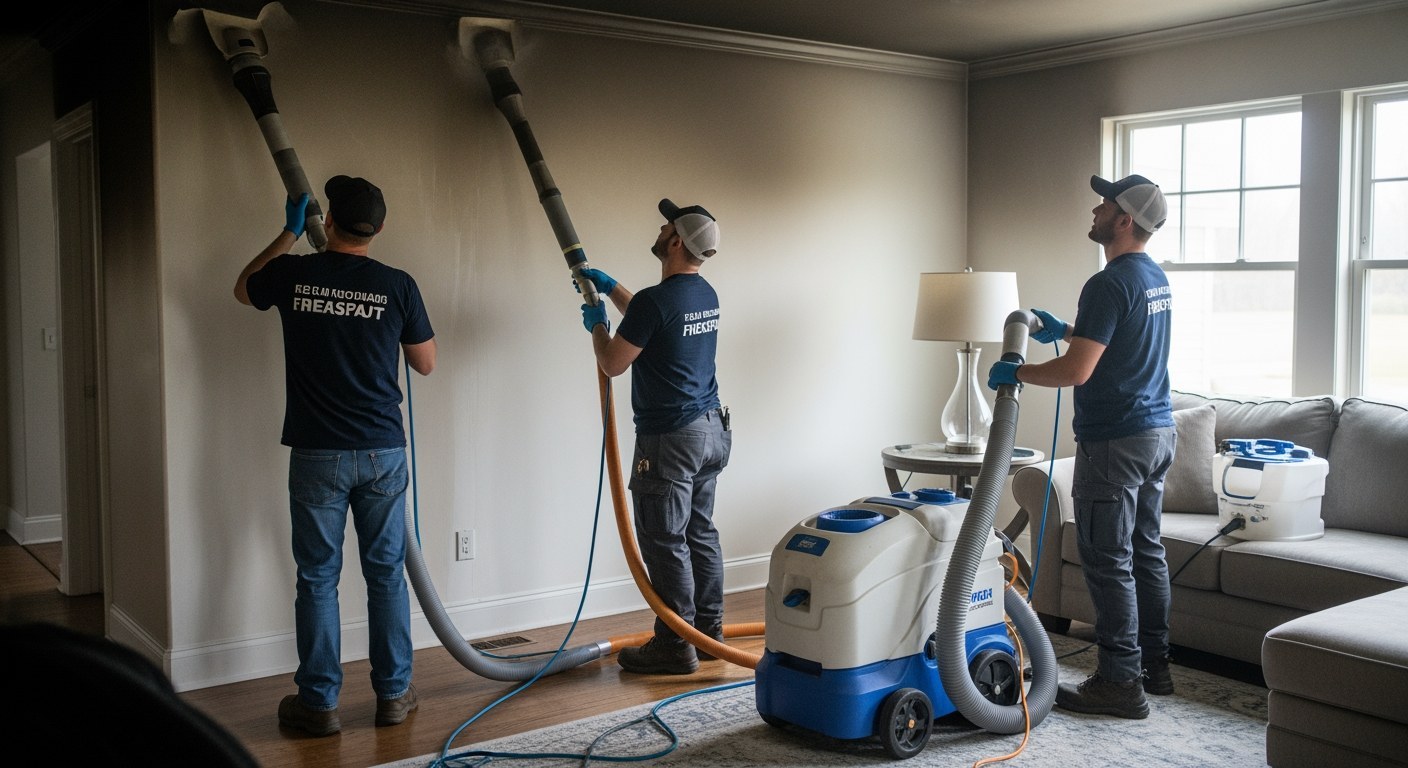
We deploy industrial-grade High-Efficiency Particulate Air (HEPA) scrubbers immediately upon arrival. These units are capable of capturing 99.97% of particles as small as 0.3 microns. By creating a negative air pressure environment, we ensure that soot particles do not migrate to unaffected areas of the home, such as clean bedrooms or kitchens.
2. Chemical Neutralization and Soot Cleaning
Soot is often acidic. If left on surfaces, it will cause permanent etching on glass and metals, and deep staining on fabrics. We use specialized alkaline detergents to neutralize the acidity while lifting the carbon binders. I’ve found that using the wrong cleaning agent can actually “set” the soot, making it impossible to remove later.
3. Thermal Fogging for Odor Elimination
Odors are trapped in the “pores” of the house. Thermal foggers replicate the heat of the fire to open these pores and introduce a neutralizing agent that pairs with the smoke molecules, effectively eliminating the scent at a molecular level rather than simply masking it.
A Case Study in Residential Restoration
Last year, we worked on a large estate where a small kitchen fire had caused smoke to travel through the entire ventilation system. While the visible damage was localized, our air quality sensors showed high levels of carbon residue in the third-floor nursery. By implementing a 48-hour HEPA air scrubbing cycle and deep soot cleaning of the HVAC system, we restored the air quality to a level that surpassed the outdoor air baseline, providing the parents with total peace of mind.
Leave A Comment